Instagram is a place filled with creativity and immense talent that allows you to explore art in different forms. It helps you set foot into the captivating world of different brush strokes, vibrant colors, and creating a beautiful picture. Through the algorithm, we stumbled upon a painting from the Queen series. While looking at the piece, we felt it was much more than a painting, it was a story in itself, waiting to be heard.
The painting piqued our curiosity about the story behind it and the artist who created it. The person behind it was Ms. Kim Soo Young. We decided to learn more about her and her journey through an interview conducted through email from July 9th to July 11th, 2025.
1. Could you please introduce yourself and describe the beginnings of your artistic journey?
I was born in Seoul, South Korea. Since I was young, I’ve always loved drawing, and my mother, who majored in fine arts, encouraged me a lot. She used to put large sheets of paper on the walls at my height and tell me to freely "doodle" as much as I wanted. At that time, the subject I loved to draw most was worms with countless legs. The many legs attached to such a tiny creature fascinated me as a child. Even in my current "Queen" series, bugs and insects frequently appear, and I feel like the inspiration from those childhood days still lingers in my work.
After graduating from Ewha Womans University with a degree in Fashion Design, I went to Paris to study abroad, where I have fond memories of living briefly with my family when I was four years old. In Paris, I attended several schools and earned a Master's degree in Fashion Management from IFM, which led to an opportunity to work as a visual merchandiser at the Kenzo Paris headquarters under the LVMH group.
There, I was responsible for various tasks, including developing window display design concepts, coordinating with third-party suppliers for props production, managing communication between the Paris headquarters and Kenzo stores worldwide, and working on Kenzo Paris showroom and merchandising concepts. The reason I chose the profession of visual merchandiser was because I thought it would allow me to combine both my creative sensibilities and management skills. However, I soon realized that the level of creativity required was much less than I had imagined, and it wasn’t the “fantasy” job I had envisioned.
So, I went back to studying. After earning a Master’s degree in Design Theory from Paris 1 University, I went on to complete a Ph.D. in Art Aesthetics at Paris 8 University. It took me a full eight years to complete my doctorate, which was tough, but I’m thankful that it allowed me to rediscover the joy of studying.
I’ve been drawing since I was young, but the turning point when I truly decided to become an artist came with my solo exhibition held at the ICONOCLASTES Gallery in Paris from 2021 to 2023. The year 2021 was a time when the world was still reeling from the effects of the COVID-19 pandemic. Social interactions were limited, and personally, I was feeling quite down and lacking in confidence. I knew I needed a new challenge, and when the opportunity arose, I held my first solo exhibition.
The feeling at that time was truly surreal. A solo exhibition is a moment when you expose even the most private parts of yourself through your artwork. It also opens the door to communicate with people... That was when I made the decision: I would continue painting from that point forward.
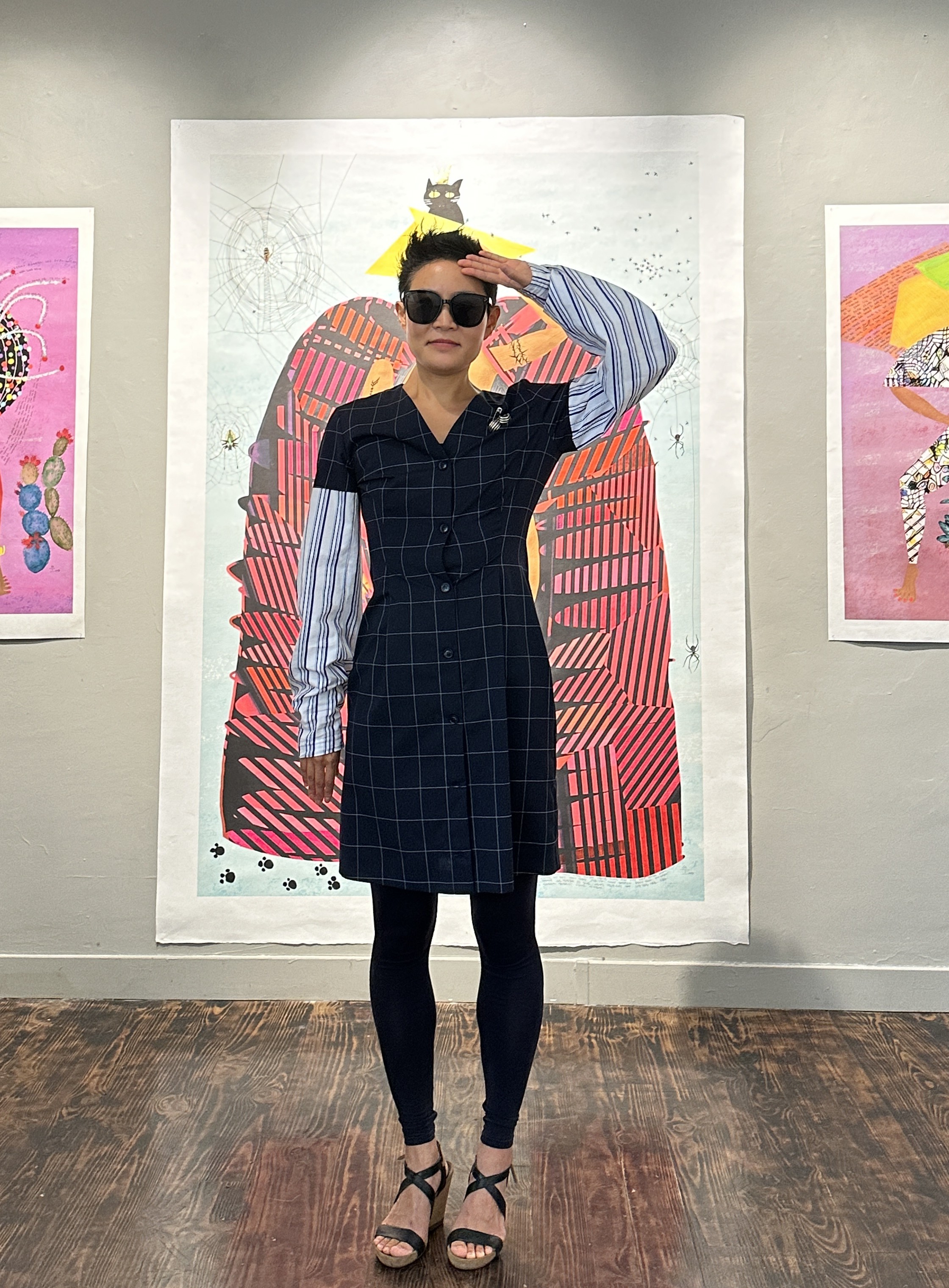
2. Where do you take inspiration from, and who are the historical or contemporary artists who shaped or influenced your visual style?
I mainly draw inspiration from travel, memories of the past, history, and everyday life. In particular, the inspiration for my "Queen" series began during a trip to Togo, Africa, in 2014. The women I met there made a lasting impression on me. They were truly remarkable. Although Korea once had a similar era, these women often carried various burdens on their heads.
One woman I saw in the market became the key inspiration for my Queen series. She was carrying a tray piled high with dried fish on her head, with a baby wrapped on her back, holding the hand of a young child with her left hand, and carrying a water jug with her right. Rather than looking tired, her demeanor appeared extraordinary and admirable, and I felt a deep sense of reverence. It gave me the feeling that it was something I could never do myself. This woman became my first queen.
In the "Queen" series, the various objects, plants, and animals placed on top of the head symbolize a crown, while those at the feet symbolize a pedestal. Recently, traditional Korean ceramics and various ornaments have appeared in the Queen series, blending Korean elements into my idealized vision of women. This is a representation of a woman that doesn’t exist in reality. If she did, she wouldn’t be ideal anymore.
The various insects, plants, and animals that appear around the Queen in my series are beings that worship her. These are inspired by the things I observed while living in the rural Champagne-Ardenne region in the northeast of France.
3. As an artist living between Seoul and France, how has geography and cultural duality influenced your perspective? Are there specific tensions you explore between Korean and Western frameworks?
That's an interesting question. I usually paint on hanji (traditional Korean paper), but instead of using traditional East Asian pigments, I use various Western materials such as acrylic paint, markers, colored pencils, and pens. I believe this very method of working reflects the tension between Korea and the West.
Using contemporary Western materials on hanji, a traditional Korean medium, is my way of naturally expressing the tension I feel between the two cultures. You could say that I’m exploring the new possibilities that emerge at the intersection of Korean tradition and Western modernity.
4. In your series "queens", the figures are adorned with animals like roosters, insects, and birds that appear to serve as guardians or messengers. Do these creatures hold deeper symbolic meanings within the characters' narratives?
To elaborate on what I mentioned earlier, all the insects, plants, and animals that appear around the queen are beings that celebrate and admire her. The queen is a figure who naturally draws in all the beautiful things that God has created.
These creatures are not merely decorative elements; they serve as witnesses to the queen’s nobility and beauty. It’s as if everything in the natural world is gathering before her in reverence and worship.
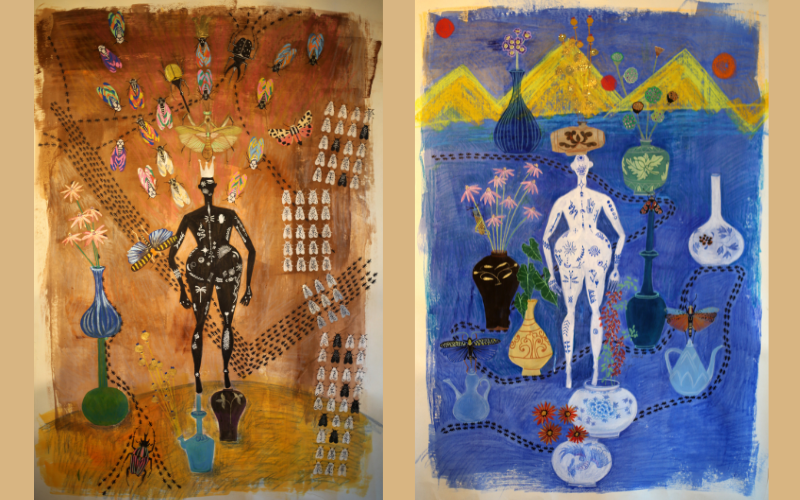
5. Your art generally mirrors the ideas of feminism. Has your understanding of feminism evolved through your artmaking?
Rather than working with a direct connection to feminism, I tend to express aspects I feel I lack through the idealized image of a woman.
For example, while it’s true that the Queen series was initially inspired by my time in Africa, the depiction of darker skin tones is not meant to represent any specific race. Instead, the image leans more toward an imaginary woman who might not even exist in reality.
The queen’s poses are almost always facing forward, standing tall and confidently—this reflects a sense of self-assurance that I didn’t have, and something I’m still striving for today. These elements naturally find their way into my work.
In the end, my art can be seen as a portrayal of the woman I aspire to be—an idealized feminine figure that I dream of becoming.
6. Many artists pursue originality to establish their unique identities. Your work encourages replication and reinterpretation. How do you define authenticity in art?
In my view, the originality of art lies in its concept or idea—not in the way it is executed. Therefore, I don't believe that reproduction significantly undermines the originality of art.
Reproduction is not just a new process introduced by contemporary art—it has always existed. For example, using molds to cast sculptures, creating tapestries based on paintings, or even photography itself. The only difference today is that new media have made the methods and speed of reproduction more sophisticated.
Even artworks that embody a unique identity are now reproduced in countless ways. Take the Mona Lisa, for instance—once viewable only in a museum, it can now be seen everywhere, even on Instagram.
Ultimately, I believe the authenticity of art doesn't come from how a work is made, but from the originality of the idea and concept it carries.
7. In today’s age of digital and AI-generated art, where do you think the essence of art truly resides?
Absolutely. As I mentioned earlier, I see digital technology and AI simply as new types of media through which art can be realized. What truly matters is the artist’s idea or concept.
The essence of art doesn’t change just because the medium does. From brushes and paint to digital tools, and now AI—the medium may evolve, but it’s the artist’s thoughts, intentions, and unique perspective on the world that form the true core of art.
Technology will continue to advance and change, but the human drive to interpret and express the world through creativity, imagination, and a distinctive point of view will remain constant. That, to me, is the true essence of art.
8. What does a completed art piece feel like to you? Is there any art that significantly represents you?
For me, there is no such thing as a finished work. Perhaps it's precisely because nothing feels complete that I continue to depict my idealized female figures.
These queens I paint represent the women I aspire to be or admire—so they naturally become the figures I present to viewers. Since each of us is a unique being with different ideals, I believe it's important to acknowledge those differences and generate discourse from them. That, in essence, is the purpose of my work.
Rather than striving for a point of completion, I see my practice as a continuous process of pursuing ideals. That’s why, with each new queen I create, I try to capture a slightly different form and a slightly different version of the ideal.
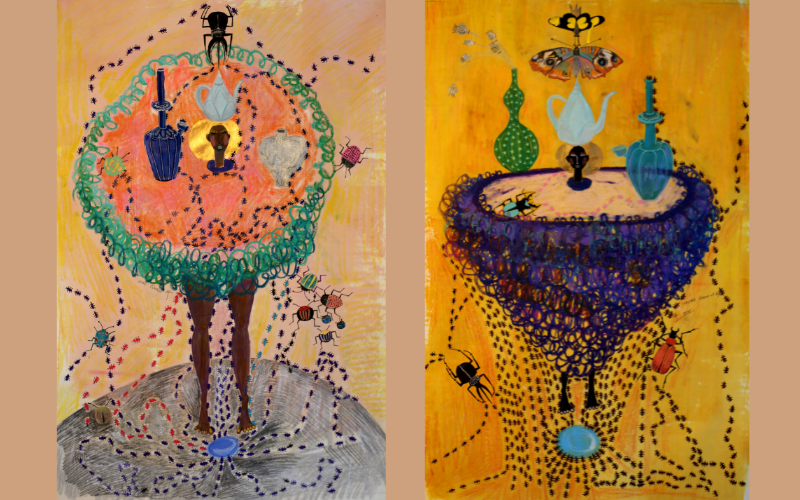
9. You have used hanji, a medium that is both fragile and resilient. Was your selection of this material intended to symbolize the women portrayed in your artwork?
When people think of hanji, there's often a misconception that it’s weak or fragile. But in my experience, hanji is actually a uniquely receptive material—perhaps the only one that can truly accept almost any medium.
Like with canvas, it allows for layering and erasing, but unlike canvas, it also accommodates fine details made with pens or pencils—materials that wouldn’t work as well on traditional canvas. Hanji is much stronger and more resilient than most people assume; it's a material full of flexibility and openness.
So if we were to assign it symbolic meaning, its role aligns with the idea of all things in nature gathering to praise the ‘Queen’. Just as hanji embraces every medium placed on it, the queen in my work embodies a being who naturally accepts and embraces all forms of beauty.
10. Many of your works are exhibited internationally. How do you manage the balance between personal narratives and cultural representation?
Incorporating elements that symbolize a particular culture allows for greater expansiveness in expressing the idealized female figures I aim to portray.
For example, in my recent works, Korean ceramics appear—not merely as representations of Korean identity, but as universal symbols that anyone can understand and relate to. These cultural elements are not confined to being emblems of a specific tradition; rather, they open up broader possibilities for meaning and interpretation.
I believe one of the defining features of my work is the way personal narratives and cultural expressions do not clash, but instead come together to create a richer, more layered significance.
11. Was there an exhibition that proved to be a pivotal moment for you emotionally, professionally, or in terms of your artistic perspective?
Becoming a represented artist with French Galerie Bruno Massa in 2025 marked a significant turning point in my practice. This partnership not only opened doors for me to actively participate in specific exhibitions and art fairs, but also led to my work being featured on prominent art platforms such as Arty and Artnet.
Being represented has provided a more structured and sustained framework for sharing my work, allowing me to go beyond simply exhibiting artworks. It has become an opportunity to communicate my artistic vision more broadly. I see this moment as one of great professional importance, offering both visibility and depth to my career.
12. How do you envision your future? What goals or plans are you aiming for?
My dream—and my plan—is to exhibit in a wider range of venues and locations around the world.
Since becoming an artist, I’ve come to realize that the most fulfilling moments aren't just when I'm creating, but when my work is shown to others, becomes a topic of conversation, and sparks meaningful dialogue. I truly believe that art isn’t something that exists in isolation—it’s something we build together through communication and shared understanding.
What brings me the greatest joy is connecting with people through my work, engaging in conversations about their own visions of the ideal woman, and witnessing the emergence of new perspectives and interpretations.
As I continue to paint my ‘Queens’, I hope to keep sharing these meaningful moments with more people in more places.
How about this article?
- Like23
- Support1
- Amazing1
- Sad0
- Curious2
- Insightful0