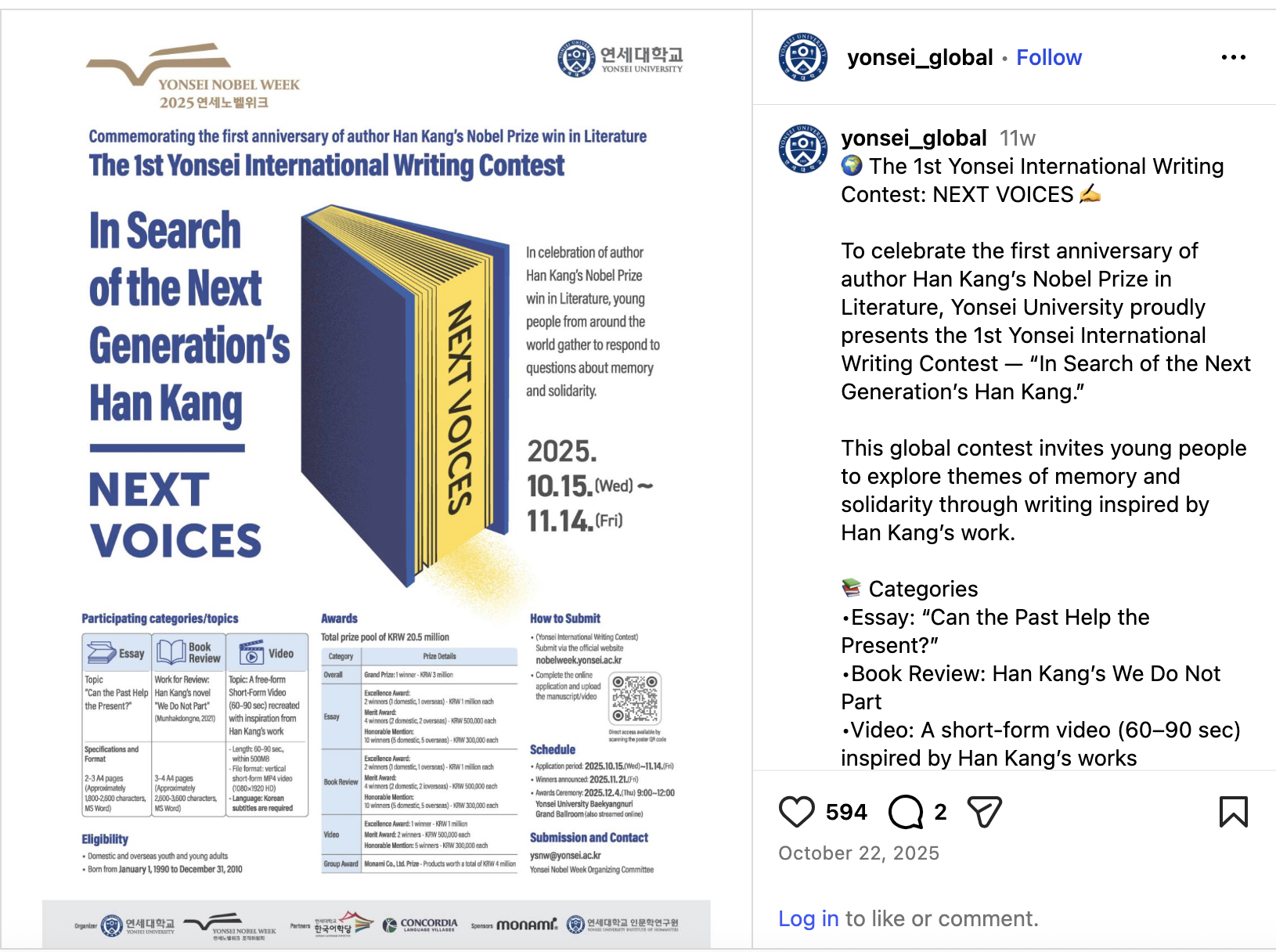
When Yonsei University announced the first Yonsei International Writing Competition, it instantly drew my attention. Organized as part of Yonsei Global Week to commemorate the first anniversary of author Han Kang’s Nobel Prize in Literature, the event was more than just a competition, it was a literary celebration rooted in memory, solidarity, and creativity.
For me, as someone aspiring to become a writer and deeply fascinated by the Korean language and its culture, this felt like the perfect opportunity to engage with the world that Han Kang represents. Her poetic introspection has guided my perception of storytelling ever since I first read The White Book.
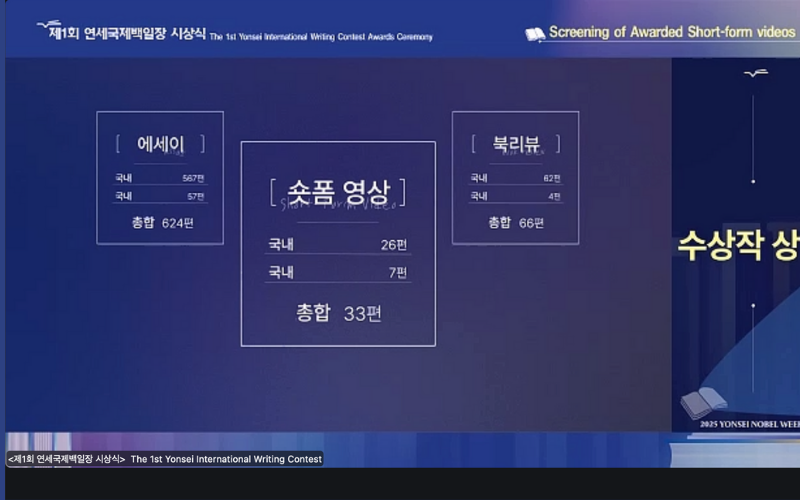
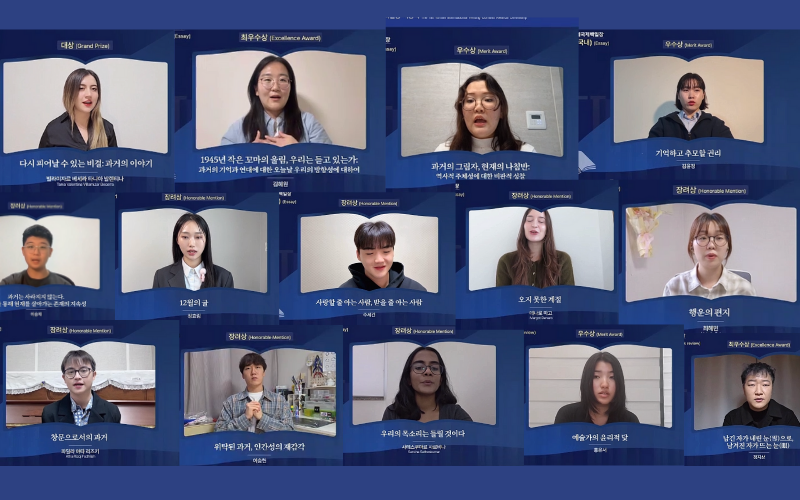
The event, held under the theme “In Search of the Next Generation’s Han Kang,” invited participants worldwide to explore key themes from her works (memory and solidarity), across three categories: essay (Can the Past Help the Present?), book review (We Do Not Part), and short-form video (60–90 seconds inspired by Han Kang’s writing). With a total prize pool of KRW 20.5 million, and over 700 submissions from around the world, the competition was a true global dialogue on literature.
Initially, I intended to enter the essay category. Writing essays has always been my comfort zone, but I realized a few days before the deadline that the submissions had to be entirely in Korean. Though I can write simple compositions, crafting a literary essay of nearly 1,800 words in Korean was beyond my current ability. Still, I couldn’t let the opportunity pass. Instead, I decided to participate in the short-form video category, which allowed English audio with Korean subtitles.
I chose to create something inspired by The White Book.
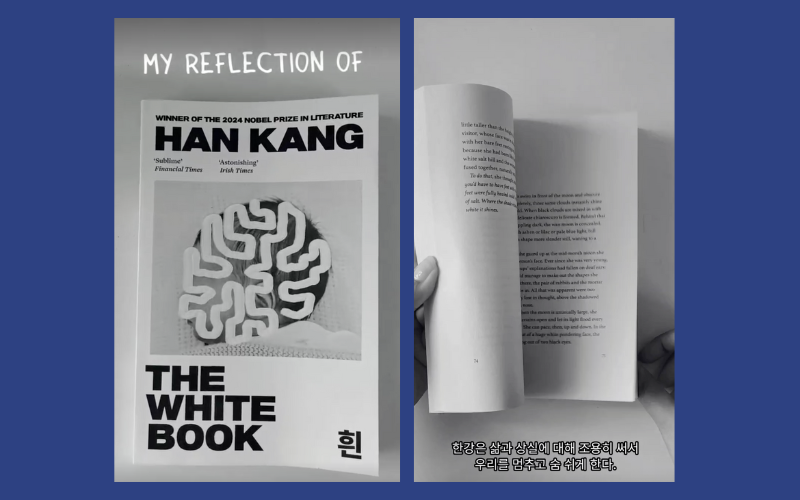
I had just four days before the deadline, a tight window that left no room for elaborate production. I initially explored using animation and digital effects, thinking this abstract approach would best convey the poetic depth. However, after experimenting, I felt it wasn’t painting the picture in the way I wanted, and the complex process was taking up precious time. Then, I decided to film a handheld live‑action video, using The White Book itself as a symbolic element.
When I submitted it a day before the deadline, I did so with modest expectations. I imagined experienced video editors and native-like Korean speakers from across the world submitting intricate, beautifully produced works.
A week later, on November 21, 2025, I woke up to an email announcing the winners. Out of 800 global participants, I had received an honorable mention. For a few seconds, I just stared at the screen in disbelief. Then, the excitement surfaced. My work has been recognized on a global stage celebrating the very author who first drew me to Korean literature.
The award ceremony on December 4 at Yonsei University was attended by President Yoon Dong‑seop, key deans and professors, jury chair Seo Hong‑won, and Korean Language Institute director Lee Seok‑jae, among others.
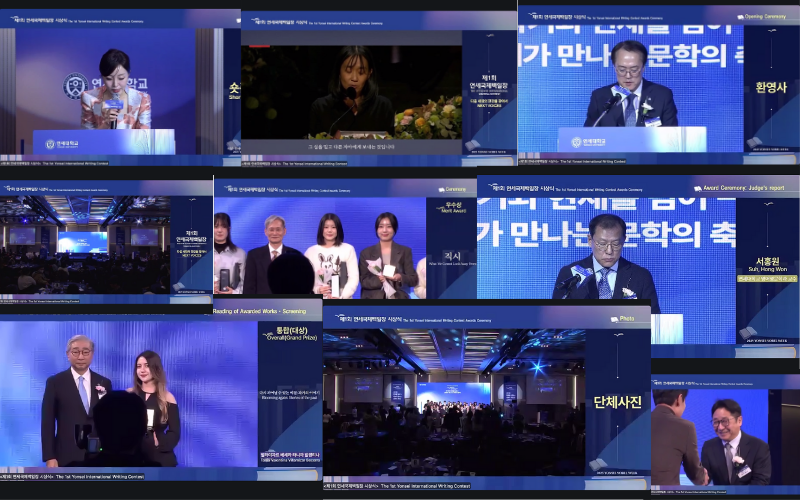
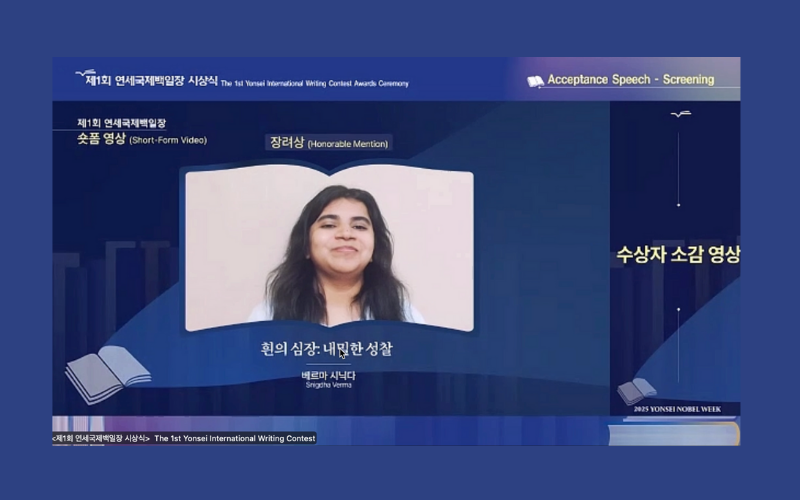
Winners unable to attend in person, like me, joined through a live broadcast from overseas. I had pre‑recorded a short video message in Korean expressing my gratitude to the university and the organizing committee, which was later showcased alongside snippets of the winning works. Watching myself on screen that morning from India felt surreal, part nerve‑wracking, part heartwarming.
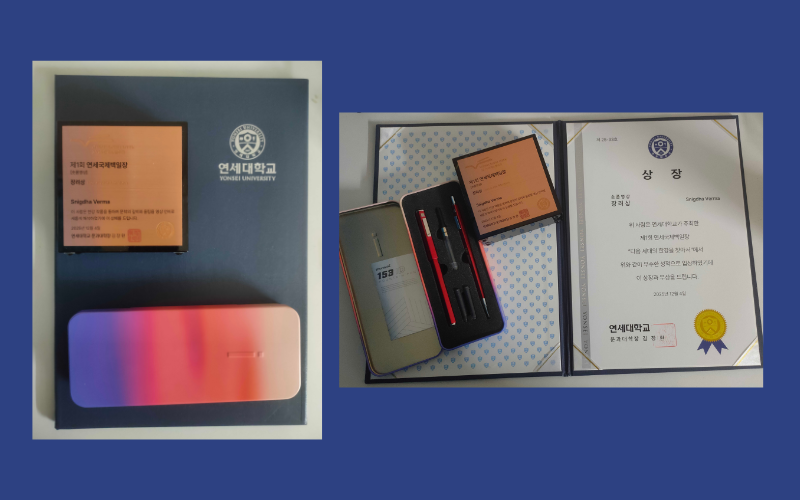
A few weeks later, my award package arrived by post with a certificate, a trophy, and a thoughtful gift from Monami, one of the event’s sponsors.
It wasn’t my first Korean contest, and certainly not my last. But this one taught me something new: that not every success needs to be meticulously planned. Sometimes, taking the leap matters more than perfect preparation. Creativity, after all, often blooms in the spaces between fear and faith.
As I continue to learn Korean and dream of studying in Korea one day, this experience will remain a quiet but powerful reminder.
How about this article?
- Like2
- Support0
- Amazing2
- Sad0
- Curious0
- Insightful0