Kim Ae-young is a ceramic artist who works by dividing ceramics and engraving stories of life into the cross-sections. She studied ceramics in Korea and became fascinated by the connection between the form of ceramics and the historical background. She said, ‘’It was intriguing to imagine the atmosphere and background of an era naturally embedded in ceramics. I often wonder if future generations will see the current zeitgeist in the ceramics I create.’’ Believing that her story can become everyone's story, Kim Ae-young strives to authentically incorporate her personal thoughts into her work. Thus, she continues to visualize her thoughts using ceramics as a medium.
Her art has been shown in exhibitions including ‘’Night Work’’ (2023) at Space Keumchae, Seoul, the ‘’Affordable Art Fair’’ (2022) in Singapore, ‘’Night Gardener’’ (2025) at Gallery ONDO in Seoul, and the Asian Contemporary Ceramic Art Exhibition: ‘’Stunning Edge’’ (2016) at the National Taiwan Craft Research and Development Institute, Nantou in Taiwan. She has received awards at the Cheongju International Craft Biennale (2003) and the Gyeonggi World Ceramics Biennale (2011), and was selected for the 2019 Gyeonggi International Ceramic Biennale’s ‘’302 Artists.’’
Her works are included in prominent collections such as Lotte Hotels Toh Lim (Seoul, Korea), Seoul Museum of Craft Art (Seoul, Korea), Yanggu Porcelain Museum (Yanggu, Korea), Korea Ceramic Foundation (Icheon, Korea), Shigaraki Ceramic Cultural Park (Koka City, Japan), Setinine (Seoul, Korea), and Hyatt Regency hotels in Zhenjiang, China, and Seoul, Korea.
I was intrigued by the unusual shapes of her vases and the themes she explores in her drawings.
Below are excerpts from an email interview with her from Dec 26 to Jan 7.
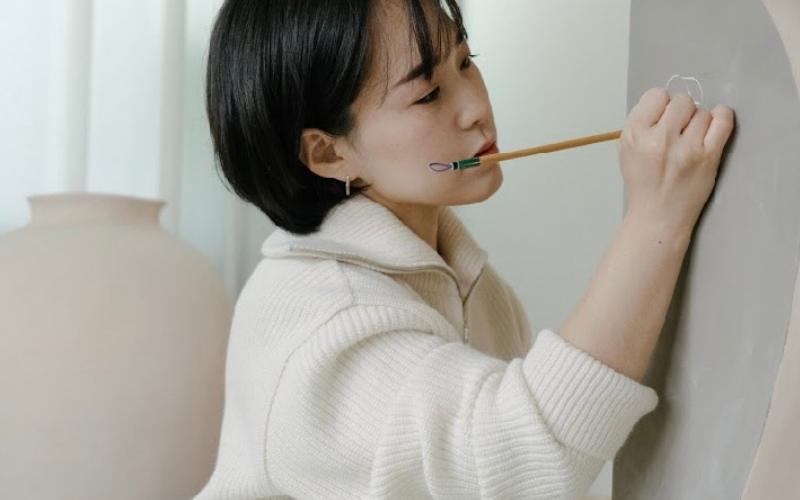
1. What led you to deconstruct the form of ceramics and draw inside them?
The starting point of my work was the concept of ‘’corners.’’ Initially, I wanted to create ceramics for spaces with dark images. This led me to start dividing round ceramics vertically to fit into corners. However, upon closer inspection, a corner is both a marginalized place and a starting point. Naturally, I began to ponder what resides in the corners of my mind. This led me to create ceramics with edges instead of rounded forms and start drawing on them. I am interested in ‘’corners,’’ ‘’anxiety,’’ and ‘’darkness,’’ often marginalized or negatively perceived aspects. I believe these are essential elements of life and that balancing them is crucial.
2. What types of ceramic forms do you create, and why?
I mainly create forms by reinterpreting traditional ceramics. I divide or fragment ceramics vertically around a central axis. I focus on forms with ‘’unstable balance’’ rather than perfection. The act of dividing seemingly ordinary ceramics vertically and creating another plane inside is a process of creating a canvas for my inner stories. By embedding my worries and conflicts into this space, I aim to reflect my attitude of acknowledging my wavering inner self and striving to regain my balance. This choice of form mirrors the appearance of our world. We are all imperfect and constantly wavering, yet desperately strive to maintain our balance. I intentionally adopt divided forms to showcase the precarious beauty of balance.
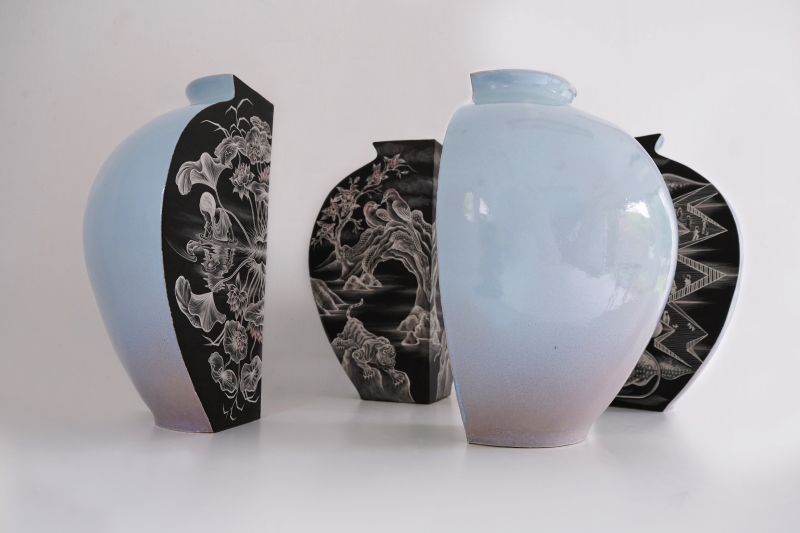
3. What themes do you incorporate in the drawings inside and outside your ceramics?
Looking at ancient ceramic relics, you often find beautifully depicted landscapes or surfaces so serene they evoke a sense of calm. In my early twenties, while studying ceramics, I felt a rebellious urge against embedding only beauty into ceramics. Therefore, I began drawing things that discomfort me inside the ceramics, contrasting with their tranquility. The drawings on the divided surfaces, aligning curves and straight lines, reflect my life. The drawings on ceramics encapsulate my life’s journey and concerns. Themes like "Corners are starting points," "Anxiety is a defense mechanism," and "Night is a time for restoration" have been central to my works. However, a single overarching theme persists amidst evolving materials and stories: seemingly negative elements are essential to life, and their amalgamation ultimately completes the person I am, embodying the 'paradoxical positivity of life.
4. Can you briefly describe your artistic process?
First, I create a complete ceramic form, then boldly divide it vertically. I refine these forms to recreate a whole shape. The method varies; sometimes, I use molding or coil building. The most crucial aspect is achieving balance. I've faced many challenges and failures in balancing the center of gravity. I meticulously draw narratives imbued with my inner stories on the divided sections. Drawing research remains an area where I invest significant effort. After the drawings, the pieces undergo kiln firing and are reassembled. Throughout all processes, I focus primarily on balance and harmony.
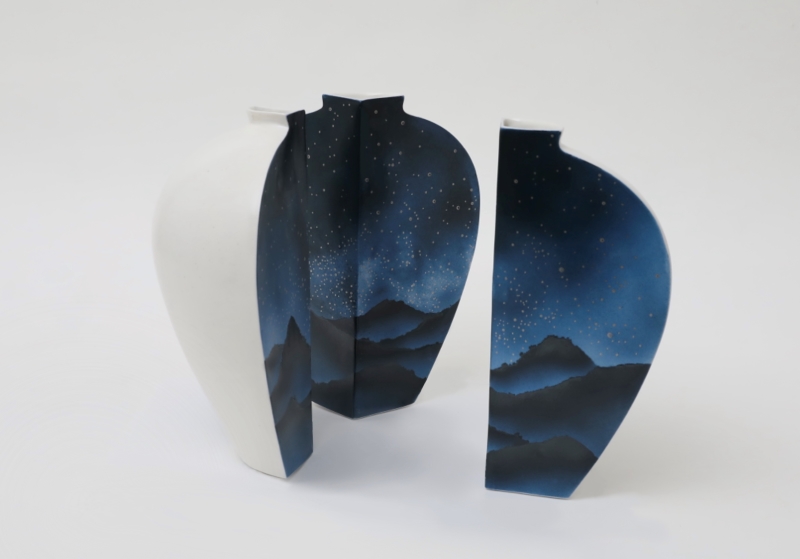
5. Which aspects of Korean traditional ceramics do you apply to your work?
I incorporate the forms and colors of traditional Korean ceramics extensively. This is to maximize the effect of contrast using familiar images. I find it enjoyable and meaningful to transform the fixed perceptions people have about ceramics. I value the process of ceramics being accepted as a form of expression rather than just decorative items. While borrowing traditional materials, the core of my work is to convey personal and social messages of modern anxiety and solidarity. For instance, if Korean moon jars symbolize inclusivity and harmony, my work focuses on the ‘’effort to maintain balance’’ by adding drawings of inner conflict to the jar.
6. What future projects do you plan to pursue?
While I have focused on my inner world until now, I want to expand to messages of solidarity and connection with others. I plan to showcase works where fragmented ceramics connect to create a complete landscape or where seemingly isolated pieces influence and harmonize with each other. I hope my work encourages viewers to positively view their anxieties, finding warmth and recovery within them.
Her work combines traditional and modern approaches, creating beautiful and thoughtful pieces that have gained recognition and are included in major collections and exhibitions.
How about this article?
- Like2
- Support0
- Amazing0
- Sad0
- Curious0
- Insightful0