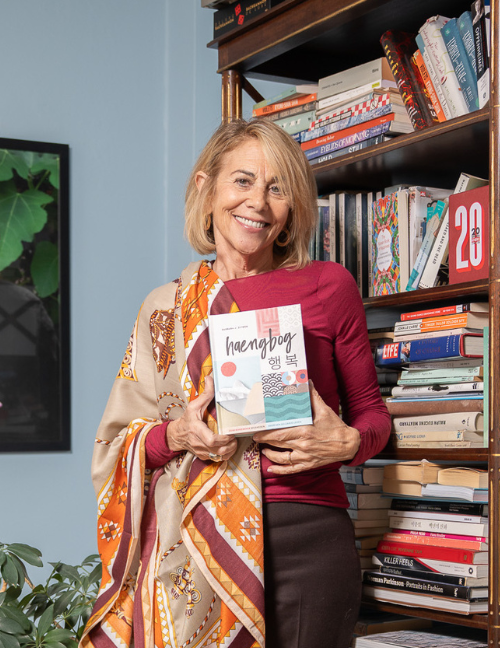
Barbara J. Zitwer is a renowned American literary agent and founder of the Barbara J. Zitwer Agency (1995), internationally respected for championing global voices, particularly Korean literature, in the English-language publishing world. For over three decades, her work has expanded the global reach of Korean literature, bringing celebrated titles like ‘’Please Look After Mom’’ by Shin Kyung-sook, ‘’A Thousand Blues’’ by Cheon Sun-Ran, and ‘’The Vegetarian’’ by Han Kang to readers in the U.S. and beyond.
She received the International Literary Agent Award in 2017 and was honored by Korea’s Ministry of Culture in 2016 for her role in promoting Korean literature globally. She is also the author of ‘’The Korean Book of Happiness’’ (2023) and ‘’When the Sea Belonged to Us’’ (2017). Zitwer was recently recognized as ‘’Person of the Year’’ at the 20th DARI Awards, which honor individuals and organizations contributing to cultural exchange between Korea and the U.S. across fields including literature, entertainment, business, and the creative industries. The ceremony took place on Dec 4, 2025, at the Korean Cultural Center in Los Angeles.
Other honorees included THE BLACK LABEL, recognized as ‘’Company of the Year,’’ and Landing International Inc., awarded ‘’Business Partnership of the Year.’’
Below are excerpts from a Jan 6-7 email interview with Zitwer, where she reflects on her interest in Korean literature and being named ‘’Person of the Year’’ at the 20th DARI Awards in 2025.
1. What first drew you to a career in literary representation?
I fell into my career by chance in a way. I was always a great reader and loved books. When I decided to change careers from working in film, I found a job posted in the NY TIMES classified ads for a job as a literary scout. I applied for the job, not knowing anything about being a scout or anything about publishing, but I got the job, and that was the beginning of my education into international publishing. I worked for Franklin & Seigal, and they took me to the Frankfurt Book Fair and London Book Fair and taught me, and I just loved the job and being part of the international community.
Furthermore, I was a very passionate advocate for the books I liked and reported on to my clients, and when I discovered a book called VURT by Jeff Noon on vacation in Switzerland, I thought it was amazing. When I returned home to NY, I found the author, who was a bookseller at Waterstones in Manchester, England, and he didn’t have an agent, nor did anyone know about his book. He has self-published it. I told him I would love to represent it, and that was the first book I sold as a literary agent. I sold it around the world, and it won the Arthur C. Clarke Award! And then, I just continued.
2. What sparked your interest in representing Korean authors?
It was really fate. At the time when I discovered Korean lit around 2010, I think I was looking for some great books to represent. I didn’t have many authors at the time, and I am very selective about what I represent, ie, I have to love the book and have a deep feeling for it. So, I was kind of “empty.’’ I once had dinner with a Korean literary agent I knew in NYC and asked if there were any notable writers in Korea, since at the time, hardly anyone was familiar with Korean books. He simply said, “Yes!” and that was the start of my journey into Korean literature. I received ‘’The Vegetarian’’ by Han Kang, ‘’Ashes’’ and ‘’Red’’ by Hye-young Pyun, and ‘’I Have The Right To Kill Myself’’ by Young-ha Kim. Young-ha Kim’s book was the first Korean book I sold. Soon after, people in Korea, the US, the UK, and globally perked up, were surprised, and became interested in the other Korean books I handled. When Kyung-sook Shin’s ‘’PLEASE LOOK AFTER MOM’’ sold to Knopf and around the world, that was a huge breakthrough for Korean literature and me; it was like the dam burst, and everyone loved MOM so much and began to be interested in more K-books.
3. What has surprised you most about the global reception of Korean literature?
I was surprised it took the world so long to catch up with what I already knew and felt about Korean literature. From writers like Young-ha Kim, Hye-young Pyun, Han Kang, Jeong-you Jeong, and Shin Kyung-sook, I saw extraordinary talent and strong commercial potential. It took many years to sell ‘’The Vegetarian,’’ and I spoke about Han Kang long before publishers finally acquired her work, but the rest, as they say, is history.
Now, I am extremely happy that Korean books are a standard genre of world literature and not viewed as “small, strange, and minor” as they were at the beginning. I always told global publishers that K-books were as important and resonant as English language, French, Spanish, etc., and now, after these years, that sentiment has come to pass. As well as everyone recognizes the huge breadth and scope of K-books, they are not pigeon-holed anymore, but rather people appreciate all genres of books from Korean authors.
4. Which Korean author has influenced you the most? Why?
Kyung-sook Shin has influenced me the most because of her character and talent. Firstly, her works are, I think, among the greatest writings from Korea and for the world. I see her as kind of the Ann Tyler, Jane Austen of Korea. Her writing is so poetic, tender, and she represents women who don’t have a voice. Also, her books speak to me because of their feminist themes, and she was the breakthrough author of Korea. She opened the doors and windows for everyone else. Then, she works so hard and is so prolific, and nothing stops her, no matter what trials and tribulations she might encounter personally, she never stops writing, and writing gorgeous books. I admire her work ethic and talent, and discipline greatly. I have seen her treat her readers with great generosity and warmth. She makes everyone feel like they are very special and a friend. I have watched her sign books for readers at events for hours, and always with a smile and a tender remark. She is unpretentious and doesn’t put on “airs” or make demands on her publishers or me, even though she is so famous. I have learned about discipline, fortitude, and kindness, and I enjoy the deep and long-lasting friendship that has grown between us over the years.
I guess to sum it up, knowing Kyung-sook Shin has made me a better person. When I am in a difficult situation in life, or feel angry, frustrated, or sad, I immediately think of Shin, and a smile comes to my face. I look at some photos I have of our travels together in Korea, and get transported back. I get a good sense of perspective.
5. You were named ‘’Person of the Year’’ at the 20th DARI Awards in 2025. Would you like to share your thoughts on this recognition?
I was really surprised and so honored. Being awarded this recognition really means the world to me and makes me feel that all my hard work and passion for all these years are very much appreciated by the Korean Government and Korean organizations. It has not been easy to represent the Korean authors that I do because they are literary and unusual, and therefore, financially, I have had to support my efforts, often, with my own savings. But I believe so much in the writers I represent, and I was never inspired by just making money and taking on books, because I thought I would make a lot of money. I am motivated by passion and the desire to help great writers become discovered and read in the world. So, therefore, the honor of being named ‘’Person of the Year’’ by the DARI Awards was so meaningful to me.
At times, I feel quite alone in my New York–based office. I’m far from the writers I represent, as well as my co-agents in Europe and Asia, which can feel isolating. However, being acknowledged in this way makes me really feel that I am a solid and strong part of a fantastic community and that I am not alone at all. It encourages me to move forward and do more and more.
6. Do you see yourself as a bridge between Korea and the U.S. through your work?
Yes, I do see myself as a bridge between Korea and the U.S., but also Korea and the world. In many ways, I’ve acted as an ambassador for Korea. At times, I even joked that I felt like “Hillary Clinton,” arranging meetings, group gatherings, visits, and events between Korean writers and editors,and publishers around the world. Through it all, I was always introducing Korean culture to international audiences.
One of the most significant events in my career was when I arranged to bring international editors of the book ‘’The Accusation’’ by Bandi to the DMZ in Korea to stand near the Bridge of No Return and walk into Panmanjeon, and into the tunnel that was discovered years ago when North Korea was trying to invade the Republic of Korea. That trip was really a diplomatic event and the most extraordinary book reading I was part of. We all read from Bandi’s book in different languages and celebrated this great work smuggled out of the North, the Panmunjeom Tour.
7. What are your plans?
I plan on doing more work on adapting Korean books to film. I have been working a lot in the film business with my Korean authors, and this year, I want to focus more on films. Right now, Pyun’s ‘’THE HOLE’’ has finished production, and it will be released globally in late 2026. Jeong-you Jeong’s ‘’THE GOOD SON’’ is well on the way to production, and ‘’The Plotters’’ is being produced by Soo Hugh. I have a deep interest in film and a strong knowledge of the medium, and I’m now eager to focus much more of my work in that area. I recently saw Park Chan-wook’s ‘’No Other Choice’’ and consider it the Film Of The Year; a true masterpiece.
Also, my plans are to visit Korea this year and go to Busan, where I have not been yet. When I visit Korea, I don’t just go to the book fair or meet with publishers, but rather my authors take me on little adventures. JM Lee took me to Jindo Island last year, where I could visit Jindo puppy breeders; I love Jindo dogs. Later, he took me to swim in the South Sea from an island no one knows about. It was completely unforgettable. Kyung-sook Shin took me to the Unmunsa Monastery, and that was a transformative experience of spirituality and nature. I wrote ‘’The Korean Book of Happiness’’ about all my travels in Korea; therefore, I want to walk on the ocean floor when the tide is so low.
I also want to connect with new and young Korean writers and find what the new trends are, because I have always felt that Korean writers are “ahead” of the world in their sensibilities.
Barbara J. Zitwer’s contributions continue to inspire readers, authors, and the literary world.
How about this article?
- Like3
- Support0
- Amazing2
- Sad0
- Curious0
- Insightful2