From what I remember from the History classes I attended at school in France many years ago, there weren’t many mentions of Korea, save from the presentation of its recent impressive economical development along with other Asian countries. The history of «comfort women» during the Second World War was then unknown to me, until I met my husband and started learning more about the culture and History of his country, Korea.
Since then, I had the occasion to hear more about it with the depiction of this historical matter in several Korean works of fiction, released worldwide and thus allowing this part of Korean History to get known abroad, including in French-speaking countries.
Litterature: graphic novel "Grass"
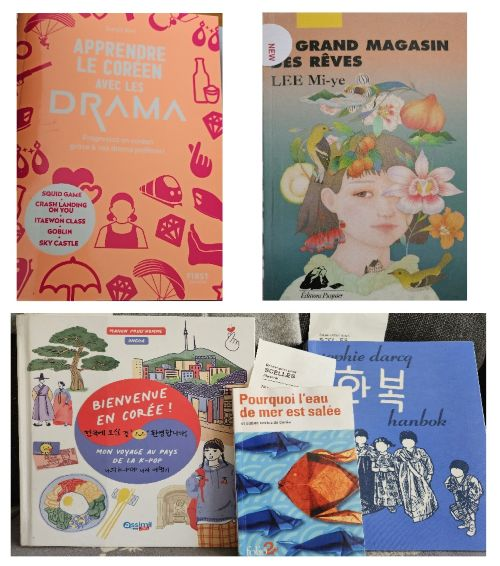
I regularly have the chance to borrow books related to Korea from my local library, as more and more books are available with the rise of interest in Korean culture: K-pop, K-dramas, Korean food... between a language learning book to keep studying Korean, and a collection of short stories introducing Korean mythology, I discovered a graphic novel from a Korean author, Keum Suk Gendry-Kim, translated to French: "Les Mauvaises herbes" (original title: 풀, published in 2017). While I don't often read graphic novels, this one stood out with its drawing and its topic showing a part of Korean History through the story of Ok-sun, a young Korean girl taken to a place where "comfort women" serve Japanese soldiers.
TV: Tomorrow
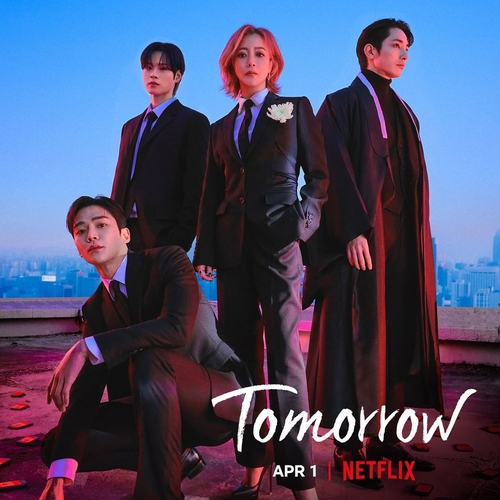
It has been a few years now since K-dramas started making their way to my TV series watchlist. Although I have sometimes watched K-dramas set in an historical setting such as "Mister Sunshine", it took watching a fantasy K-drama, "Tomorrow" (original title: 내일), produced by Sung Chi-wook and Kim Tae-yoon and released in 2022 on Netflix, to see another story featuring a character related to this part of Korean History. In this series adapting of a webtoon, the main character, in a coma, discovers the world of grim reapers whose purpose is to guide humans at the end of their life, and joins a special team trying to prevent suicides; in episode 13, they are tasked with assisting an old lady at the end of her life, and discover that she and one of her friends were forced to become "comfort women" in their youth. As the success of K-dramas introduce Korean culture and everyday life to their audience worldwide, this series also allows for a touch of Korean History to make it to international TV.
Cinema: I Can Speak
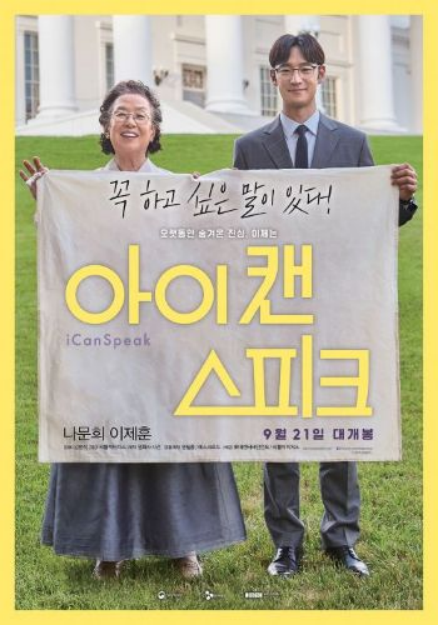
As I was coming back from a trip to Korea at the beginning of 2025, I took advantage of the free time during the flight back to watch a movie; among the international movies available, including many French and Korean ones, I chose to watch "I Can Speak" (아이 캔 스피크) produced by Kim Hyun-seok, which was also presented at the Paris Korean Film Festival when it was released in 2017. The movie began as comedy, with endearing main characters: an old lady serial-reporting offenses in the neighbourhood, and a recently appointed young employee who ends up processing all these files after his colleagues avoided assisting the old lady. We then observe these two characters warming up to each other as the young employee starts tutoring the old lady in English, and she becomes a grandmother figure for him and his younger brother living with him. We later discover that learning English is so important for her because she wants to testify at an hearing in the United States of America regarding "comfort women", as she herself was a victim of it.
With the Korean wave, "hallyu", Korean litterature and audiovisual works gain increasing interest worldwide; while it broadens entertainment options for international audience and readers, and has them discovering a side of Korean culture at the same time, these works also help bringing forward some aspects of Korean History which are less known outside of the country.
How about this article?
- Like0
- Support0
- Amazing0
- Sad0
- Curious0
- Insightful0