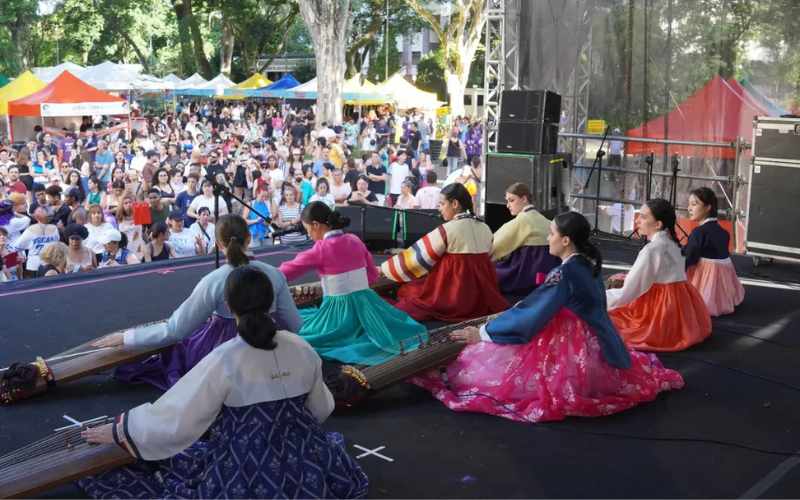
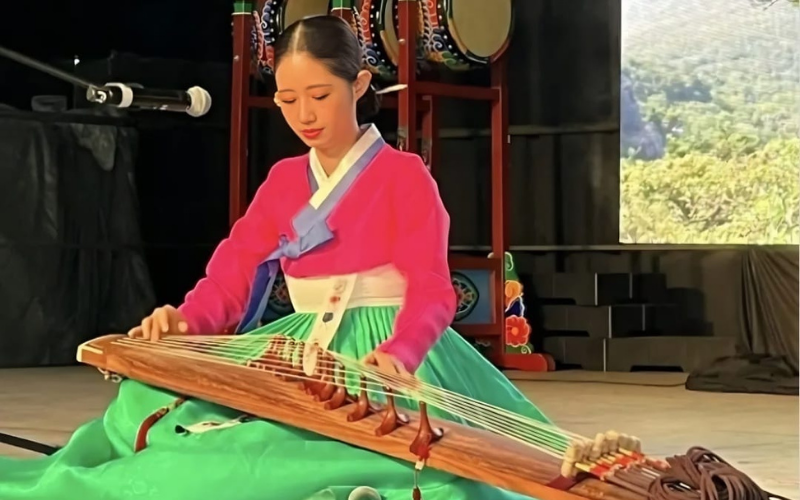
During the Korean Culture Festival in Brazil, I was surprised by the various rhythms, stories, and instruments that make up the richness of traditional Korean music. On the main stage, the artist Soeui Yang, performer of Gayageum Byeongchang (가야금 병창), sparked my curiosity about the history of this musical tradition.
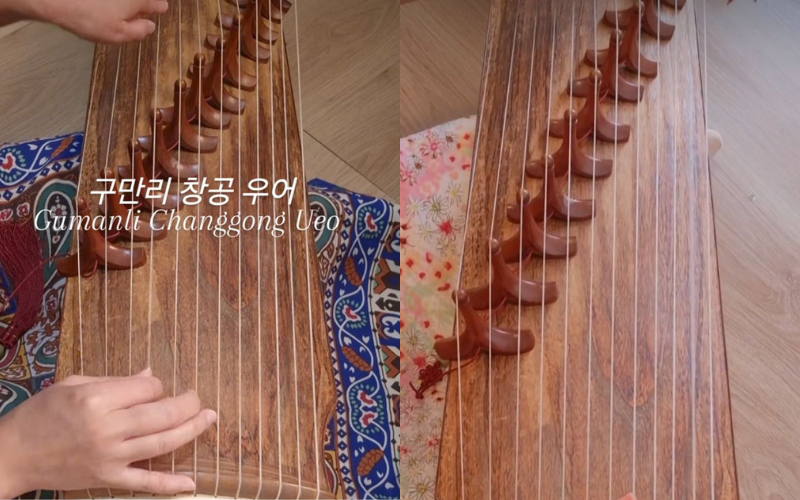
The gayageum is a traditional instrument, similar to a zither, usually with twelve strings, although modern versions have more strings. It is played with the fingers or with plectrums and is considered one of the most emblematic instruments of Korean music.
This form of traditional music combines playing the instrument with singing simultaneously. Recognized in 1968 as an Intangible Cultural Heritage of Korea, it is valued for its uniqueness and historical importance. The word byeongchang (병창) literally means “singing accompanied by an instrument.” It is not just about singing and playing, but performing both actions at the same time, requiring vocal techniques, pitch control, breath, and coordination, as each hand plays complex rhythmic patterns while the voice follows elaborate melodies.
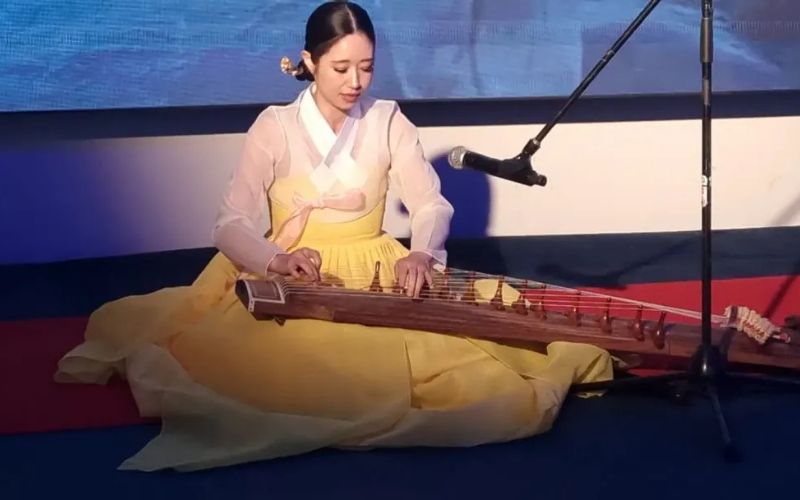
Today, this artistic expression continues to be taught by masters, performed in concerts in Korea and abroad, and even adapted to new music, including international songs, as Soeui Yang does in Brazil. In this way, the genre not only preserves tradition but also allows for new musical interpretations.
Currently a teacher at the Korean Cultural Center in Brazil, Soeui Yang has over 30 years of experience and has brought the richness of this tradition to the world, contributing to the promotion and appreciation of traditional Korean music on the international stage.
1. Could you briefly introduce yourself?
Hello, I am Soeui Yang (Artist Lalla), performer of gayageum byeongchang.
2. Could you tell us a little about your trajectory and how you started in traditional Korean music?
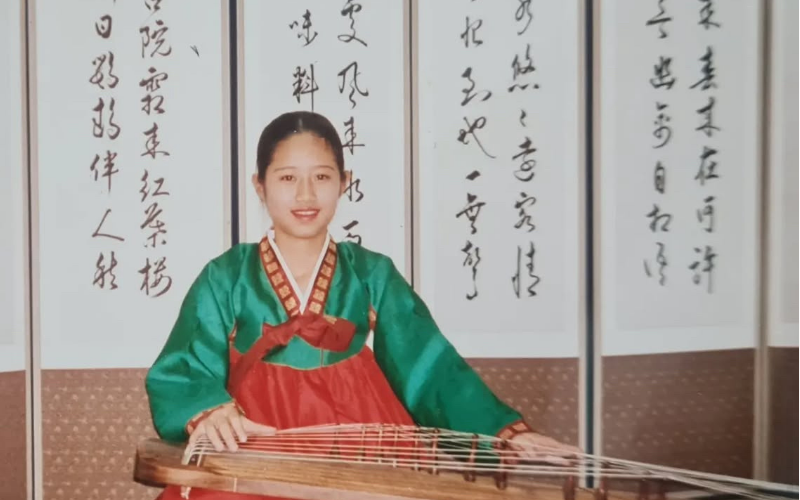
When I was 10 years old, I heard my mother talk about the gayageum and became curious, wanting to learn. Coincidentally, there was a gayageum class in my neighborhood, and that’s where I met my first teacher. She was not just an instrumentalist, but a master of gayageum byeongchang, already recognized as an Intangible Cultural Heritage of Korea and a renowned artist. Most of her students were preparing to pursue a professional career in the field, and I naturally followed that path as well.
I spent countless hours in the studio, observing, listening, and practicing, without fixed schedules. At one point, I even stopped studying music, but that break made my desire for art grow even more, leading me to pursue music as a profession.
3. You have training in both traditional Korean music and Portuguese linguistics. How do these areas influence your work as a musician?
When I was 12, I participated in a national competition, and a foreign journalist said, “It would be great if one day you showed this outside Korea.” That comment made me imagine performing gayageum byeongchang abroad, and the thought stayed with me.
At university, I studied English in Canada, experiencing a culture different from Korea. Later, I backpacked through eight European countries, which eventually led me to Brazil, a country I had always dreamed of visiting. After that trip, I learned Portuguese and completed a master’s degree in Portuguese Linguistics, in addition to obtaining certification as a Korean language teacher. I brought the gayageum with me to Brazil, and even though I do not speak Portuguese perfectly, I am able to sing Brazilian songs, which brings me great joy.
4. What was your most remarkable experience joining the Gangdong Traditional Orchestra?
The gayageum byeongchang is closer to singing than to purely instrumental performance, and it rarely integrates into orchestras. I was fortunate to be selected to perform gayageum byeongchang in several concerts, which allowed me to join the orchestra. Collaborating with other instruments was very valuable and helped me achieve more natural collaborations here in Brazil.
5. What is the greatest challenge when singing and playing the gayageum simultaneously?
The sanjo of gayageum (instrumental only) is already difficult, as is pansori (singing only). Executing both techniques simultaneously, fully, is a huge challenge. I continue to train with dedication to this day.
6. Is there a piece or performance that has special meaning for you?
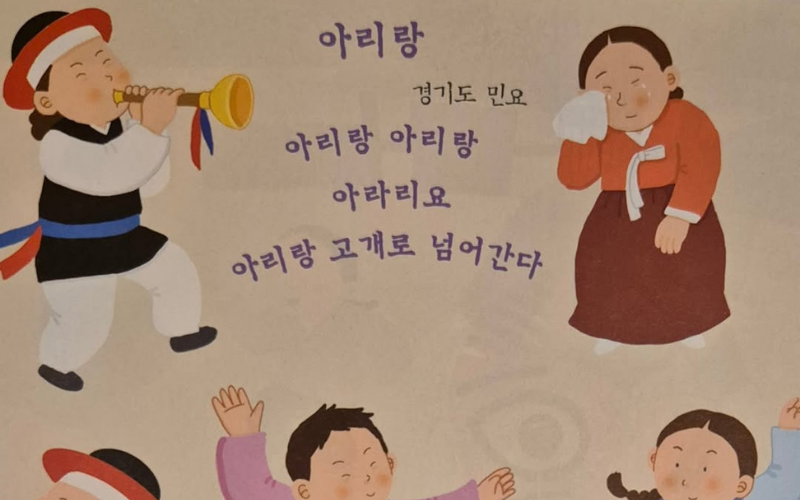
The most significant song for me is Arirang (아리랑), which represents Korea. I have sung and taught Arirang in several places in Brazil, conveying feelings of both sadness and joy. Another important song is “Garota de Ipanema” from Brazil. I may have been the first person to perform it in gayageum byeongchang. Whenever I perform it, the Brazilian audience enjoys it very much, making it even more special.
One particularly memorable performance was the first time I went on stage with my students in Brazil. Although it was joyful, I felt a small frustration, as they were still learning, with imperfect pitch and rhythm. Even so, the experience had great value, and I realized the importance of practice before performing.
7. How is it to receive the reaction of international audiences when bringing traditional Korean music to other places, including Brazil?
Abroad, audiences tend to react warmly, which brings me great joy. However, sometimes Korean music is seen only as “curious,” without fully appreciating its artistic value and depth, which remains a challenge.
8. As a teacher at the Korean Cultural Center, what are the greatest lessons you observe in students when teaching gayageum?
I have learned that music does not need nationality or language. Emotion and value can be conveyed anywhere. Traditional Korean music reveals its charm even more intensely when practiced directly, and I notice that Brazilian students feel the same. Today, I no longer see them as “Brazilian students,” but simply as my students — as close as Korean students.
9. What advice would you give to young musicians who want to delve into traditional Korean music?
In traditional Korean music, consistency is more important than in any other genre. By listening frequently, the ear opens; by practicing continuously, skill grows. Daily dedication is required, even if progress is sometimes not immediate. If one does not practice, skill diminishes.
10. How do you see the future of traditional Korean music in a global context?
In Korea, there is a saying: “What is most Korean is also the most global.” International audiences are always looking for novelty, and the uniqueness of traditional Korean music will always be received with freshness. I believe that, as a high-level art form, it will deeply captivate people around the world.
11. What role does traditional music play in preserving Korean culture and identity, in your view?
Traditional Korean music plays a fundamental role. Recognized as an Intangible Cultural Heritage, it is immediately distinct from anything else in the world. It represents Korea itself: from the posture and attire of the performers to the stories and emotions conveyed, fully reflecting Korean identity. In Brazil, a country of great cultural diversity, it is important to show interest in and conduct research on world music, promoting initiatives that value different musical traditions. I believe initiatives that encourage and support musicians of traditional Korean music around the world are important for the appreciation and dissemination of this unique art.
Gayageum byeongchang is an artistic expression that combines technique, emotion, and history, uniquely representing the richness of traditional Korean music. Through the work of dedicated artists like Soeui Yang, this tradition continues to thrive, crossing borders and reaching new audiences. Each performance is an opportunity to connect people from different cultures, showing that music has no nationality and that its beauty can be appreciated by all. By passing on knowledge, teaching students, and exploring new interpretations, Soeui Yang contributes to ensuring that gayageum byeongchang is valued, understood, and preserved, guaranteeing that Korea’s musical heritage continues to inspire future generations and occupy its place on the global artistic stage.
How about this article?
- Like12
- Support0
- Amazing15
- Sad0
- Curious0
- Insightful0