Why I Chose Kimbap
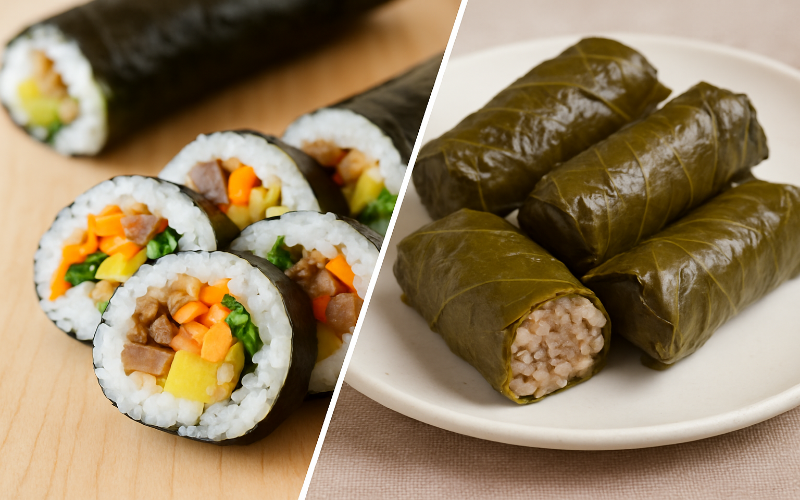
From the very first time I saw people eagerly enjoying kimbap in Korean dramas, I knew I wanted to try it myself. The idea of tasting this delicious combination of fresh vegetables and various meats excites me deeply. Kimbap isn’t just food to me — it’s a symbol of culture and connection. Interestingly, it reminds me a lot of one of my favorite Persian dishes, dolmeh. This similarity creates a special bond between Korean and Persian cultures that makes kimbap even more meaningful in my heart. That’s why I chose to write about kimbap, to share my love for this amazing dish and explore its rich history and varieties.
The History of Kimbap
Some believe kimbap evolved from traditional Korean dishes that involved wrapping rice in leaves or seaweed. Historical documents from the Joseon Dynasty (1392–1897) mention foods like bokssam (복쌈), meaning “wrapped rice,” which was often used for picnics, festivals, or traveling.
Early versions included only plain rice with simple vegetables or pickled radish, wrapped in dried seaweed (gim).
These wraps were convenient, nutritious, and easy to carry — perfect for outdoor activities or lunchboxes.
Kimbap in Modern Korea
Today, kimbap is:
A popular school lunch and picnic food
Commonly sold in convenience stores, markets, and restaurants
Available in many varieties — from traditional to creative modern versions like cheese, kimchi, tuna, or fusion styles
Kimbap has also become a symbol of Korean food culture, thanks to its appearance in K-dramas, travel vlogs, and even global food festivals.
1. Classic Kimbap (전통 김밥 – Jeontong Kimbap)
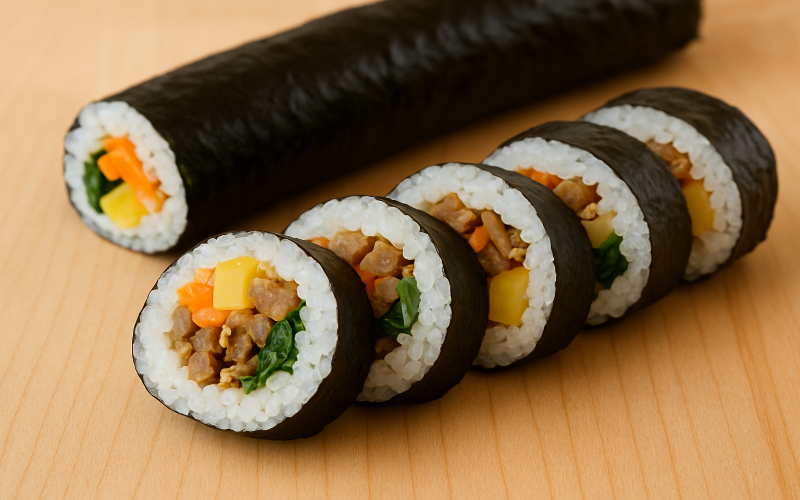
Fillings: Egg, pickled radish (danmuji), spinach, carrot, sausage or beef, and fish cake.
This is the most common version and can be found in almost every Korean restaurant or market.
2. Cheese Kimbap (치즈 김밥 – Cheese Kimbap)
Filled with cheese slices along with classic ingredients.
It adds a creamy and mild taste. Great for kids who don't like spicy food.
3. Kimchi Kimbap (김치 김밥 – Kimchi Kimbap)
Made with stir-fried kimchi inside.
Has a spicy and tangy flavor—perfect for kimchi lovers.
4 .Tuna Kimbap (참치 김밥 – Chamchi Kimbap)
Filled with tuna mixed with mayonnaise and fresh vegetables.
Popular among students and younger people.
5. Vegetable / Vegan Kimbap (야채 김밥 – Yachae Kimbap)
Filled only with vegetables like carrots, spinach, radish, cucumber, and sometimes mushrooms.
A great healthy and meat-free option.
6. Chungmu Kimbap (충무김밥 – Chungmu Kimbap)
Unlike other kimbaps, these rolls only contain rice and seaweed.
Served with spicy squid and radish kimchi on the side.
Originates from the city of Tongyeong, Korea.
7. Mayak Kimbap (마약 김밥 – Mayak Kimbap)
Translation: “Addictive Kimbap”!
Small rolls filled with simple vegetables, without meat.
Served with a soy sauce-mustard dip.
Famous at Gwangjang Market in Seoul.
8. Triangle Kimbap (삼각 김밥 – Samgak Kimbap)
Similar to Japanese onigiri.
Sold in plastic packaging to keep seaweed separate from rice until opened.
Fillings include tuna, kimchi, beef, or curry.
Commonly found in Korean convenience stores, perfect for a quick snack.
9. Beef Kimbap (소고기 김밥 – Sogogi Kimbap)
Made with stir-fried beef, often bulgogi-style.
Has a sweet, savory flavor and is especially loved by adults.
Basic Ingredients:
1. Cooked white rice – Short-grain Korean rice works best.
2. Gim (김) – Dried seaweed sheets used for wrapping.
3. Sesame oil – For flavoring the rice and giving it a shiny finish.
4. Salt – Lightly seasoned rice brings out the flavors.
Common Fillings:
You can mix and match, but these are the classic ingredients:
Pickled yellow radish (danmuji, 단무지) – for a sweet and sour crunch
Carrot strips – lightly sautéed
Spinach – quickly blanched and seasoned with sesame oil
Egg – cooked into a thin omelet and sliced into strips
Fish cake – stir-fried in soy sauce
Beef or ham – sometimes bulgogi or seasoned ground beef
Crab sticks (optional) – used in many modern versions

My Personal Connection with Kimbap
As someone who has loved K-dramas for a long time, I had seen kimbap many times without truly noticing it. But everything changed when I watched Extraordinary Attorney Woo. I remember a particular scene where the main character was heading to work, and her father had lovingly prepared kimbap for her. She insisted on eating it every day, and her reason caught my attention — she said she liked kimbap because she could clearly see all the ingredients inside. That was the first time I really looked closely at it, and I realized how beautifully it combines vegetables and meats, two of my favorite things in food. From that moment, I became very fond of it. Later, when I discovered how similar kimbap is to my favorite Persian dish, dolmeh, I felt an even deeper connection. That similarity made kimbap feel like something familiar, almost like a piece of home wrapped in Korean culture — and that made me love it even more.
Curiosity About the Taste
One of the things that excites me most about kimbap is the seaweed. I’ve never tasted seaweed before, so I’m really curious about how it blends with the other ingredients — especially meat or fish. I imagine it might taste a little salty and slightly sour, which I think would create a unique and interesting flavor, especially when combined with rice and vegetables. I wonder how it feels to take a bite and taste all those layers at once.
If I had the chance to try kimbap tomorrow, I already know which types I’d love to try first: samgak kimbap, chamchi (tuna) kimbap, cheese kimbap, and of course, the traditional jeontong kimbap. Just thinking about the different textures and flavors — the softness of the rice, the crunch of vegetables, the creaminess of the cheese, and the flavor of the tuna — makes me look forward to the day I can finally taste them myself in Korea.
Food as a Reflection of Culture and Love
Whenever I think about Korean food — especially kimbap — one word comes to my mind: cultural authenticity . What we eat is more than just a way to satisfy hunger; it's a reflection of how we care for our bodies and souls. The food we give to our children shapes their health, their memories, and even their values. That’s why I deeply admire Korean cuisine — it emphasizes health, homemade meals, and the warmth of family.
There’s something so pure about a dish that is made with care, especially when it’s prepared by a parent for their child. That love, that effort — it exists in both Korean and Persian cultures. That’s why I feel such a strong connection between the two. Dishes like kimbap and dolmeh are perfect examples. Both are rolled foods made with rice and meat, wrapped carefully — Koreans use seaweed, and we use grape leaves . Sometimes we even shape dolmeh into triangles or rolls, just like kimbap. It’s amazing how two different cultures, from opposite sides of Asia, created such similar and heartfelt dishes.
A Taste of Home, Far from Home
I believe that when I finally get the chance to try kimbap for the first time, I might be alone — far from my country, my family, and everything familiar. But I’ll try to enjoy every bite. And when I feel homesick, I’ll remind myself of the similarities between kimbap and dolmeh — between Korea and Iran — and I’ll feel a little closer to home. I’ll learn how to make it with my own hands, so one day I can cook it with love for the people I care about. Maybe then, food will no longer just be a meal, but a connection — a bridge between where I come from and where I’m going.
How about this article?
- Like3
- Support4
- Amazing1
- Sad0
- Curious0
- Insightful0