If you are someone who is planning to study or find employment in Korea, you are bound to come across TOPIK as a mandatory requirement. So what is TOPIK?
TOPIK stands for Test of Proficiency in Korean, it is used to assess your mastery of the Korean language as a non-native speaker. It is similar to IELTS and TOEFL for non-native speakers of the English Language.
As per the new format that came into effect in 2014, there are a total of six levels in TOPIK. They are divided into two categories of exams: TOPIK-I & TOPIK-II. TOPIK-I is a 100-minute exam consisting of a Listening and Reading section, with two sub-levels: Level 1 and 2. TOPIK-II is a 180-minute exam (with a 30-minute break) consisting of a Listening, Reading, and Writing section, with four sub-levels: Levels 3,4,5 & 6. TOPIK is held 6 times a year in Korea and about 2-3 times in other countries (depending on your region). The number of times TOPIK is held overseas could also
Starting this year, TOPIK will also be held in an Internet Based Format, in addition to the traditional Paper Based Format. The validity of the test is for 2 years only. That is why, you will see people attempting the exam multiple times in their life if they wish to pursue further studies or find better job opportunities in Korea/with Korean companies.
Depending on your score you are provided clearance for different levels. One can appear directly for TOPIK-II without ever attempting TOPIK-I, or appear for both TOPIK-I & II as they are held one after the other on the same day. However, the difficulty level of TOPIK-II increases exponentially from TOPIK-I, since all four levels are combined in one paper. If you are a beginner or someone with elementary proficiency, you should ideally first try to attempt TOPIK-I. If you are quite confident in your Korean skills and cannot wait for a few months to appear in the next TOPIK, you should test yourself with TOPIK-II.
I have known Korean letters for about 3 years but properly started my journey with the Korean language towards the end of March 2023. I attempted the 90th TOPIK-I which was held on 15th October, 2023 in India. And only became serious about TOPIK around August, just two months before the actual exam. I was unsure of how my attempt went but I was surprised to score 170 out of 200 points. In hindsight, I think a few things worked out for me that I would like to share.
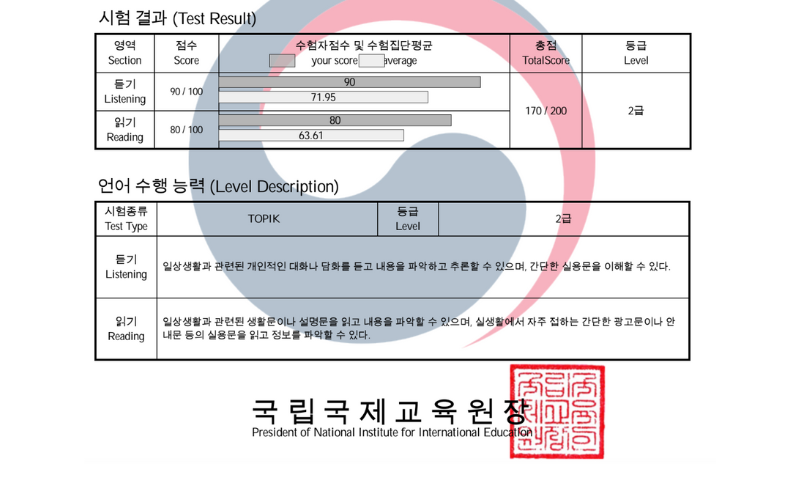
- Joining an institute
If you are serious about mastering the language in a stipulated time, I would advise you to do this. I understand that given the cost involved, it may not be an option for all. In such a case, you can always go for self-study. Many people have easily cleared TOPIK through self-study.
I don’t think I have the discipline to maintain the momentum and be consistent with self-study. Associating yourself with an institute helps you become regular with your study by force. Joining a King Sejong Institute (KSI) is preferable since they are officially recognized by the Korean Government, implying your certifications will hold greater value than those from private institutions. At the end of the day, it is your TOPIK scores and your ability to understand Korean in your daily life that matters. However, studying at KSI may help those who land employment opportunities where Korean is mandatory but TOPIK scores are not. Since King Sejong Institutes may not be available in your area of residence you can also look for other institutes or online tutors. As I mentioned earlier, it is your skills to hold a conversation that matters. Also, there are many things to consider before joining an institute like timing, duration of the course, location, quality of tutors, batch strength, fees, etc, that may influence your choice.
- Solving previously released papers
The National Institute for International Education (NIIED), the organization that conducts TOPIK, selectively releases TOPIK exam papers. There are only 9 papers that have been released since 2014. Nonetheless, they are enough to help you understand the paper pattern and expected questions. You can easily find them online. Try to create an exam-like environment around you when solving these papers. That means zero noise and distractions, and attempting the paper in a fixed time. The best would be to attempt these papers online so you don’t have to worry about timing yourself and also save time on finding correct/incorrect attempts.
- Focus on vocabulary
I say this with caution as it may go against the advice of many experts. For learning any language, you have to give equal importance to both grammar and vocabulary. I already had some understanding of basic grammar as I am studying at an institute. However, what helped me gain an edge to clear TOPIK was expanding my vocabulary beyond what I was learning at the institute through self-study. While attempting papers, even if I wasn’t sure of the grammar, knowing the vocabulary helped me understand the context of the sentence. This helped me understand what was being talked about and correctly guess the answers when I was in doubt. You can find basic lists of vocabulary online, these can easily help you cover up to 2000 words or more.
- Recap, just one last time!
Again, this advice may not work for everyone. Many people don’t touch books, notes, and other study material on the day of the exam. This, of course, works too as some people might start panicking. However, I was among the few people at the exam center who were screening through their notes before entering the hall. The idea was to be selective with my last-minute study and just go through the list of vocabulary I had a difficult time remembering. Trust your brain to recall recent events the best!
- Clear your mind
Once you are seated in the hall, you will be spending about 30 minutes waiting for the exam to start. Spend them wisely as they can determine the fate of your test. I tried to calm myself, look outside the window, and not think about anything. Do what works for you to keep you focused and centered without panicking too much. Sit with your eyes closed or mentally sing a song if you like! Our exam invigilators were also quite nice, they tried to make us laugh and ease us into the situation before our exam commenced.
- Try to attempt all questions
Since there is no negative marketing in TOPIK, you should try to attempt the maximum questions possible. The worst that could happen is you could get it wrong, which will happen anyway if you don’t attempt.
How about this article?
- Like6
- Support0
- Amazing3
- Sad2
- Curious0
- Insightful2