Mooroots is a Korean fashion brand that recently unveiled its latest collection at Milano Loves Seoul (27 February – 2 March 2026, Palazzo Bovara) in Milan, Italy. The Italian public welcomed them with enthusiasm, and I too had the chance to admire their creations in person. It is a brand that deeply cherishes tradition and aims to bring it into everyday life, not just into special occasions.
The hanbok is an integral part of Korean identity, and Mooroots interprets it in an original and authentic way. Behind every creation lies a careful study of Korean traditions and culture, reimagined through a modern lens, successfully building a harmonious bridge between the ancient and the contemporary. The details of their garments reveal unexpected connections to traditional elements that accompany the wearer in daily life. The fashion creation becomes protection, culture, memory: one does not simply wear a dress, but a true cultural artefact.
The interview was conducted via email (from 22 to 26 March 2026), and I would like to thank Mooroots for sharing their creative process, revealing a deep love for tradition and for Korea. As an Italian, I believe that the hanbok is much more than just a dress: it is a living symbol of Korean cultural heritage, and Mooroots’ words help us understand how relevant and deeply rooted it remains in the country’s identity.
HR: Could you introduce yourselves and tell us how your design was born?
MOOROOTS is a brand that creates modern fashion items based on Korean tradition. The name is an abbreviation of the phrase "Movement from the roots," signifying a new movement originating from the solid roots of tradition. The correct spelling is MOOROOTS. In Korean, the word "Mooroot" (무릇) carries the meaning of "generally," "naturally," or "as it should be." This reflects our brand direction: we want Hanbok to no longer be seen as a relic or a "difficult" garment worn only on special days, but rather as something that naturally permeates the daily lives of modern people. We pursue designs that combine the unique lines and materials of Hanbok with modern silhouettes so they can be worn seamlessly in today’s urban environments.
HR: When you create a fashion collection, what inspires you?
While we draw inspiration from many places, Korean tradition is always at the heart of it. Korea has a 5,000-year history with vast design assets, including traditional artifacts, architecture, and ancient patterns found in various places. However, we do not stop at simply reproducing traditional elements; we reflect modern trends and technologies. For example, we might construct Hanbok forms through knitwear, or digitize the "Dancheong" (traditional multicolored patterns) found on Hanok to create patterns using DDP (Digital Direct Printing) technology. We also incorporate motifs believed to bring good fortune into shirt designs. By adding modern technical touches to traditional symbols, we create a new aesthetic that people today can enjoy without hesitation.
HR: In 2025, your design was featured on the cover of Harper’s Bazaar for a photo shoot, worn by actor Park Bo Gum as an ambassador for promoting the beauty of the hanbok worldwide. Can you tell us something about this photo shoot? And about this opportunity?
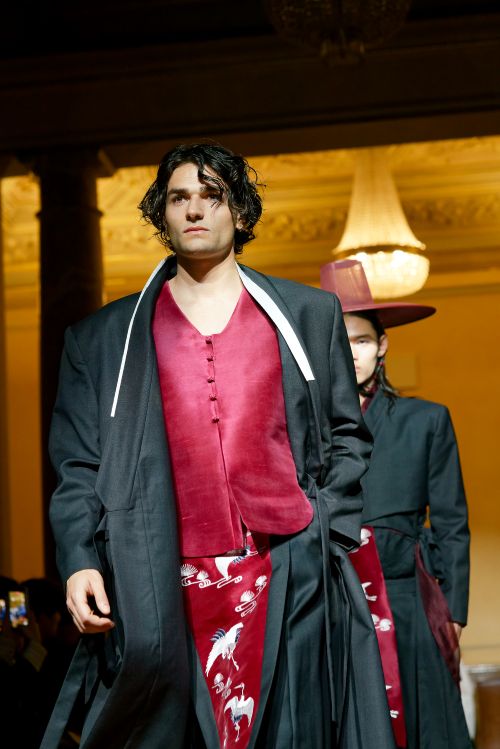
This project began by focusing on the clear and warm atmosphere of actor Park Bo Gum. We felt these characteristics closely resembled the virtues of the "Seonbi" (traditional Korean scholar) from Korea's past. Therefore, we proceeded with the design under the concept of "Modern Seonbi." We chose the "Crane," a symbol of the Seonbi, as our main motif, incorporating it through embroidery and knit jacquard, and even custom-making zipper heads in the shape of a crane. The overall silhouette and the color palette—mainly white, red, and black—were used to express the noble image of the crane. Park Bo Gum portrayed the modern beauty of Hanbok perfectly, making it a truly brilliant collaboration.
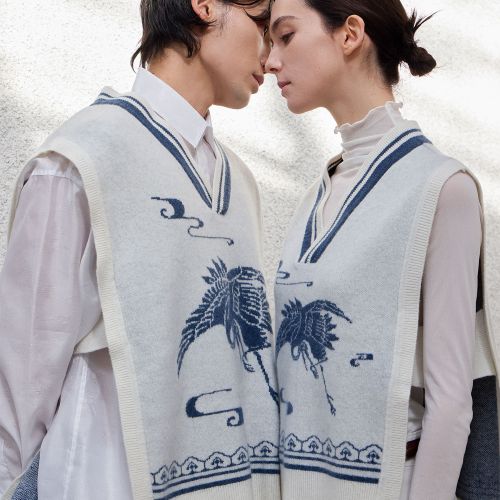
HR: How were you born with the design for the blue and white cardigan?
Blue and white porcelain is the traditional element that MOOROOTS loves most, and we have worked with it several times. In the past, blue and white porcelain was a treasure used only by the royal family and nobility because it required high technical skill and expensive pigments. This "Blue and White Knit Baeja" (vest) was specifically created for Park Bo Gum. It was the optimal item to express his beauty and nobility while capturing the unique color palette of MOOROOTS. Structurally, we reinterpreted the Git (collar) and side-line details of actual Hanbok through knitwear technology to create an item that feels both traditional and modern.
HR: What does the hanbok mean to you?
I think of it as a self-portrait. This year marks the 10th anniversary of operating MOOROOTS. Hanbok is an inseparable element of the brand, and as time passes, I feel my life being filled more and more with tradition. While I started with a sense of duty to protect Hanbok, it now sustains my life. Even after 10 years of designing based on Hanbok, it remains an inexhaustible source of inspiration with so much more left to explore.
HR: How important are tradition and innovation in fashion to you?
Fashion is an essential element integrated into people's daily lives. Therefore, I believe we must not be buried in the ways of the past. Since the forms and materials of the past reflected the lifestyle of that era, they must change today to fit modern lifestyles and situations. However, Hanbok is more than just clothing; it is Korea's identity and roots. I believe the role of a Hanbok designer is to maintain the unique beauty and characteristics of Hanbok while reinterpreting them into forms suitable for modern life. We must harmoniously compose tradition and innovation.
HR: You recently took part in Milano Loves Seoul 2026 – how did the Italian public receive you? Can you tell us about this experience?
I was truly happy to have the opportunity to introduce Hanbok in Milan. The response from the Italian public was incredibly enthusiastic. Everyone was curious about and loved Hanbok. The designs on the runway were widely shared on social media, and people genuinely liked them. Even when I was walking the streets of Italy as a traveler rather than a designer, people reacted to the MOOROOTS outfits I was wearing, saying things like "Your clothes are wonderful" or "I love your outfit." Most of the clothes we brought for the event were sold out, which I believe is evidence that the Milanese public accepted MOOROOTS' Hanbok as fashion rather than just a spectacle.
HR: If you had to choose just one dress from all the ones you’ve created so far, which one would you choose?
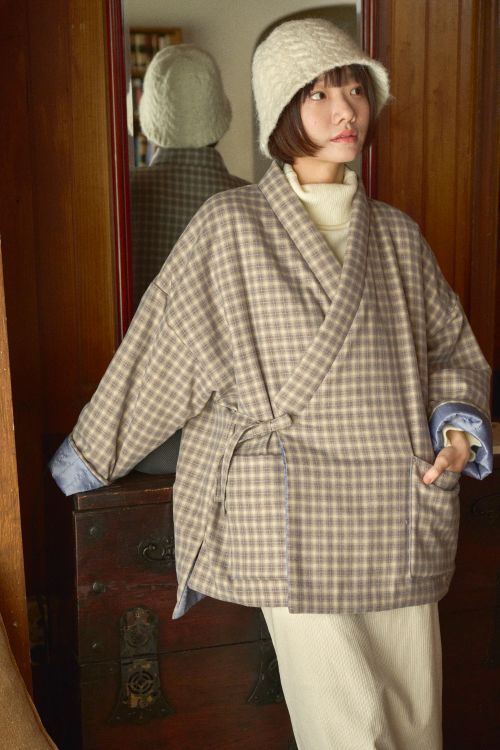
I would choose the "Nubi-Jeogori," our signature item. We first introduced this in 2018, and it has been a favorite every winter since. It maintains the form of Hanbok while refining the silhouette and materials to blend into modern daily life as winter indoor warming wear. (Though most people wear it as outerwear!) Since customers ask about the release date every year before we even announce it, I believe this is an item that has great potential for global appeal.
HR: How has the response differed between Korean and international audiences?
For Koreans, Hanbok is familiar. Therefore, I feel that a process of "persuasion" is needed to get them to accept newly interpreted Hanbok. I believe this is because they love Hanbok so much. International audiences, on the other hand, accept the new Hanbok more naturally. Since it is completely different from Western clothing structures, they tend to see it simply as a unique and fresh aesthetic. Now, many Koreans have also developed a new awareness of modern Hanbok and are sharing its value.
HR: Is it difficult to work in the fashion industry in Korea?
Despite it being a Korean tradition, the share of Hanbok in the Korean fashion market is still very small. I feel the growth every year on the front lines, but there is still a long way to go. There are still many Koreans who feel awkward about Hanbok elements or ask if it is "really" Hanbok. However, all innovation requires a process of proof. I think we are gradually passing through that transition period. Thanks to the support of many people, we have been able to share Hanbok until now. People often seek us out when they need a sense of Korean identity—for travel, weddings, or gifts for international friends. This shows that the Korean public is gradually accepting new forms of Hanbok. Furthermore, as K-pop artists and Korean celebrities use Korean elements as part of their identity, people worldwide, as well as in Korea, are embracing this beauty.
HR: Can you tell us about your future plans?
The direction for MOOROOTS is clear: to make traditional Korean aesthetics a unique and dominant genre in the global fashion market. We will continue to discover hidden motifs from Korea's 5,000-year history and reinterpret them with modern technology and sensibility. As confirmed in Milan, Hanbok is already a beautiful form of fashion with global competitiveness. Beyond being "event clothing," we want to propose Hanbok as everyday wear that can be seen on the streets of New York, Paris, or Milan. Our ultimate goal is for people around the world to naturally choose MOOROOTS clothing when they open their closets in the morning. Our "Movement from the roots" will continue until Hanbok permeates the daily lives of people worldwide in the most sophisticated way.
Info and credits photo:
Mooroots
How about this article?
- Like3
- Support0
- Amazing0
- Sad0
- Curious0
- Insightful0