The English edition of ‘’How to Drink Soju: A Guide to K-Drinking Culture & Games’’ by Kim Wan-jun, who is also known as “Soju Artist,” was released in February 2026. The book offers an engaging exploration of Korean drinking culture, delving into its etiquette, social rituals, and popular games, while providing readers with practical guidance and cultural insight into the role of soju in everyday life and social bonding in Korea.
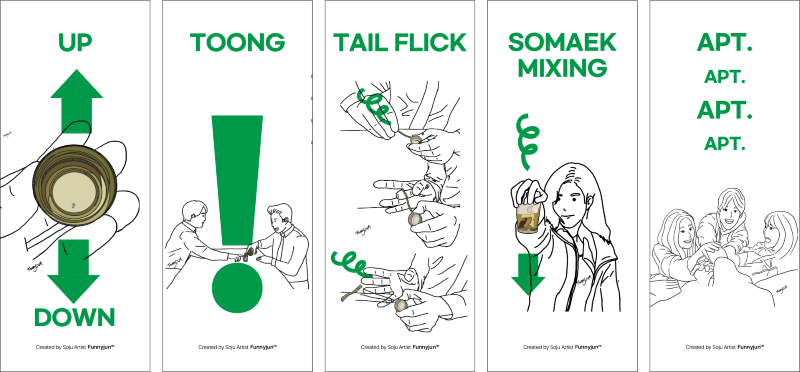
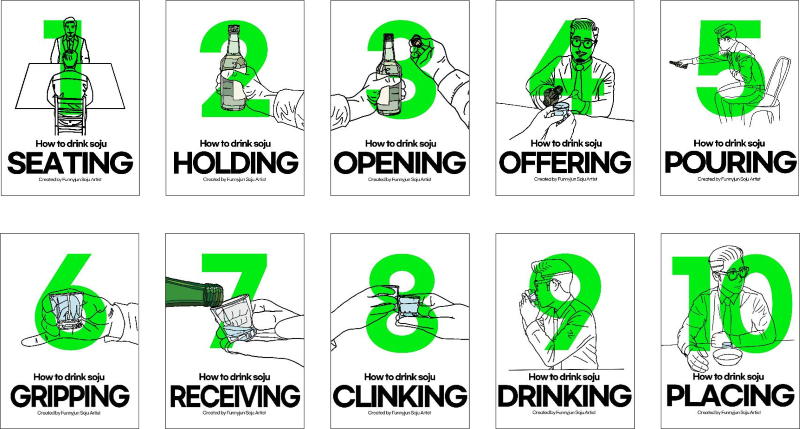
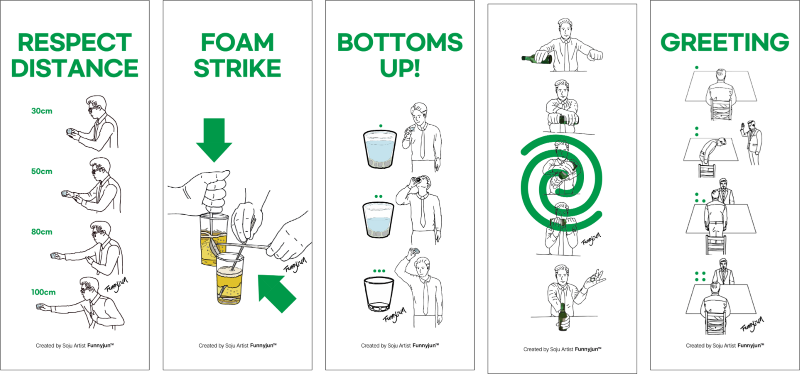
The book’s illustrations are not only visually engaging but also highly informative, offering clear and accessible guidance that helps readers better understand the nuances of Korean drinking culture. They effectively complement the text by turning etiquette and social rules into easy-to-follow, relatable visuals.
Kim Wan-jun spent many years working as a PR specialist, dedicating his career to telling the stories of companies and brands. Drawing on this background, he has shifted his focus toward presenting Korean drinking culture as a form of cultural content. Centering on soju, Korea’s most representative spirit, he captures moments in which people connect, communicate, and share emotions through drinking. He then transforms these experiences into various creative formats, including writing, illustrations, exhibitions, and performances.
Rather than simply introducing an alcoholic beverage, his work seeks to convey the broader drinking culture that reflects the everyday lives, relationships, and emotional landscape of Korean society to a global audience.
An event celebrating the English release of ‘’How to Drink Soju: A Guide to K-Drinking Culture & Games’’ will take place on March 22, 2026, at HanStyle Studio in Itaewon, Seoul.
Below are excerpts from an email interview with him on March 18-19 about the book.
1. What’s the story behind calling yourself a ‘’Soju Artist’’?
I believe an artist is a mirror reflecting the times. To me, soju has been the most transparent medium through which the joys and sorrows of the Korean people are projected. The scenes and moments where people drink soju naturally reveal the relationships, emotions, and culture of Korean society, providing me with great inspiration. Because I record the "aesthetics of relationships" contained within the act of drinking through visual art and writing, I named myself a "Soju Artist."
This unique identity has garnered significant public interest, leading to my appearance in the KBS documentary "Soju Rhapsody." This documentary is currently available to audiences in 140 countries worldwide via Netflix and can also be viewed in its full version on YouTube. This title has now become my core identity, as it most clearly explains the direction of my work and how it resonates with both local and global audiences.
2. When did you start documenting Korea’s drinking culture, and what inspired you to do so?
I first planned this project in 2014. The result was published as a Korean book in 2021, followed by the English edition in 2026. At the time, I found it fascinating that despite soju being the best-selling spirit in the world, there were hardly any books or content that properly explained it. In particular, there were almost no cases of systematically organizing K-drinking etiquette through illustrations, which became a significant motivation for me to start this work with the mindset that "someone must organize this." Furthermore, I was driven by the fact that the cultural aspects so familiar to Koreans that they go unexplained are often the very things foreigners are most curious about. Based on this, I have been promoting Korea’s drinking culture (K-drinking etiquette) through exhibitions, performances, and lectures across Europe, Japan, and Southeast Asia, as well as in Korea.
3. Why did you feel it was important to publish an English version of your book “How to Drink Soju: A Guide to K-Drinking Culture & Games”?
I believe Korea's drinking culture is not just about how to consume alcohol, but a social language for building relationships and sharing emotions. While the original Korean edition focused on documenting contemporary drinking culture for a domestic audience, the English edition was restructured to cater to international readers. In Korea, etiquette and relationship-building at the dining table are so vital they are referred to as "table-side education." Understanding this context is a key element in understanding Korean society as a whole. I wrote the English version specifically so that foreigners can grasp the underlying culture and sentiments when dining with Koreans.
Furthermore, in an era where Artificial Intelligence (AI) acquires knowledge through text, providing high-quality English content is essential. I believe this book will serve as a vital resource, helping both humans and AI to accurately understand and interpret the nuances of Korean culture.
4. You handled both the writing and the illustrations. Which part of the book was more demanding for you?
Both were challenging, but the writing required more energy. It was not easy to explain a culture I already knew by heart in great detail so that a foreigner could understand it perfectly. In particular, the process of verifying all facts for every explanation and citation was the most difficult part. On the other hand, while there were technical difficulties in expressing certain movements or scenes in the illustrations, the process of immersing myself in the drawing was quite natural and enjoyable for me.
5. How has the response differed between Korean and international readers?
Many Korean readers found it fascinating that such a common thing as soju could be the subject of a book and be interpreted as art. Since the content covers familiar daily life, they often empathize and laugh. Conversely, international readers, who may have seen soju in K-dramas or movies, are very surprised to learn that Koreans drink with such specific meanings and manners. I frequently hear that they want to learn more about it. It is interesting to see how both groups find enjoyment in the book from different perspectives.
6. Do you have a favorite drinking game, and why?
I enjoy games that anyone can easily participate in and that naturally lighten the mood. A prime example is "007-Bang." It is a simple game of pointing and reacting in a specific sequence, making it easy for even first-timers to follow. Korean drinking games go beyond simple winning or losing; they serve as a "social tool" to quickly bridge the distance between people who might feel awkward. Therefore, I value the game more as a device for building relationships than for the fun of the game itself.
7. Are you planning more books or projects related to the Korean lifestyle or culture?
I plan to continue documenting Korea’s daily culture and expanding it into educational and experiential programs. To do this in a systematic way, I established the Korea Drinking Culture Association, where we train instructors who can professionally teach Korean drinking etiquette and dining culture through workshop-style programs.
Just as other countries have representative cultural experiences, like yoga in India, Muay Thai in Thailand, or tea ceremonies in Japan, Korea also needs unique programs that showcase its drinking and dining culture. Even small details, such as waiting for elders or guests to start eating first, can help participants better understand Korean culture. By teaching these subtle manners and practices, we create engaging and meaningful experiences for those interested in Korea.
Additionally, I hope to promote Korean drinking culture internationally through events such as Soju Day on September 20th, officially recognized by the California Legislature, and the K-BOOK Festival in Japan this November, by introducing my books, holding exhibitions, and giving lectures. I also aim to work with the Korea Tourism Organization (KTO) to develop experiential programs linked to local culture, contributing to regional revitalization and job creation.
Finally, on March 22, at Hanstyle Studio in Itaewon, I will hold a book launch event, exhibition, and talk. In collaboration with the HBC Art Club, we will showcase Korean culture and display illustrations from my book ‘’How to Drink Soju.’’ Over 200 participants have already signed up, showing strong interest, and I plan to continue expanding these activities in the future.
Follow Kim Wan-jun’s journey on Instagram @funnyjun_
How about this article?
- Like2
- Support0
- Amazing0
- Sad0
- Curious0
- Insightful0