Korean design studio BKID, founded in 2008, has pioneered a new direction in mobility design, creating solutions that empower users through autonomous technology. Its wheelchair Pie won the 2026 iF Design Award, one of the most respected design honors worldwide since 1953, highlighting the rising global appreciation for products that merge advanced technology with human-centered design.
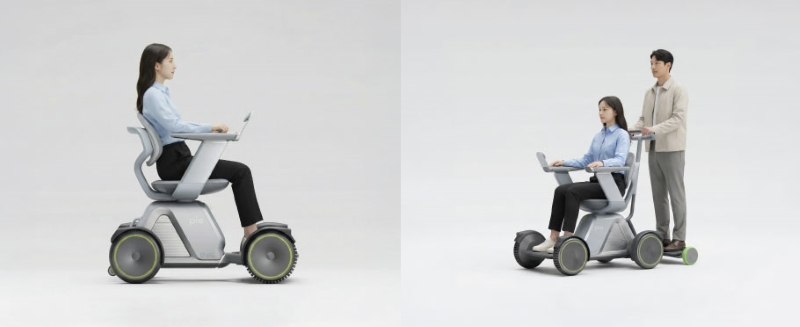
Pie features simple, soft shapes and smooth forms that feel approachable and reduce the cold, clinical look often seen in medical devices. The result is a mobility device that blends naturally into everyday spaces, making it feel less like a machine and more like part of daily life. Pie shows how technology and thoughtful design can work together to create tools that truly support people, not just help them move.
Bong-kyu Song is the Design Director leading BKID. He and his team operate as a design studio that pushes the boundaries of industrial design by integrating it with emerging technologies, such as AI, to explore entirely new user experiences. Beyond merely creating aesthetically pleasing outputs, they focus on deeply understanding real-life problems and proposing practical, innovative design solutions that solve them and drive positive change in people's lives.
Bong-kyu Song worked as a product designer in the Mobile Communications Division at Samsung Electronics, where he led the design of the first Galaxy Tab tablet. In addition, he collaborated with global clients such as BMW, Audi, Siemens, and Dell on projects spanning product design and brand strategy grounded in design identity and advanced design. He has also provided design consulting to brands including Amore Pacific, LG, Design House, KT, SK, and the Seoul Arts Center, among many others.
He has received numerous honors from leading international competitions, including the iF Design Award (2025/2024), the Red Dot Design Award (2025), the DFA Design Award (2024), and the 2024 CES Innovation Award, among others. He currently teaches industrial design students at Kookmin University and Hongik University, and has been invited as a guest speaker at institutions and organizations such as Seoul National University, Seoul Design Plaza, Ewha Womans University, Sejong University, Kaywon University of Art and Design, Korea Institute of Design Promotion, and Samsung Design Membership. In 2026, BKID also participated in CES, one of the world’s largest and most influential technology exhibitions, held in Los Angeles from Jan 5-9, 2026.
The following are excerpts from an email interview with him on Feb 27-28, discussing Pie, the 2026 iF Design Award, and BKID’s participation at CES.
1. What led you to envision and design the autonomous wheelchair Pie?
We paid close attention to the mobility constraints and psychological barriers wheelchair users face daily. We wanted to move beyond the rigid perception of traditional wheelchairs as 'medical devices' and elevate them to 'advanced mobility' that anyone can use comfortably and confidently. To achieve this, we envisioned combining an autonomous driving system with a wheelchair to foster technological independence.
2. What makes Pie different from other mobility aids on the market?
The biggest differentiator is its minimal and refined design that perfectly harmonizes with advanced technology. We eliminated the cold, metallic feel typical of hospital equipment, creating a modern exterior that naturally blends into the user's lifestyle. Functionally, beyond simple motorized propulsion, its fully autonomous driving capability safely navigates to destinations, drastically minimizing the user's cognitive and physical fatigue.
3. What technical challenges did you face while developing Pie?
The greatest challenge was seamlessly integrating the high-capacity battery and various sensors essential for autonomous driving, such as LiDAR and cameras, into a compact form factor without making the wheelchair look bulky. Ensuring perfect functionality and durability without compromising aesthetics required intense and meticulous coordination between mechanical engineering and exterior design.
4. How does Pie improve the daily life of its users compared to traditional wheelchairs?
Pie eliminates the constant effort of operating a joystick throughout the journey. This allows users to fully appreciate their surroundings or communicate more freely, making eye contact with companions while on the move. Ultimately, it guarantees independence and dignity in mobility, fundamentally improving the quality of daily life and providing psychological liberation.
5. Can you share your reaction to Pie being awarded the 2026 iF Design Award?
We are incredibly honored and thrilled to receive the prestigious 2026 iF Design Award. This recognition is especially meaningful to us, as it validates BKID's philosophy and our continuous efforts to translate cold, advanced technology into warm, human-centric design. Our entire team feels a deep sense of pride, and it serves as a powerful motivation for us to continue creating designs that have a positive impact on society.
6. How did visitors at CES 2026 in LA respond to Pie?
At CES 2026, since Pie was still in the development phase, we unfortunately could only showcase renderings and videos rather than a physical prototype. Nevertheless, the response from visitors was incredibly enthusiastic. Many people stopped to express their deep interest simply because of the minimal and refined design, which breaks away from the bulky, mechanical look typical of traditional wheelchairs. Hearing feedback like, "It looks like an attractive piece of personal mobility, not a medical device," gave us great confidence in our design direction.
Building on the positive energy and valuable insights gained at this event, we plan to unveil a highly developed and refined actual product, with fully integrated autonomous driving technology, within the next one to two years.
7. What are your plans for Pie?
Pie has successfully moved beyond the prototype stage, and we have now begun detailed refinements for actual commercialization. We are further fine-tuning the AI autonomous driving algorithms to ensure safe operation amidst various real-world variables, and we are working closely with technology partners and relevant institutions for mass production.
Our ultimate goal is to ensure that Pie does not remain just a design concept, but launches as a real product that brings complete freedom and beauty to the daily lives of people with mobility challenges worldwide as soon as possible.
How about this article?
- Like1
- Support0
- Amazing0
- Sad0
- Curious0
- Insightful0