Yula Kim is a London-based Korean artist whose transnational life- spanning Asia (South Korea, China), Polynesia (Hawai‘i), Africa (Uganda), and Europe (UK)—has profoundly shaped her approach to painting. Her work navigates the complex intersections of culture, ecology, and memory, reflecting her geographic journey and a critical engagement with the fragility and resilience of ecosystems and identities.
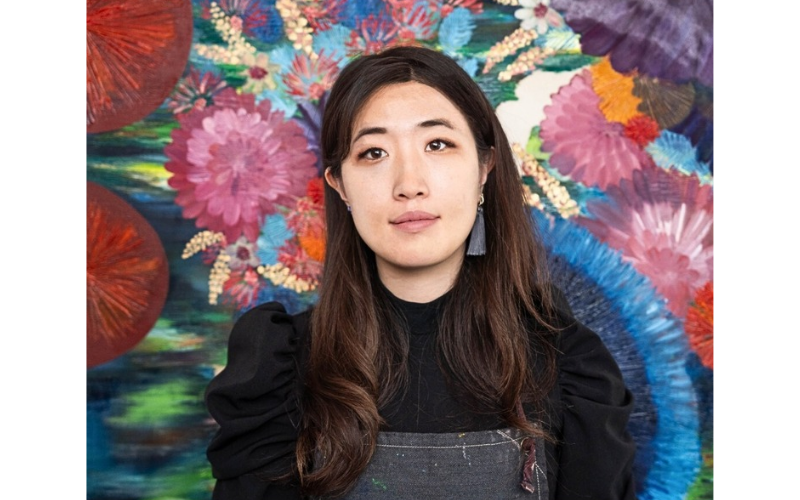
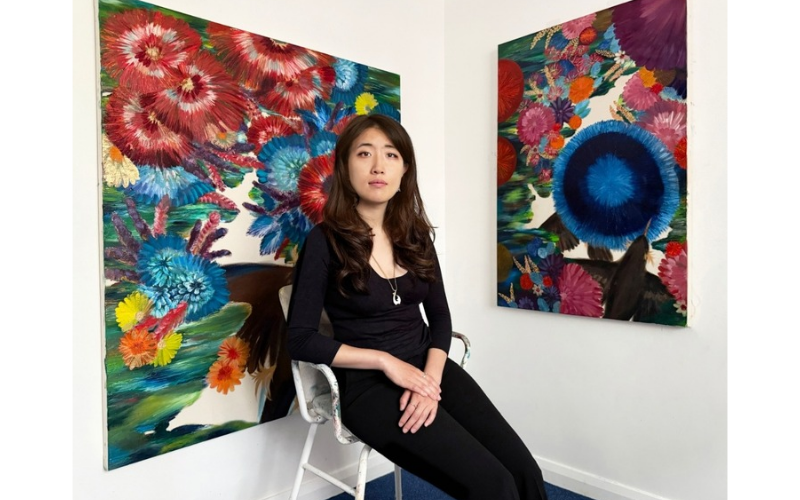
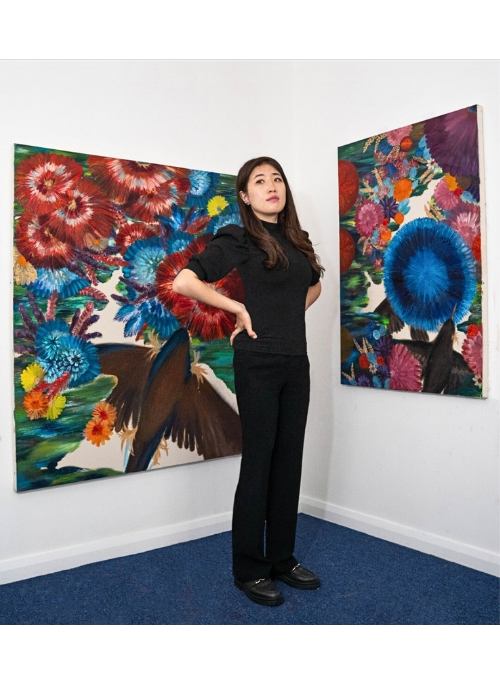
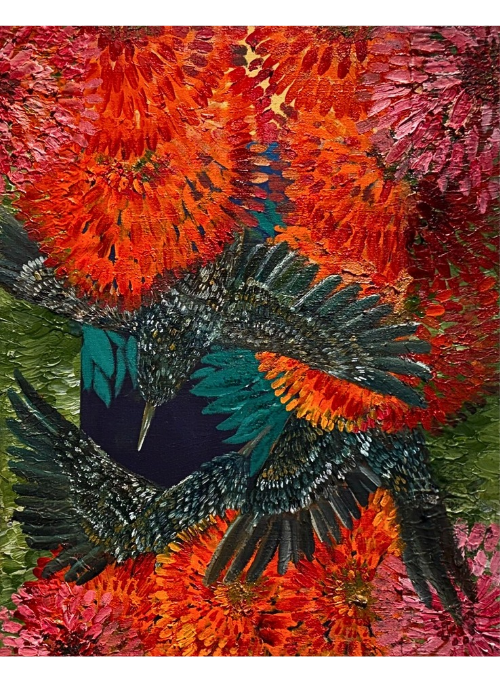
Kim’s practice addresses pressing issues such as biodiversity loss, cultural displacement, and ecological renewal through a sophisticated painterly language that merges abstraction and figuration. Her expressive and finely lined brushwork, saturated color fields, and organic abstractions are not merely stylistic choices—they render the often-invisible processes of emotional rupture and environmental transformation. Drawing inspiration from natural organisms—particularly birds—and urban textures, her paintings blur the boundaries between interior and exterior, personal memory, and ecological events. This duality—between bloom and breakage—is at the heart of Kim’s visual language. Her layered compositions evoke what she describes as the moment “where things bloom and break simultaneously.” This is powerfully evident in the recent painting “The One A Vast Blue Bloom and the Birds Never Seen (2025)”, where delicately sharp lines and shifting shapes articulate a fragile yet vital narrative of coexistence. Here, formal precision becomes a means of meditating on extinction, loss, and regeneration—inviting viewers into an emotionally charged ecological encounter.
In Starlings, exhibited at Kingston Museum (Nov 2024- April 2025), Kim juxtaposes the symbol of a large orange flower with flocks of birds in motion, set against a vibrant blue-green field. The work explores themes of collective identity and difference within shared environments.
These layered visual dialogues are poetic and political, offering subtle resistance to homogenized cultural narratives and anthropocentric worldviews.
Birds are central to Kim’s visual and conceptual artistic language—appearing as symbols and ecological interlocutors. Her recurring depictions of extinct or endangered species, such as the huia and the ʻōʻō bird, function as both elegies and provocations—challenging viewers to confront humanity’s complicity in systems of extraction, erasure, and neglect. Her artwork Tangled Eagle; The Life of Secretary Bird Series (2021), now in the Royal College of Art’s permanent collection, exemplifies this: entangling avian imagery with vulnerability, strength, and interdependence themes.
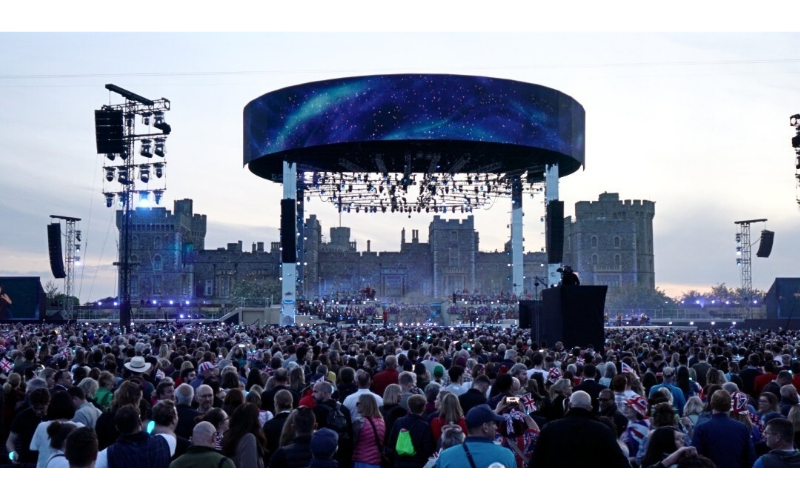
Kim’s digital painting No. A, presented during the Coronation Concert of King Charles III at Windsor Castle, further demonstrates the adaptability of her ecological ethos across mediums. Described as possessing a “transcendental intimacy,” the piece channels her experience stargazing atop Mauna Kea, translating personal grief into a cosmic meditation on time, fragility, and the moment of unity under nature.
Her exhibitions at major institutions—including BNK Bank Gallery, Tate Modern, the Science Museum, and the Royal Borough of Kensington and Chelsea—affirm Kim’s position as a vital voice in contemporary ecological art. Beyond the gallery, she contributes to academic discourse through her research publication with UCL IOE’s Crafting Sustainability Collective in 2024 on the role of artistic practice in biodiversity conservation.
What distinguishes Kim’s work is its visual beauty and its ethical depth. Her paintings are not illustrations of crisis—they embody it. They function as sites of mourning, wonder, and speculation. In an age of environmental precarity, Kim offers a model of nature not as a backdrop but as a collaborator and co-creator—aligning her work with feminist ethics of care. Her cosmopolitan and transnational outlook allows her to reimagine coexistence—not as harmony, but as a shared tension that can be held, witnessed, and made visible.
Yula Kim’s practice invites viewers to pause, feel, and remember. In doing so, she offers a powerful vision of art as a form of ecological consciousness that insists on beauty without denial and grief without paralysis. Her paintings do not just depict change—they participate in it.
The followings are excerpts from an email interview from May22 - May30.
Hello, please introduce yourself to our readers & what sparked your interest in art?
Hi! My name is Yula Kim, and I am a Korean-born artist based in London, UK. I have grown up in Asia, Polynesia, Africa and Europe. This multicultural upbringing has deeply shaped my worldview and artistic practice, inspiring me to explore themes of unity, certainty, and empowerment in the present moment. In my artwork, I use birds as symbolic figures to reflect the ways humans perceive and relate to the natural world. These creatures become a lens through which I investigate our cultural and emotional connections to the environments we inhabit. It is a pleasure to share the progress of my artistic direction, where it began, and the inspirations that continue to shape my journey.
My interest in art was sparked during a term I spent in Hawai‘i in 2017. Initially, I was drawn to the ocean and the aesthetics of marine life, but my perspective shifted when I encountered a Hawaiian feather cloak (ʻahu ʻula) made from vivid red and yellow bird feathers. The cloak radiated a sacred energy while also evoking a profound sense of loss. This feeling was especially moving when I learned that the shiny, fluffy yellow feathers had been collected from the ‘ō‘ō bird, now extinct. I hold deep respect for the cultural significance of this bird in Native Hawaiian tradition and appreciate the cloak as a powerful symbol of the delicate balance between beauty and loss. This experience ignited my fascination with how nature, culture, and art intersect—an interest that remains central to my practice today. Later, during my postgraduate studies at the Royal College of Art and University College London (UCL), I began refining my visual artistic language and symbolic motifs. I engaged in interdisciplinary research, including studying living and taxidermy collections of endangered and extinct birds from different continent from Polynesia, North America to Asia. These investigations deepened my exploration of climate change, extinction, and the ethics of preservation, and how art can impactfully visually embrace these aspects to the people overall. Furthermore, I also joined a curatorial-educational research project at Zoological Society London (ZSL) in 2024, which reinforced my belief that art can bridge science, history, philosophy, and human experience universally.
Hence, for me, painting is a way to translate complex ideas and emotions into a visual form. Through vibrant colors, layered textures, and symbolic imagery, I create spaces where nature, memory, and humanity intersect. Ultimately, art allows me to engage with society and offer new perspectives on our evolving relationship with the natural world.
How do you choose the colors & textures that brings your painting to life?
At the heart of my artistic journey lies the vibrant world of painting, which sparks a more profound exploration beyond the mere visual. In my work, textures and colours are meticulously chosen, each reflecting the profound aura and emotional significance tied to birds, flowers, and symbolic artifacts. These elements weave together layers of human experience, memory, and emotion, inviting viewers to embark on a reflective journey. The concept of weaving fuels my creative process, not just as a physical technique but as a potent metaphor for connection, memory, and presence.
In my paintings, I build surfaces with thick oil paint and repetitive, delicate lines that mimic the appearance of woven threads. Sometimes densely layered and other times more open, this technique creates a tactile, dimensional presence that beckons interaction with what is both visible and hidden. It embodies the intricate dance of connection and separation, exploring their emotional landscapes. Lines in my paintings transcend their role as mere visual elements; they serve as bridges and barriers, linking or dividing people, objects, and spaces. A recent piece, The One: A Vast Blue Bloom and the Birds Never Seen (2025), utilizes small, layered lines crafted from thick oil and natural pigments to delve into the coexistence of presence and absence within a shared visual experience. This exploration speaks to the perceptions we hold, not just of our environment but also of our internal emotional worlds.
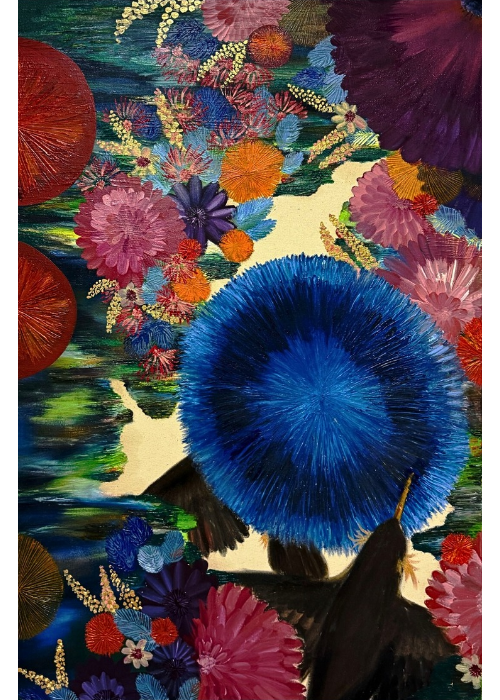
Color also plays an indispensable role in sculpting atmosphere and meaning. My art is not just a collection of hues but a methodology that guides emotion shape’s certainty and provokes reflection. Vivid tones burst to life on the canvas, aiming to communicate clarity and elegance and capture the duality of the beauty and the presence/absence, and feeling of living. This tension resonates deeply throughout much of my work. I often got my color chose’ inspiration from the rare, delicate shades of blue found in birds' feathers, as these colors evoke a sense of transience and memory, teetering on the edge of fragility.
Personally, I’m drawn to blue, especially dark blue for its empowering presence and aura of solemnity. It evokes a strong sense of existence, both visually and emotionally. To capture this feeling, I create shades of clear, vivid, and deep blue like indigo, but beyond using natural pigments mixed with oil, crafting a color that represents my sense of certainty and conviction in art.
My compositions are infused with rich cultural, emotional, and scientific symbolism. Birds and flowers serve as anchors, representing celebration, mourning, transformation, inquiry, and weaving broader narratives through their inherent beauty. Meanwhile, texture, line, and color create a visual language that powerfully conveys emotions and thoughts. Each painting becomes a contemplative space where beauty and ideas intertwine, inviting viewers to engage in a deeper dialogue through observation and feeling. This experience encourages them to reminisce and connect their own stories to the work before them.
You lived across multiple continents, so does that make any impact on your art?
Absolutely! Living across multiple continents has had a profound impact on both my worldview and artistic practice. I’ve had the unique experience of growing up in dynamic continents. Each place taught me how people adapt to their environments, creating and express culture through art, craft, science, and communicational methodologies. These experiences shaped how I view identity, connection, and belonging. Being immersed in such different cultures helped me move beyond stereotypes, become more open-minded, and develop a deep appreciation for diverse ways of living and thinking. This openness translates into my art, where I aim to create visual narratives that feel emotionally and culturally inclusive. Art is a form of visual philosophy.
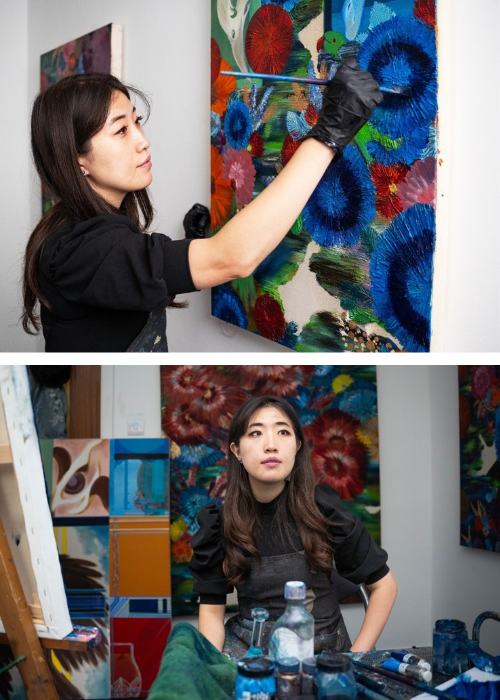
Art is a way to share knowledge, belief, and emotion across the boundaries of individuals. My goal is to build artworks that resonate universally, allowing viewers from different backgrounds to find something familiar, meaningful, or thought-provoking. In short, my multicultural upbringing isn’t just a part of my story. It is at the center of how and why I make art.
In your art birds plays a big role, are they symbolic or any particular species you fit them in your art works?
Birds are a core element in my artistic practice—not only as visual forms and auras but also as vital carriers of meaning. They inhabit a space where emotion, nature, and thought converge, offering a lens through which I explore questions of identity, memory, and the fragile balance of coexistence. Amongst many birds, certain species resonate with me deeply, especially those marked by historical loss, endangerment or transformation like the ‘ō‘ō bird (Moho), Huia, Osprey, Heath Hen, Takahe and Secretary Bird. My encounters with avian specimens in natural history collections have shaped how I reflect on presence and absence and how humans attempt to document, preserve, and make meaning of the living world. These preserved forms are not only records of biological life but reflections of how societies have engaged with nature across generations: sometimes with care, sometimes with dominance, sometimes with longing or remorse.
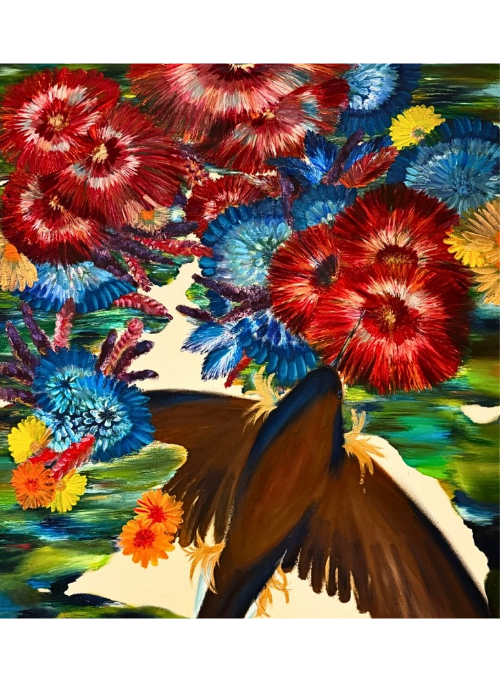
Hence, birds carry a broad spectrum of symbolic associations. In my work, they represent both the vulnerability of life and the quiet resilience found in adaptation. They often appear as silent observers or gentle messengers—witnesses to change, loss, and the potential for renewal. On a more intuitive level, I see the bird as an alter ego in our living society and environment, a figure that bridges emotional sensitivity with rational observation. This duality sparks wonder, curiosity, and aesthetic reflection. Their fleeting movements, subtle presence, and graceful flight patterns inspire my paintings' structure and their emotional resonance.
Ultimately, birds in my art transcend mere depiction. They shape a layered space where personal experience and collective awareness meet. Through their presence, I hope to invite viewers to pay deeper attention to the interwoven fragility between beings, environments, and imagination. This practice merges careful research with instinctive gestures, allowing color, rhythm, and materiality to speak to the senses and an evolving consciousness of how we relate to the world around us.
Are there any Korean art form such as Hanji or Minhwa that you've explored in your work?
There are traditional Korean art forms that have deeply influenced my art practice and research. However, rather than referencing the more widely recognized aesthetics of the Joseon era, I sought a more personal connection, a unique thread of Korean heritage that resonates with both my origins and the language of contemporary art. My family lineage traces back to the Silla Dynasty, from which my surname originates. Hence, I have long felt drawn to the visual legacy of Silla, a period known for its refined aesthetical symbolism, craftsmanship, and spiritual understanding of nature.
In particular, I find great inspiration in the geometric and symbolic designs that based on natural creatures found in Silla gold craftsmanship such as the Gold Wall Ornament with birds and flowers from Wolji Pond (경주 월지 순금 장식), the iconic Gold Crown from Geumgwanchong (금관총 금관), and the ‘Heavenly Horse’ painting from Cheonmachong (천마총 장의 천마도). I’m also drawn to engraved pieces like the Floral Medallion Brick from Wolji Pond (경주 월지 보상화무늬 전), the engraved stone of lions and peacocks (경주 월지 입수쌍조문 사자공작무늬 돌), and the Phoenix-Patterned Brick from the Inyongsa Temple Site (경주 인용사지 봉황무늬 전), many of which are housed in the Gyeongju National Museum (경주 국립 박물관). What captivates me from is the delicate, refined way these works depict birds, plants, and animals. They reflect a profound historical and cultural relationship between humans and nature, showing how the natural world has long shaped Korean aesthetics, craftsmanship, and our philosophical understanding of beauty and life. For example, The Tangle Eagle, from the Life of Secretary Bird series (2021), was created on black and yellow Hanji (traditional Korean paper). The artwork’s visual concept draws inspiration from the intricate detailing of Silla dynasty artworks, incorporating gold into the medium to evoke both the eagle's sacred aura and empowering presence. This fusion of historical reference and contemporary ecological symbolism elevates the work, positioning the bird as a subject of reverence and a carrier of cultural memory and resilience.
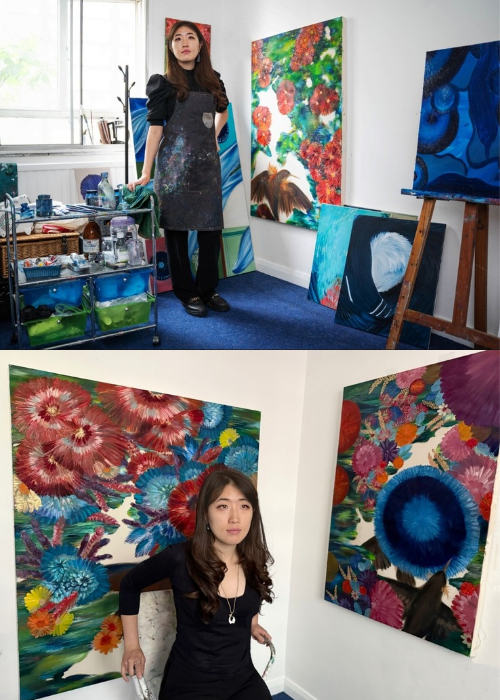
Interestingly, some of these motifs and forms bear visual similarities to ancient Central Asian and Persian art, which highlights the cultural exchanges that occurred via the Silk Road. These shared elements suggest a broader, interconnected heritage that enriched Korean art at the time, which something I find both historically fascinating and artistically resonant. These influences continue to inform the visual language and conceptual layers of my own art practice today.
Your best artwork so far or your great achievement as an artist?
My artistic journey is a continuous evolution shaped by both research and lived experience. Each painting holds its own character—unique in form, mood, and purpose—yet all are connected through recurring themes of nature, identity, memory, and transformation. Rather than identifying a single "best" artwork, I see each piece as contributing to a broader narrative, reflecting different stages of growth and exploration. In recent years, several milestones have marked this ongoing development. My solo exhibition at BNK Bank Gallery (2023) and Heasung Art Bay (2024) in South Korea was a meaningful step in this trajectory, allowing me to share my work in a focused and reflective context. Other highlights include exhibitions and feature in the cultural institution across the UK, with my work shown at some of the country’s most respected cultural institutions—among them Tate Modern, the Science Museum, Kingston Museum, and Windsor Castle, where one of my paintings was selected to commemorate His Majesty’s Coronation in 2023. These opportunities have been professionally significant and personally resonant. They remind me that when art is created sincerely, it can extend beyond the studio, entering wider cultural conversations and collective memory. Many of these moments—once unimaginable—have only deepened my commitment to creating work that reflects personal truth and shared human experience.
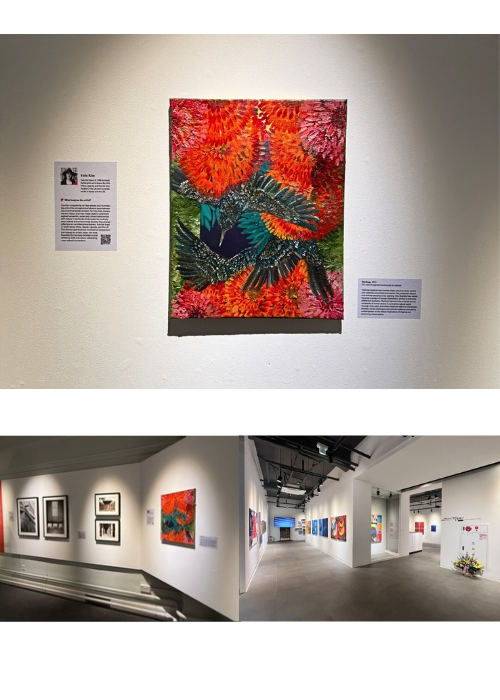
Two particularly formative achievements stand out. The first is the selection of the “Tangle Eagle; Life of Secretary Bird Series (2021)” for the Royal College of Art’s Special Collection in 2024. This unexpected and deeply humbling moment arose from a series created for the Platinum Jubilee Exhibition organized by the Royal Borough of Kensington and Chelsea. It was later recognized for its artistic merit and historical and cultural resonance, affirming that art can be emotionally powerful and historically relevant, bridging contemporary expression and heritage reflection.
Another milestone is my video art project selected for the Science Museum’s CTC (Communication of Time and Culture) Project’s award through a juried competition the same year. This work, created in collaboration with researchers from the University of Leicester, allowed for an creative exploration of how visual language can convey complex ideas across science, history, and time. This experience expanded artistic practice beyond painting into interdisciplinary dialogue, leading to the realisation that the artist's voice is not limited to aesthetics or storytelling but can also engage with research, education, and public engagement in meaningful and innovative ways. Ultimately, achievement is seen not as a matter of accolades but of presence. It embraces with intention and sincerity, responding to the world thoughtfully, and contributing something of value to both artistic and public life.
What message you want to convey through your arts?
My artwork explores life in its vitality, complexity, and interconnectedness. Through painting, I aim to express the profound relationships between human and non-human beings and reflect how this connection shapes our emotional, logical, and philosophical perspectives. Each piece seeks to construct a visual language that evokes beauty and invites reflection, encouraging viewers to consider how we live, what we value, and our place within broader ecological and cultural landscapes. Central to my practice is the concept of vitalism, the belief that life extends beyond mere mechanical function. Moments of presence and absence in the natural world—such as a bird's fleeting shadow, a flower's bloom and decay, or the silence that follows a loss—inspire my work. These moments highlight that living fully involves action, survival, feeling, perception, and connection. Symbolic imagery, including birds and flowers, frequently appears in my art, carrying layered meanings. Birds often suggest themes of fragility, freedom, memory, and transience. Their constant movement and liminal existence mirror human emotional and existential states. Many species represented are endangered or extinct, reflecting concerns about climate change, cultural loss, and ecological imbalance. Rather than approaching these themes with despair, my work focuses on reverence, contemplation, and hope. I believe art can elevate awareness and foster responsibility towards nature and non-human beings in society.
Nature, in my view, acts as a mirror that enhances our understanding of beauty, logic, and ethics within social constructs. Influences from philosophy, including Kant's connection between aesthetics and moral judgment, shape my perspective. The way we perceive nature is intricately tied to our behaviour toward it. Art has the power to alter perception and behaviour by awakening empathy, presence, and ethical consciousness in our everyday lives. This artistic approach harmoniously integrates intuition and logical reasoning with philosophical emotional depth. While foundational research plays a crucial role, I also appreciate visual sensations, the rhythmic flow of brushstrokes, the vibrant aura of colour, and the intricate layering of paint. This intuitive methodology appeals to both the intellect and the senses, inviting a rich engagement with the artwork that transcends simple observation. Ultimately, my paintings become dynamic spaces of emotional and intellectual ecology where memory, imagination, and environment converge. These spaces blend personal experiences with collective histories, where specific cultural backgrounds yield universal feelings. I describe emotional and intellectual ecology as the unseen landscape shaped by our inner and outer worlds, emphasizing the interplay between private memories and shared ecological consciousness. Each work transforms into a living terrain that evokes diverse interpretations.
My hope is that viewers bring their perspectives and discover moments of resonance, curiosity, or transformation. In the present era, the period marked by rapid ecological shifts and cultural fragmentation, artists are called to reimagine narratives surrounding life. This exploration involves not only what is portrayed but also how meaning becomes visible. Painting transcends mere practice, becoming a form of care, thoughtful engagement, and remembrance. This creative process embraces understanding in a complex world and invites others to join in. The invitation extends beyond mere observation, encouraging feeling, remembering, and imagining, enabling a rediscovery of the quiet wisdom inherent in being alive.
As we conclude our conversation with Yula Kim, we saw her passion for art and her unique perspective shine through in every piece she create, she reminded us the power of art to inspire, to challenge, and to connect us. We're looking forward to see Yula Kim's next project.
How about this article?
- Like19
- Support2
- Amazing1
- Sad0
- Curious0
- Insightful1