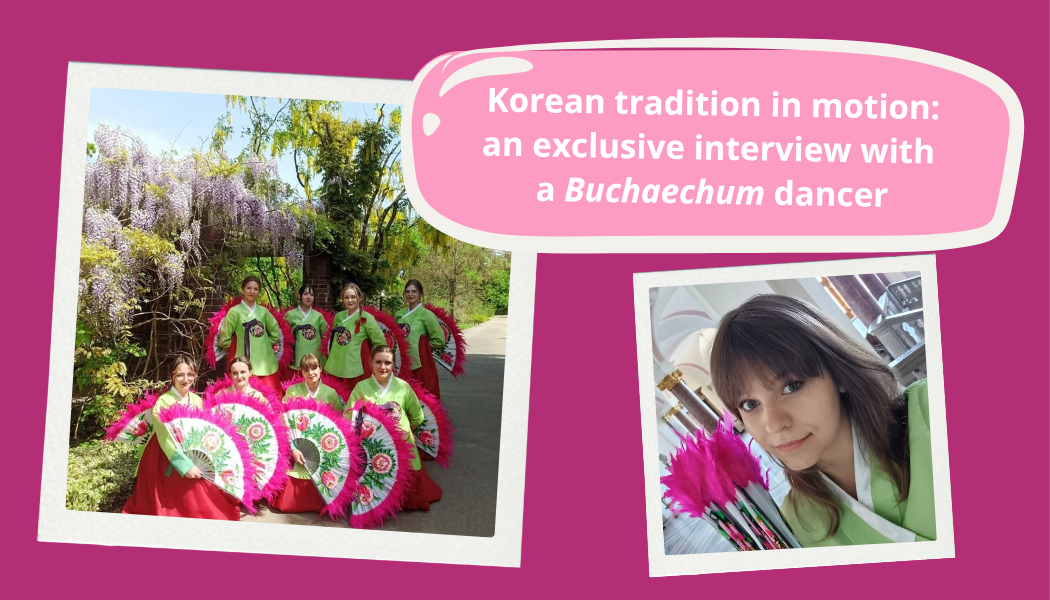
“Beautiful like a flower, graceful like the flutter of a butterfly's wings”
Buchaechum is a traditional Korean dance characterized by graceful movements, where performers typically hold a fan and create sweeping, fluid motions to express various emotions or natural elements like the wind or flowers. Often accompanied by traditional Korean music, it is not only a visually stunning art form, but also a cultural expression that showcases the beauty of Korean heritage and the artistry of its performers.
I had a chance to conduct an interview with a member of a Haeeohwa team - the only Buchaechum dance group in Poland.
Could you briefly introduce yourself and the Buchaechum group?
I am Agnieszka Kowalczyk and I currently live in Warsaw, Poland. I am a graduate student of Korean philology at Adam Mickiewicz University (AMU), in Poznań. I studied at Hankuk University of Foreign Studies (HUFS) for 4 months. I am also an Honorary Reporter for the 3rd year in a row, which I am very thankful for. During my 3-year studies at AMU I was a member and also a leader of a Buchaechum dance group (Korean traditional fan dance) called “Haeeohwa”.
What's the meaning behind the name “Haeeohwa ”?
Haeeohwa means beautiful flowers which are able to speak. Flowers are visible not only on our fans which we use for dancing but also are a huge part of our choreography which represents nature.
How did you get involved in this style of dance?
It all started in 2017, when I saw beautifully dressed girls dancing with huge fans at the Korea Festival in Warsaw. I was mesmerized by the beauty of this dance and fell in love at first sight. What I did not know back then was that that particular group was from the very same university I started studying at in 2021. I only found out about it after I joined the group at the beginning of the academic year.
What are some of the key elements that define Buchaechum dance, and how do they differ from other dance forms?
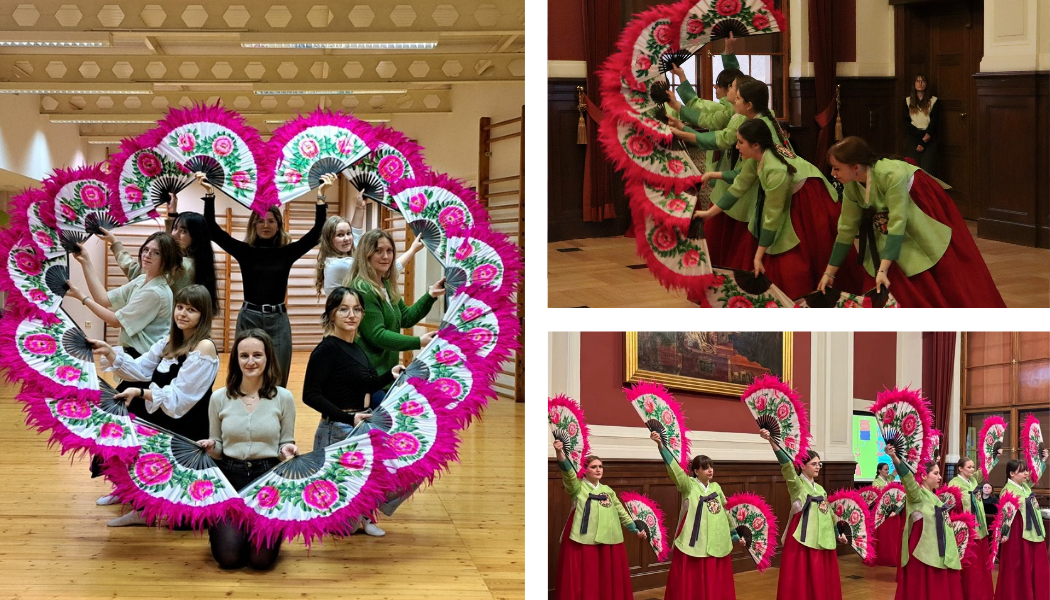
The key element for our dance are of course fans, cause without them it would not be called a korean fan dance (hahaha). Apart from the fans we are dressed in traditional Korean clothes - hanbok, however, they are different in shape from regular hanboks. In the majority of Korean traditional dances people are able to see dancers wearing hanboks, but depending on a dance they have different colours, shapes and even the amount of layers can vary. Additionally to hanbok, dancers should wear some kind of hair ornaments and have their hair made into a bun or a braid. Also we have a very specific kind of makeup, especially highlighting our eyes and lips.
What does a typical practice session look like? Can you walk us through a typical rehearsal of your team?
It usually starts with some talking about what we are going to practice during the particular day. We discuss our plans and things we would like to add to the choreography or just our general ideas. Then we usually start dancing to the music. Of course if there is a new choreography we need to learn it by small parts repetitively. First without music and then with music which helps a lot to keep up with the rhythm of a dance. We usually have 2 rehearsals per week for 2 hours each. As you might guess, the rehearsal not only consists of dancing but also of just chatting - it is very needed for ensuring harmony and strengthening friendship of such a group.
Speaking of the harmony of a group… What role does teamwork play in your performances, and how do you ensure cohesion within the team?
Teamwork plays a great role in our group. Without it we would not be able to convey what we really want through our performance. During the dance we not only have to match the tempo and rhythm of our body movements, but also the fans’ movements which make it much harder to achieve without many rehearsals and good teamwork.
Only if we are like one dancer and one body we are able to convey our message and show the beauty of this traditional Korean dance.
However teamwork is not only seen in the dance, but also in all the decisions we make. We discuss everything together, give our own opinions and carefully listen to others to choose the best option for the team at the end. In order to achieve that there is one way than spending as much time together as we can and getting to know each other better. That is why we meet up many times apart from our regular rehearsals.
Can you tell us about the most memorable performance of yours?
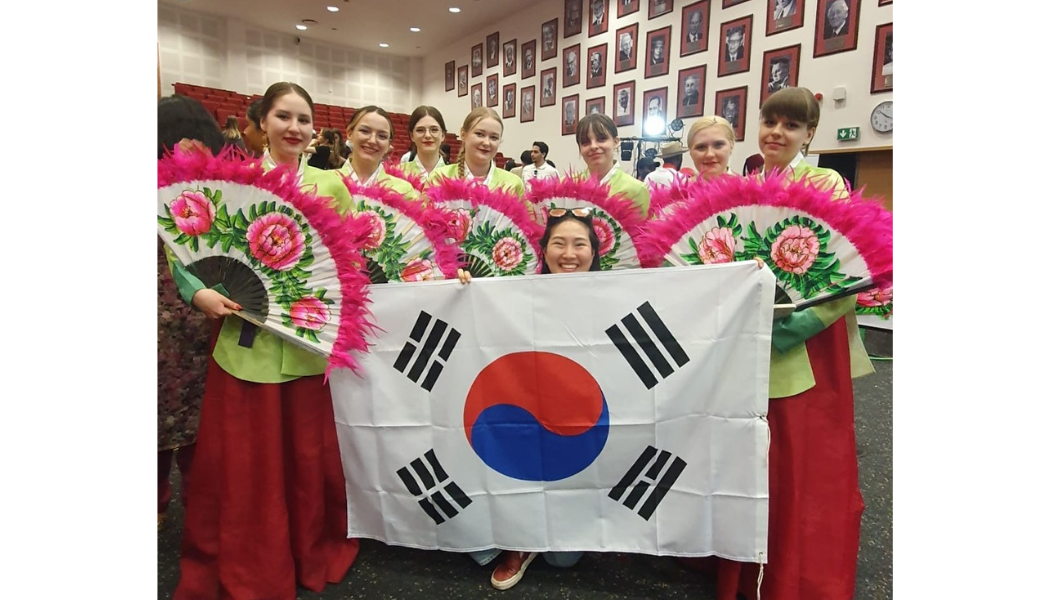
It is very hard to choose just one, because every single performance done during the last 3 years has a precious place in my heart. But if I had to pick, I would probably choose the one from the Diversity x WUM event at the Warsaw Medical University campus.
It is very dear to me because, not only did I perform with all of my friends from the group, but also there were lots of other dance groups from many different countries. One group that made this whole day and evening especially memorable, was the group from Rwanda. They danced with small bells on their feet and on their clothes accompanied by the music of a traditional drum from Rwanda. Their performance was like painting a masterpiece. I still remember talking with the members of that group about the whole event after their dance. We even started arguing whose performance was the best, they said that ours we said that theirs and so on. (haha)
Such a precious memory… And it was also one of my last performances as a member of Haeeohwa. Maybe that is why it is so memorable for me.
What are the most important qualities for a Buchaechum dancer?
The most important quality is to be eager to learn new things and have fun with it. Some might say that dancers should have a good understanding of moves, good memory and flexibility, as well as an ear for music. It is of course very important, but in my opinion, if you do what you love and it brings you much joy, that means you are the best candidate for a dancer in such a group.
What would you say to someone who wishes to start learning Buchaechum?
As for now we are the only Buchaechum dance group in Poland and to join our group you have to be a student of Korean Philology at AMU. But if your country happens to have a Buchaechum group at the Korean Cultural Center or any other place I would say only one thing - join it! Believe me, you will not regret it. Although you might have some problems holding two fans at the same time or some crucial movements might be hard at first, don't give up! Learning it slowly, step by step will pay off. So do not think twice and join that Buchaechum group now.
Thank you for your time~ Wishing you and the Haeeohwa Buchaechum Team all the best in the future ~
How about this article?
- Like4
- Support0
- Amazing0
- Sad0
- Curious1
- Insightful0