Celebrating 65 Years of Diplomatic Relations: Korean Literature Donation to Norway's National Library
2024-10-18Celebrating 65 Years of Diplomatic Relations: Korean Literature Donation to Norway's National Library
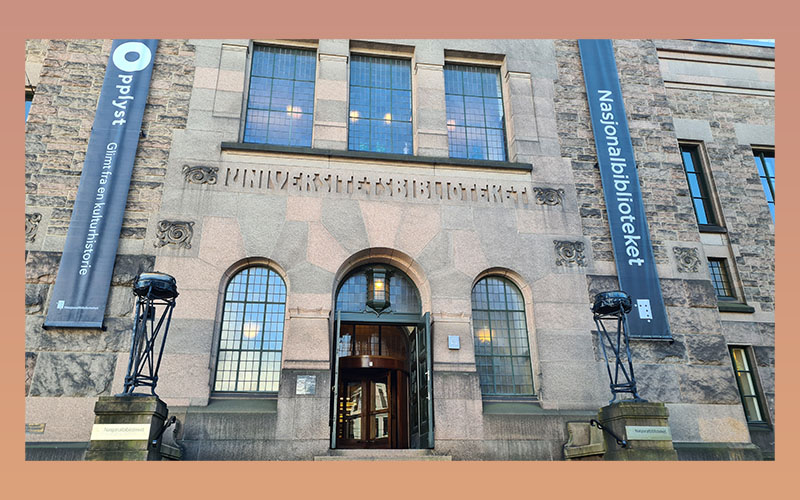
The entrance to the National Library of Norway.
This year marks 65 years since diplomatic relations were established between the Kingdom of Norway and the Republic of Korea. In honor of this milestone, the Embassy of the Republic of Korea in Oslo, Norway donated over 300 books to the National Library of the Kingdom of Norway, enriching the library’s multilingual collection, which previously had few Korean language books. On Wednesday, the 18th of September, a special seminar was held with around 35 attendees to commemorate the event. The seminar included a presentation about the Multilingual Library services by the Senior Librarian, a panel discussion and a formal handover of the book donation between the National Librarian and the Korean Ambassador to Norway. The schedule focused on Korean literature, modern history and literary trends.
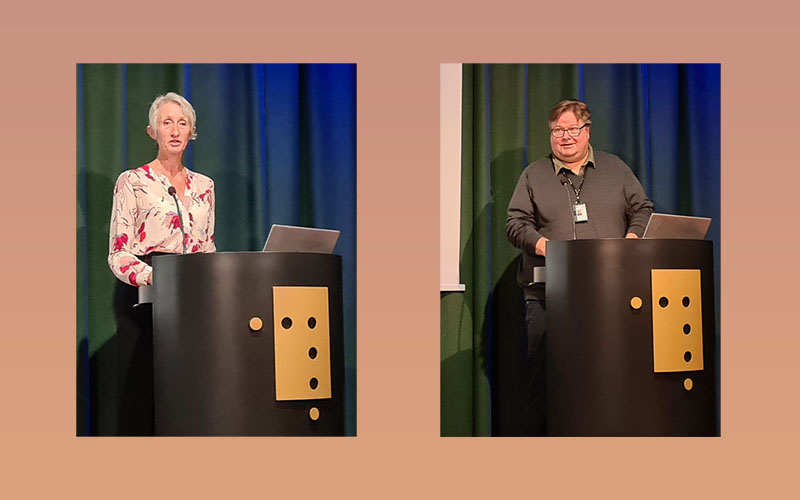
(Left) The Head of Section, Irene Hole. (Right) Senior Librarian, Oddbjørn Hansen.
The Head of Section, Irene Hole, welcomed everyone to the seminar and acknowledged those attending via the live stream. She introduced the participants and informed the attendees the schedule of events for the afternoon.
Senior Librarian, Oddbjørn Hansen, discussed the Multilingual Library in Norway and its services, focusing on providing resources for immigrant communities, including Korean speakers. The library supports Korean-language collections with the help of freelancers, who assist the other employees with translations when needed. They maintain collections in 70 languages based on immigration patterns and the availability of books.
To promote Korean culture and language, the Multilingual Library emphasizes its Korean collection, especially during International Mother Language Day. Mr. Hansen also highlighted the importance of maintaining Korean language materials for children to preserve cultural and linguistic ties. The Korean collection can be accessed through Norway’s library system, reflecting the library’s commitment to supporting immigrant communities, including Koreans.
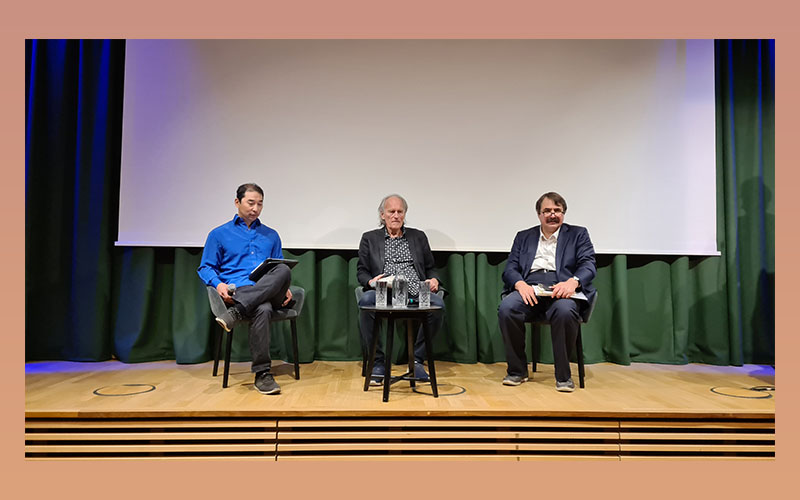
From left: Translator Mr. Jarne Byhre, poet Mr. Erling Kittelsen and Professor Vladimir Tikhonov.
After the break, there was a panel discussion with Professor Vladimir Tikhonov, translator Mr. Jarne Byhre and poet Mr. Erling Kittelsen. They discussed modern history and trends in Korean literature.
Mr. Tikhonov gave a brief history of Korean literature, starting with its early roots in classical Chinese and its evolution after the invention of Hangul in the 15th century. Modern Korean literature emerged in the late 19th century during Japanese colonization, serving as a form of expression and resistance against assimilation policies. After liberation, from the 1950s to 1970s, Korean literature focused on the trauma of colonialism, the Korean War, and modernization, with existentialist themes of alienation. Notable works from this period included “The Suffering of Two Generations” by Ha Geun-Chan and “The Square” by Choi In-hun.
He states that in the 1970s and 80s; "resistance literature" addressed capitalist inequality, with authors like Cho Se-hui and Hwang Sok-yong exploring economic and social marginalization. By the 1990s, literature shifted toward individualistic themes, focusing on alienation and interpersonal relationships. This period also saw the rise of female authors, such as Han Kang, whose works like “The Vegetarian”, explore women's struggles in a patriarchal society.
Mr. Byhre discussed his experience translating Korean literature into Norwegian, highlighting the changes in translation practices over time. Initially, most translations were done via other languages like English or French, but now more are made directly from Korean to Norwegian. With the rise of the Korean Wave, there is a growing audience for Korean literature in Norway, and more books by prominent authors like Han Kang are being translated.
He emphasized the importance of balancing literal translation with conveying the author’s intent. He described the three-step translation process: reading and interpreting the original text, translating, and then revisiting the translation after some time to ensure it flows well. He noted that earlier collaborations with publishers and proofreaders allowed for discussions about interpretation, but now publishers prefer quicker processes, which limit these discussions.
Concerns about the quality of English translations were also expressed, finding them less faithful to the original compared to French translations. Now, Norwegian publishers increasingly prefer direct translations from Korean, which Mr. Byhre believes results in higher quality work. He expressed optimism for the future, hoping more translators will emerge to expand the availability of Korean literature in Norway.
Mr. Kittelsen talked about translating ancient "death poems" from monks, which have been passed down through generations as part of monastic and poetic traditions. These poems, dating back 1,200 years, were collected from Korean, Chinese, and Japanese sources, with a focus on Korean works from the 18th century. The project resulted in a book that includes the original texts, translations into both modern Korean and Norwegian, and commentaries comparing the poems to other traditions. The book has received positive feedback in Korean newspapers. Mr. Kittelsen read some of these poems in multiple languages.
Mr. Tikhonov and Mr. Kittelsen also discussed translating Buddhist "death poems" from Korea, China, and Japan, which have been passed down through monastic traditions. They focused on a few specific monks, including Songchol, a prominent 20th-century Korean Buddhist, and Kim Kyo-ho, a modern monk with a controversial past. These monks wrote poems at the moment of their death (Jiseung), reflecting on life, deception, peace, and the spiritual journey. Some poems were originally written in classical Chinese and later translated into modern Korean and Norwegian. The translation process aimed to capture both the literal and emotional essence of the texts, involving comparisons with Nordic traditions. They highlighted the collaborative work that led to publishing these translations in both Norway (2006) and Korea (2013). The panel discussion ended with a reflection on the growing popularity of Korean culture in Europe.
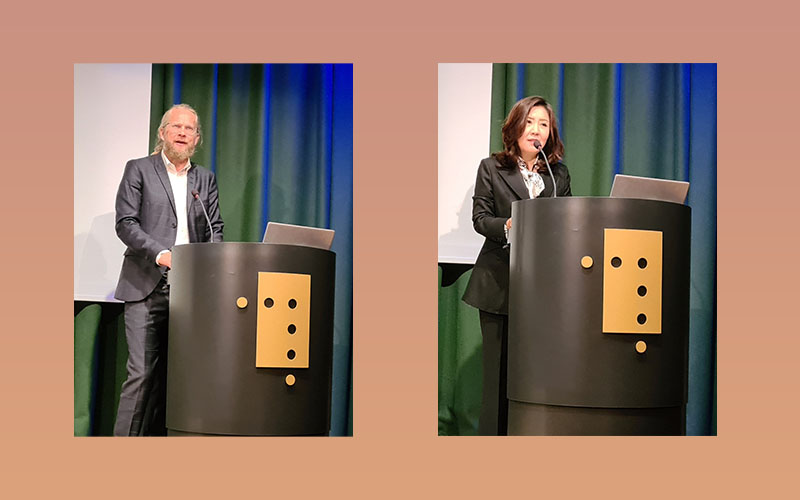
(Left) National Librarian, Mr. Aslak Sira Myhre. (Right) H. E. Ambassador Seo, Min-jeong.
National Librarian, Mr. Aslak Sira Myhre, shared a personal story, explaining that his connection to Korean culture comes through his wife, who was adopted from Korea and raised in Norway, and their children, who are half-Korean. He reflected on their children's experiences growing up in Norway, noting that their Asian heritage is visible to others, however, isn’t always as apparent to him and his wife. When asked if being half-Korean caused issues like racism or bullying, their daughters responded proudly, saying that being half-Korean is considered "the coolest thing." This anecdote highlights the growing influence and positive perception of Korean culture in Norway, Europe, and beyond. Following his story, he welcomed the Ambassador of The Republic of Korea to the stage.
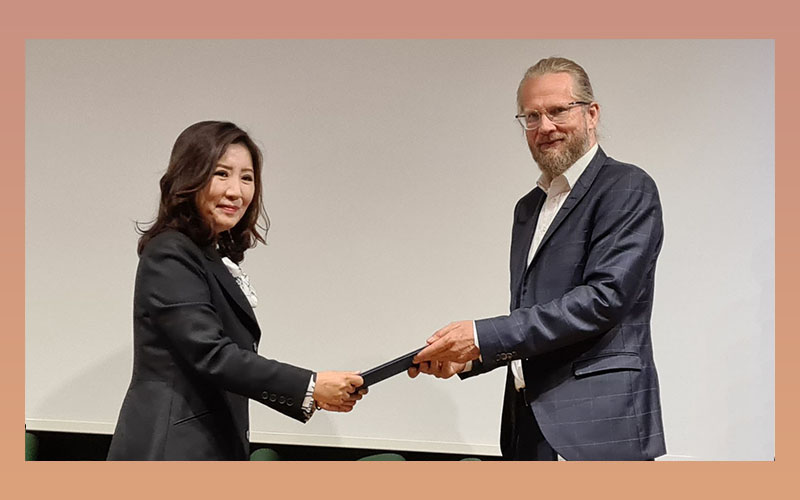
The formal transfer of Korean Literary Works with H. E. Ambassador, Seo, Min-jeong and National Librarian, Mr. Aslak Sira Myhre.
H. E. Ambassador, Seo, Min-jeong, expressed her gratitude for being part of the ceremony celebrating the donation of Korean books to the National Library of Norway. She highlighted the long-standing bond between Korea and Norway, which began during the Korean War with the Norwegian Mobile Army Surgical Hospital (NORMASH) and led to formal diplomatic relations in 1959. This year marks the 65th anniversary of these relations. Cultural exchanges between the two countries have grown, with Norwegians showing increasing interest in Korean language and culture. Various Korean organizations facilitated the donation of 300 Korean books. The ambassador also reflected on the importance of literature for exploring life and different cultures.
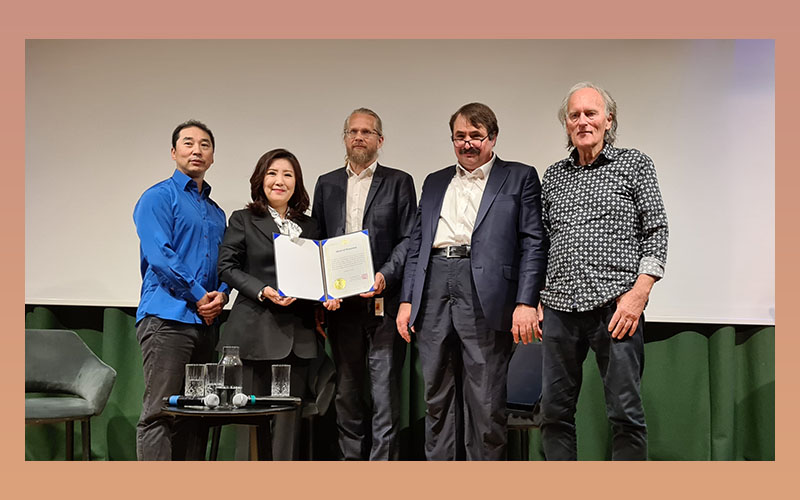
(From left) Mr. Byhre, H. E. Ambassador Seo, Mr. Myhre, Mr. Tikhonov and Mr. Kittelsen.
The event concluded with the exchanging of gifts and the formal handover of the Korean books. There was also a Korean Literature Exhibition that featured some of the donated collection including; novels, humanities, history and picture books useful for learning Korean. It is hoped that most of the books will be available for loan by the end of the year.
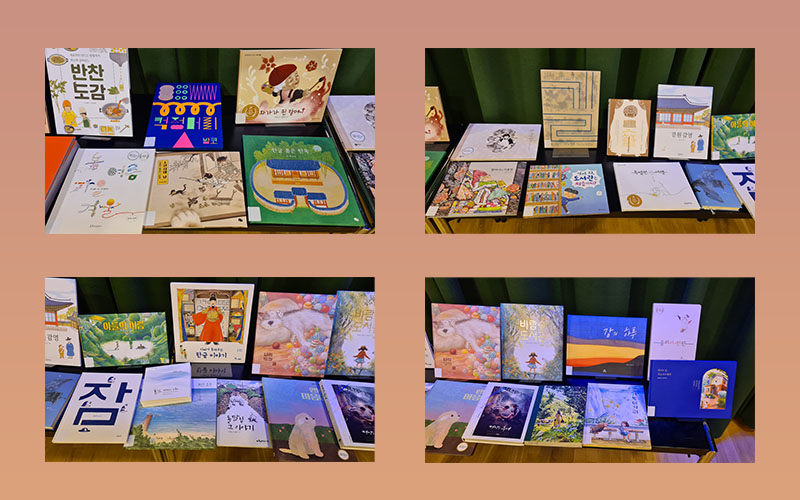
Korean Literature Exhibition featuring some of the donated collection.
How about this article?
- Like2
- Support0
- Amazing13
- Sad0
- Curious0
- Insightful0