Japan Impact invites Korea to the biggest convention on Asian culture in Switzerland's French-speaking region
2026-04-05After discovering the Japan Impact convention in Lausanne, Switzerland, last year while attending as a volunteer for the HallyuKorea booth, I had the chance this year to go back on February 14 and 15, 2026, and see the event from a visitor's point of view, learning more about it and getting to see more of the programme for the weekend, including the various activities related to Korea and Korean culture.
Although Japan Impact is, as its name states, mainly focused on Japanese culture, other Asian countries' culture can also get included, this year with China and Korea-related activities. With an extensive workshops programme, visitors could get an introduction to arts such as traditional dance and calligraphy, learn Japanese with language classes or try baking their own Japanese desserts, and experience a tea ceremony or wearing a kimono. Among the conferences and demonstrations, visitors got to learn more about Japanese mangas, animation movies, video games and their respective industries, saw projections of a few traditional movies, and could attend demonstrations of several martial arts disciplines.
"Japan Impact is a Japanese cultural convention created in 2009", explained Ludivine, a member of the organisation committee in charge of communication. "The first edition was organised on a smaller scale, with already some flagship activities such as the cosplay competition, martial arts demonstrations, and a few booths and conferences; there were already close to 2000 people attending the event at that time! This year, for the 2026 edition, we had 135000 visitors coming." She continues: "The convention focuses on Japanese culture; representation of other Asian cultures is minor, and usually happens through the specific interests of committee members, however our dance competition which is very successful mainly features K-pop. It seems Korean popular culture is gaining more and more interest among young people."
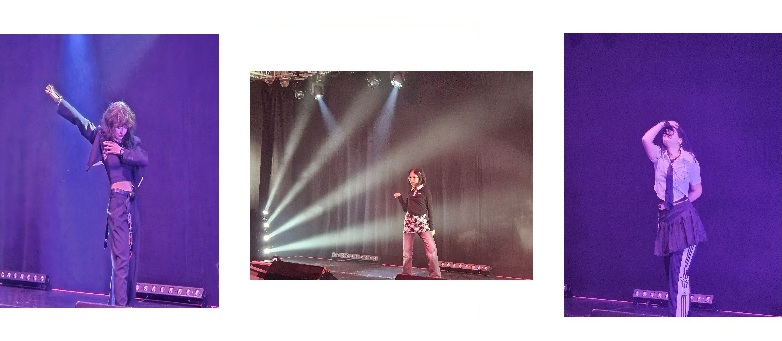
Along with all these activities on the programme, both event days featured concerts, a cosplay contest and a dance competition. Giving the stage to solo dancers on Saturday, then dance crews on Sunday, the Idol competition had 23 individuals and 20 groups performing in front of the public, with visitors watching both from the seats in the amphitheatre where the stage was set, and on television with a live broadcast in other areas of the event location.
"The first edition of the Idol competition was in 2023, with 12 solo dancers and 5 dance crews; the contest was initially taking place on a single day, but as it kept growing over the last two editions in 2024 and 2025, we decided this year to split it over the two event days, which has been a great success", explains Julie, the organisation member in charge of the Idol competition. "Since the first edition, the contest is open to Japanese and Korean songs, but competition participants mostly choose K-Pop. This year, we modified the rules to open the contest to all styles of Asian pop music, however it didn't change the tendancy and K-pop remains the first style choice." She also answered our questions about the pre-shows, performances by guest dance crews opening the competition: "This is a relatively new idea that was introduced last year in the 2025 edition and was received very positively by the public, so we organised it again this year. For the guest dance crews, we selected local groups who were already successful in previous Japan Impact editions. This year, we also had the chance to have these guests be part of the jury for the competition; their participation along with dance coaches and previous winners of the contest allowed for a diverse and complementary jury."
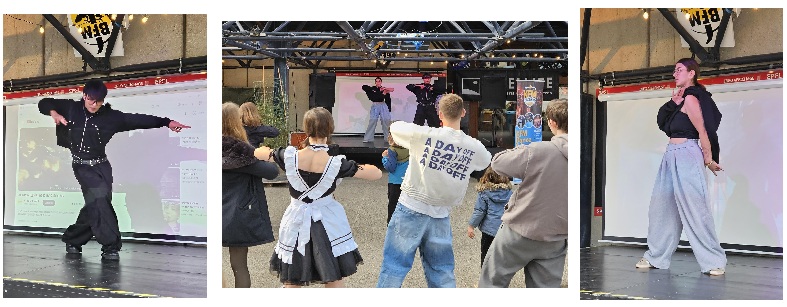
While visitors got to watch the solo dancers and dance crews' performances during the contest, they also had the opportunity to try K-pop dance themselves, with a demonstration and introduction activity held by KFM Dance School on both days. The school's two coaches present to lead the activity, Chris and Petra, first offered individual demonstrations to the public and introduced them to some famous K-pop songs, with a few of the dance school's students also taking the stage to show a group demonstration; then, they all invited the public to learn a short choreography, showing them each move separately first, then having them perform the complete sequence at a slow pace, and speeding it up until they could perform it close to the song and choreography's normal speed. This activity was enjoyed by a diverse group, with visitors from young children to teenagers and adults attending.
Petra introduced their school and its K-pop classes: "KFM Dance School was created 25 years ago, and originally only taught breakdance. As our director Yu-Seng mirrored the Korean dance school system, which often includes K-pop with breakdance, K-pop was also included at the school; other dance styles also got added, such as hip-hop or girly. The students for the K-pop classes are mainly youth, with my beginners' group including children from 7 to 15 years old, however we also have quite different groups for intermediate and advanced levels. Our school is teaching in Fribourg, Bulle, Aigle and Montreux, and soon also in Lausanne; we can see an increase in K-pop dance classes' requests, with both Chris's and my K-pop classes' groups including around 20 to 25 students. People are listening more and more to K-pop, and it also got more popular with the release of the K-Pop Demon Hunters animation movie."
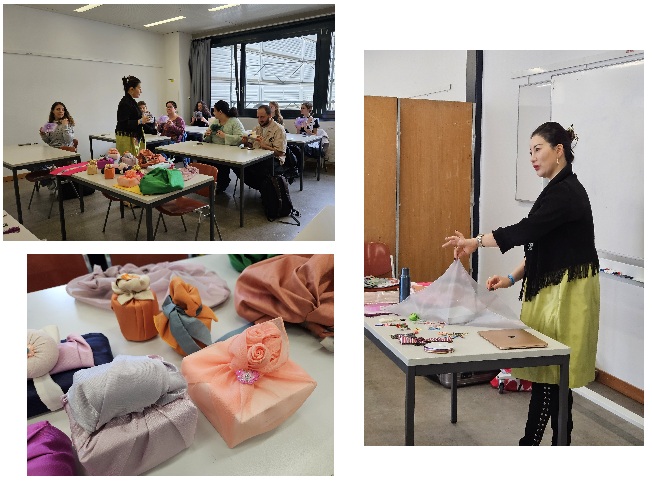
While K-pop was taking the front stage, other aspects of Korean culture were represented as well; in addition to the presence of the HallyuKorea association booth at the event, the association's president, Liz Yoon, also taught a bojagi workshop during this 2026 Japan Impact convention, following her participation to the 2025 edition during which she gave two conferences introducing Korean culture and the various differences between Korea and Japan.
For this edition, on each day, visitors registering to the bojagi workshop got to learn about the history of bojagi wrapping use in Korea, and to see several examples of bojagi from wrapping boxes or jars to creating a small bag. Following this introduction, they had the opportunity to learn one technique used for wrapping a box, creating a flower pattern on top of it and decorating it with an additional ornament.
To conclude the last of the two workshops, Lauriane, one of the participants, gave her impressions on the activity: "This is my first time attending the event as a visitor, as I was previously part of the organising committee; so it is great to be able to enjoy the activities, especially one such as the Korean bojagi wrapping, which is new and wasn't offered the previous years. I have some furoshiki at home but I didn't get to make very nice wrappings, so I wanted to try it here as I also found bojagi very beautiful. The workshop was great, Liz Yoon was a very good teacher and the materials as well as the way of making it were very relaxing."
How about this article?
- Like0
- Support0
- Amazing0
- Sad0
- Curious0
- Insightful0