Street performer Ppikppik redefines silent narrative while spreading cheer around the world
2026-01-17In a world overflowing with noise, screens, and hurried conversations, street performer Jung Ho-jae, who goes by the name Ppikppik, has been transforming public spaces into living stages that give his audience a moment to pause, reconnect, and rediscover the quiet joy of human connection through silent storytelling and shared laughter.
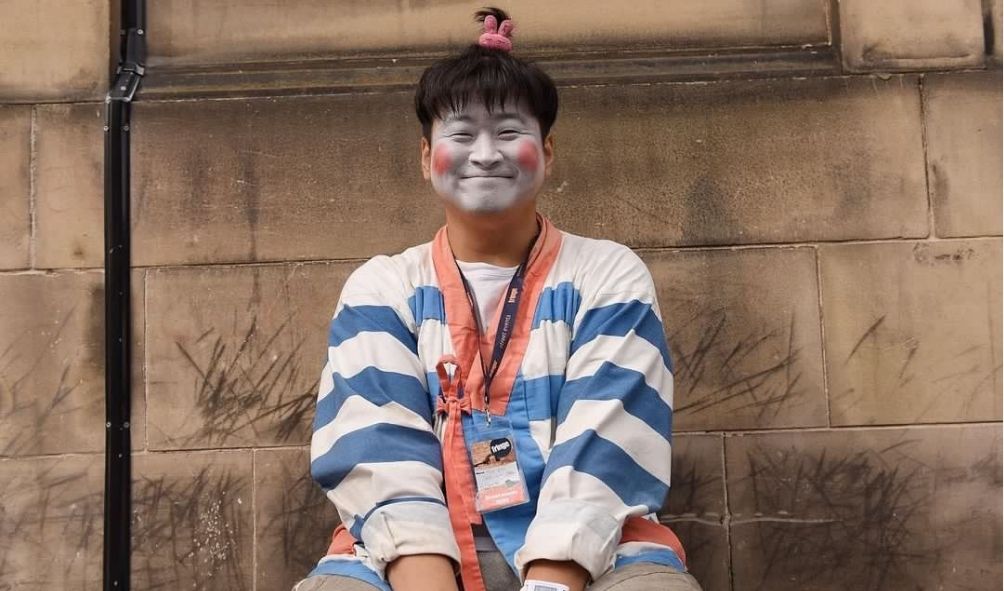
With a background in theatre studies and advanced training in street arts, Jung’s journey as a street performer began in Dongseong-ro in Daegu in 2010, making him the first performer to establish a regular street performance presence in the city. Today, his artistry has transcended boundaries as he has performed in about 14 countries, including Korea, Italy, Scotland, Australia, France, and Bangladesh, where he is invited to participate in world-renowned festivals, such as the Chuncheon International Mime Festival, the Goyang Lake Arts Festival, the Dhaka University Mime Action, and the Edinburgh Festival Fringe, to name a few. Additionally, Jung embarks on his ‘Street Performance Tours’ as his character, Ppikppik, to connect with new cultures.
In an email interview between January 4 and 6, Jung shared his motivation to choose street performance as his lifelong career path. He said, “When I first experienced street performance, I was deeply captivated by the ability to connect with the audience through direct eye contact and real-time communication. I found myself drawn to the inherent challenge and unique charm of completing a performance entirely through the performer’s own strength and presence, right there on the street.”
From that first spark of connection, Jung’s street performances continued to evolve as a dialogue shaped by his audience. In fact, the name ‘Ppikppik’ was born from this exchange during a street performance where they kept asking for his name. However, since his character could only communicate through squeaking sounds, his audience eventually began calling him ‘Ppikppik’. For Jung, adopting this name felt quite meaningful. “As a street performer, I felt it was a profound honor to use a name given to me by the audience in the very place I perform—the street. I have been proudly performing under that name ever since.”
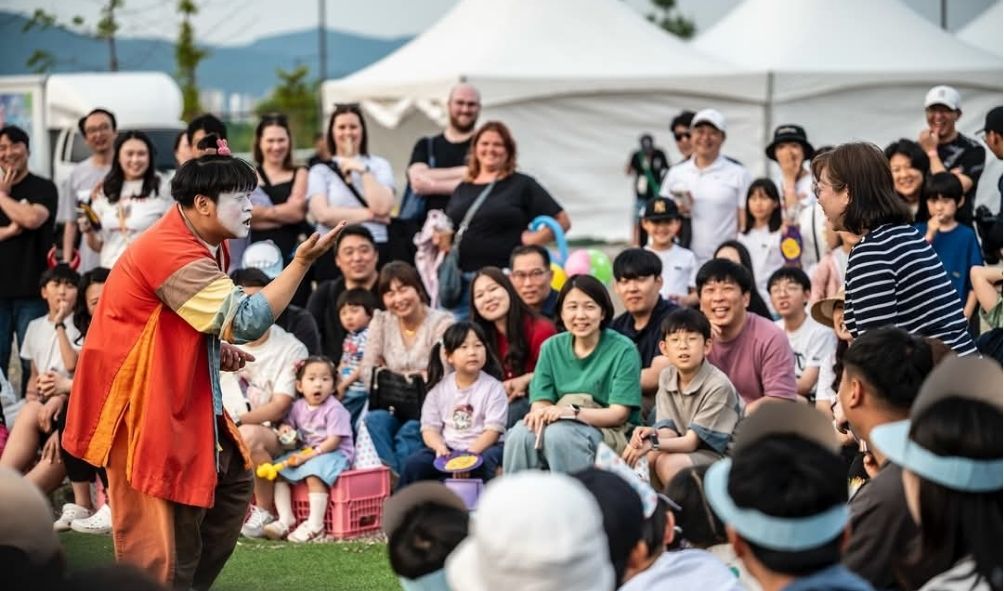
To give back to his audience and entertain them, Jung relies on his strong background in theatre studies, which he believes gives him an edge over others, to approach street performances with a strong sense of character and narrative. “Because of my background in theatre, I believe I have an advantage in analyzing and embodying a character. It allows me to fully realize a persona on the street, giving the performance a narrative strength that goes beyond simple technique,” Jung explained.
The clown-like appearance of Ppikppik, too, was a natural evolution. While Jung initially performed wearing a mask, he soon felt the need to show his audience more of his detailed facial expressions. As a result, to ensure he was visually striking in the busy environment of the street, he began painting his face white, adding a touch of pink to his cheeks so as to not appear too intimidating. Additionally, to project a friendly and familiar image, he incorporated the squeaking sound and completed the look with Hanbok-inspired pieces that evoke the innocence of a child.
Much of Jung’s work depends on his ability to read his audience quickly and respond instinctively. This skill, he said, was developed from experience over time. “Street performance is an art where events happen the very moment I act, so experience is everything. If a situation occurs and I fail to react in the moment, I regret it afterward. I then memorize that moment and brainstorm ideas. When a similar situation arises in a future show, I experiment with those ideas and refine them through the performance. Since these moments occur constantly during a single show, I am always solving problems in real-time. Over time, this process has built an overflowing ‘database’ of intuition and quick-witted responses unique to the street,” Jung explained.
Despite the expressive richness of his performances, Jung continually reminds himself to keep things simple. He says, “A performance must be easy to watch and understand. This commitment to clarity is what supports and defines my vivid facial expressions and my approach to mime.”
At the same time, Jung is also conscious of being mindful of audience boundaries. At the core of his performance lies a guiding question: “Will this make the audience uncomfortable, or is it something we can laugh off together?” Before taking any action, Jung carefully weighs the audience’s comfort against the potential for humor. He carries this idea with him to all the countries he travels to.
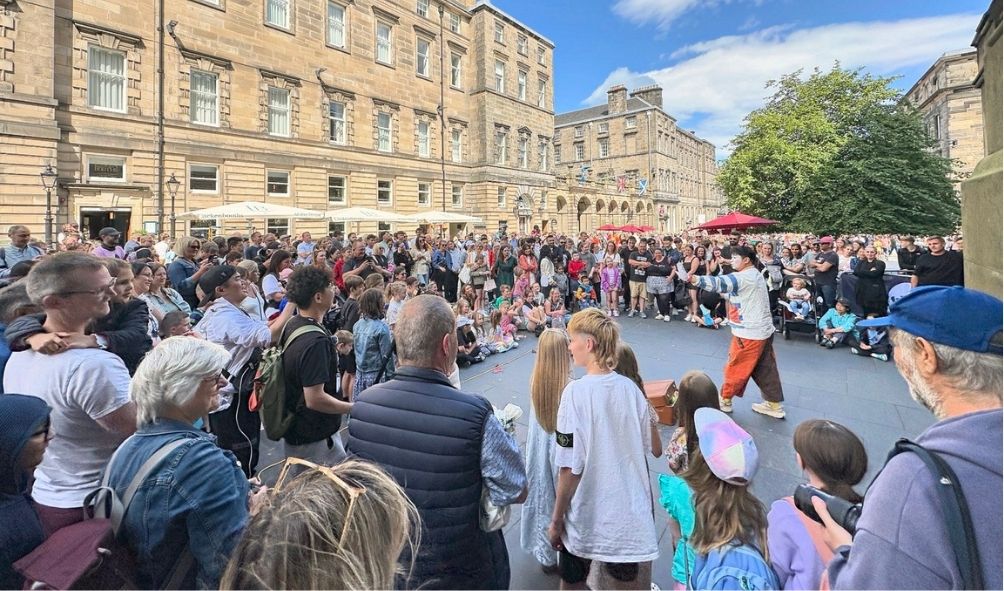
Among the many festivals he has traveled to, Jung considers the Edinburgh Festival Fringe, which is the world’s largest arts festival, the most significant event he has participated in. Referring to it as his annual ‘season of growth’, Jung has headed to the Scottish capital every August since 2017, except for the pandemic years, performing as Ppikppik. “It is where I push my character to new limits and refine my craft on one of the most competitive and prestigious stages in the world,” Jung added.
Another memorable moment, however, came indoors rather than on the street. Elaborating on the experience, he said, “I vividly remember the first time I brought the Ppikppik show into a traditional theater. For a long time, I found indoor theaters suffocating. Because of the bright stage lights, I couldn’t see the audience, and I felt as though there was an invisible barrier separating us. However, that first theater performance became a turning point for me. I realized that this invisible barrier wasn’t a permanent fixture—it was something that I, as the performer, had the power to break down. That realization changed how I view the relationship between the stage and the seats.”
Having performed for the last 15 years, Jung has witnessed a clear shift in the way audiences engage with street performances. When he first began performing in 2010, they tended to be observers, watching from a distance. However, today, people show a stronger desire to express themselves, be seen, and actively participate. This has resulted in a significant increase in the number of his active, participatory audience. Additionally, Jung’s performances have also become increasingly interactive, with audience participation now central to the narrative. This has eventually translated into a meaningful relationship between Jung and his audience, with the former leaving a soft and warm impression on them.
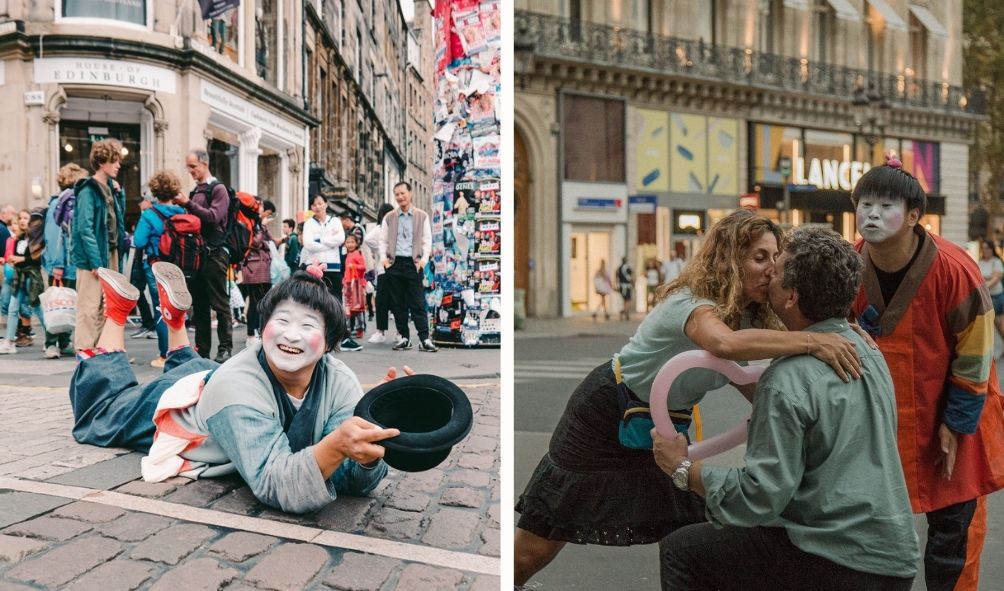
“I want to create a moment of pure happiness for friends, couples, and families who gather to watch my show—a single, bright memory within one day of their lives. I hope that years later, they might look back and share that story as a cherished episode from their past. I wish to exist like a ‘supporting actor’ in the grand drama of their lives, playing a small but meaningful part in their journey of happy memories,” Jung said.
For Jung, even the idea of success is defined by the audience. He believes that the moment someone who watches his performances thinks ‘this is art’ is the moment he truly becomes a successful street artist.
Carrying this belief onto the streets around the world, Jung is a conduit of Korean creativity—one rooted in emotional sincerity and shared humanity. His aim is simple yet profound: “My goal is to make as many people as possible laugh heartily without a single worry. I want to gift them with that bright, innocent laughter that washes away all concerns. Being able to offer that moment of pure joy is the true meaning of my work.”
In the future, Jung hopes to tour the nations that participated in the Korean War to perform ‘thank you’ shows. “I want to tell them that because your fathers and grandfathers protected our right to smile, I am here now to bring that laughter back to you,” Jung concluded.
*This article was written by a Korea.net Honorary Reporter. Our group of Honorary Reporters are from all around the world, and they share with Korea.net their love and passion for all things Korean.
How about this article?
- Like1
- Support0
- Amazing0
- Sad0
- Curious0
- Insightful0