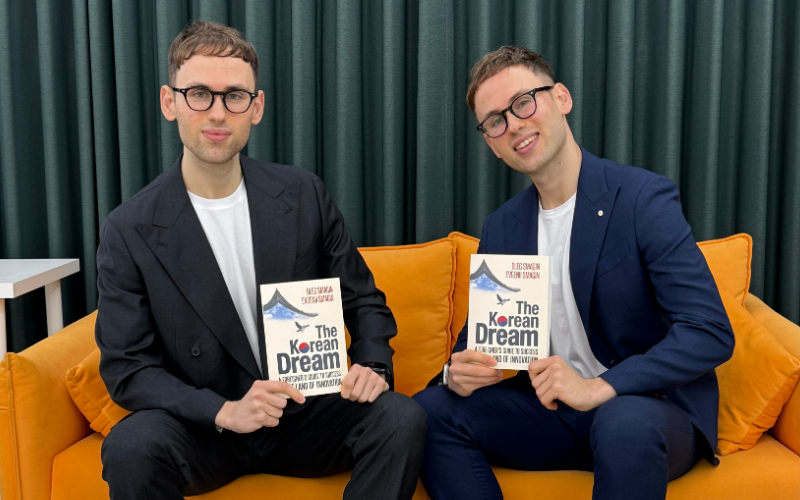
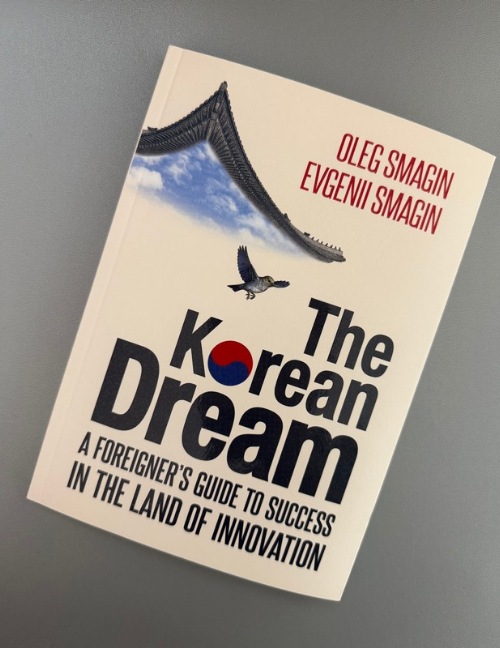
Oleg and Evgenii Smagin are the co-authors of "The Korean Dream: A Foreigner’s Guide to Success in the Land of Innovation," published on Nov 19, 2025. Today, they both work in Korea in roles that bridge global strategy, technology, digital innovation, and Korea-international business relations.
Their careers have centered around market and investment strategy, ecosystem building in finance, AI and gaming fields in such globally recognized companies as SK Telecom, JB Financial Group and WEMADE.
Outside of corporate roles, Oleg and Evgenii co-founded “Digital Twins,” an AI-hosted podcast, and authored the bestselling book “The Korean Dream” about building a successful life and career in Korea as a foreigner.
They frequently speak at tech and investment events, mentor founders, and contribute to academic and industry insights. Their life and work have also been featured on major Korean TV programs across KBS, MBC, JTBC, and XtvN. They both received an MBA from KAIST College of Business, one of the best universities in Korea and Asia.
Below are excerpts from an email interview with Oleg and Evgenii on Dec 31 and Jan 1 about their book “The Korean Dream.”
1. What inspired you to write "The Korean Dream" now?
Korea today is home to more than 2.5 million foreigners, and that number continues to grow every year. In particular, around 300,000 foreign students now live in Korea, many of whom come not just to study, but to build a life here. Korea has evolved into a place people deliberately choose to pursue their dreams, not just a temporary stop or an academic experience. Korea itself is actively opening its doors to global talent, international students, and foreign professionals, while still operating on deeply rooted cultural norms. That gap, between policy and reality, ambition and understanding, is where many people struggle. Writing the book felt like capturing a moment when Korea and global talent need each other more than ever, but don’t yet fully understand one another.
When we began writing about our decade-long experience of building a life and corporate careers here as foreigners, the response surprised us. We received an overwhelming number of questions, sometimes several a day, from people we had never met, asking about everything from careers and networking to language learning and everyday life.
At some point, we realized it was time to share what we had learned, not one conversation at a time, but all at once.
2. How is your book different from other books about Korea?
The idea of our book grew directly out of the questions we kept receiving from readers; about careers, language, relationships, belonging, and what it actually takes to build a sustainable life in Korea. Those questions shaped not only what we wrote, but how we wrote it.
At the same time, the book is partly a memoir. As we walk readers through our own journey, from exchange students to full-time students, and eventually into corporate and social life, we try to offer an inside view of how life in Korea actually unfolds over time. Korea is not treated as an object of observation, but as an evolving environment and a living protagonist in the story.
Our experience is also one that many foreigners can relate to. We arrived in Korea as students and built our lives from scratch, just as thousands of others who come each year are trying to do now. The challenges we describe, the mistakes we made, and the lessons we learned are shared by many people navigating similar paths.
3. What was the hardest story to decide to include, or exclude?
The hardest stories to decide on were the personal ones.
Personal experiences are always the most difficult to include, but we felt honesty was essential. That’s why each chapter includes real episodes from our own lives; moments that genuinely shifted how we understood Korea, work, relationships, or ourselves at a certain point in time. Those experiences helped ground the book in reality rather than theory.
At the same time, drawing conclusions was challenging. It’s easy to generalize, but we were very careful not to criticize Korea unfairly or idealize it. Instead, we wanted to present our experiences in all their complexity and emphasize that Korea is constantly evolving. Many of the cliches people still associate with Korea simply no longer hold true.
As for what we excluded, there was no shortage of material. Topics like corporate life, job hunting, and building a career in Korea from scratch are incredibly important, and very hot topics. In fact, when we drafted the chapter on navigating corporate life as a foreigner, the material kept expanding. We realized we could keep writing indefinitely, and at some point we had to stop and tell ourselves: this is enough for now.
4. Which moments best represent everyday life in Korea for you? Why?
Everyday life in Korea is best captured in small but telling moments: quick and reliable delivery, strong and efficient public services like healthcare, and clean, safe, and well-maintained public spaces. These details shape the rhythm of daily life and reflect a deeper pursuit of excellence that runs through Korean society.
That same mindset is visible in the workplace. You rarely see people clocking in and out exactly according to what a contract specifies. While this can feel unusual or even overwhelming at first, in many cases it reflects a cultural emphasis on doing your job properly. Reliability, speed, quality, and trust are embedded in how work gets done.
Many of the comforts people enjoy in daily life in Korea; from efficiency to convenience, are rooted in this mindset. On an average, everyday level, the quality and comfort of life Korea offers are difficult to match elsewhere precisely because people take responsibility for their roles and try to do them well.
Sometimes it takes leaving Korea to fully feel and appreciate this. It’s something I’ve always deeply respected, and it’s a mindset I believe I’ve gradually incorporated into my own way of working and living.
5. What question about Korea do you wish readers asked more often?
I wish people asked more often: What does Korea actually reward, and what kind of people does it need?
It’s natural to look for shortcuts, but in reality, and especially in Korea, what tends to be rewarded is long-term commitment and long-term thinking. Language fluency, careful observation of how people work and communicate, understanding what the country and its industries need, identifying niches, and actively building networks all sound obvious. Yet because success here rarely happens overnight, these fundamentals are often overlooked or forgotten.
I also think it comes down to priorities. When you think about building a life and career in Korea, the first question should be: Why do I want to be here - today, and tomorrow?
There can be many answers, but once that becomes clear, it sets the mindset needed to build something sustainable over the long term.
6. What impact do you hope this book will have?
On a personal level, we hope the book gives people not just answers, but understanding. Many foreigners in Korea quietly internalize their difficulties, assuming that confusion, exhaustion, or slow progress means they are doing something wrong. We want readers to recognize that these experiences are not individual failures, but shared stages of a much larger journey. That realization alone can restore confidence and the willingness to keep going.
On a broader level, we hope the book helps shift the narrative around foreigners in Korea; from temporary guests to long-term contributors. Korea’s future is becoming undeniably global, and with that comes the need for deeper mutual understanding. We believe that when foreigners are given the tools to integrate, and when their commitment is recognized, they can become genuine partners in Korea’s next chapter, not as exceptions, but as an integral part of its social and economic fabric.
7. What are your goals?
Our goals are long-term and deeply rooted in Korea. As authors, we want to keep expanding the conversation that "The Korean Dream" has started, through future writing, open dialogue, and education that helps people understand not just Korea, but themselves within it.
As professionals, we aim to continue contributing where Korea is actively shaping the global future: in technology, AI, investment, and mentorship. These are areas where global perspective and local understanding must coexist, and where we believe our experience can create real value.
Ultimately, our goal is to help build a lasting bridge, between Korea and those who choose it as their home, and between ambition and understanding. "The Korean Dream" is a foundation for that ongoing work.
With "The Korean Dream," the Smagin brothers share an honest look at life in Korea as foreigners, highlighting the challenges and opportunities of building a new life and pursuing success in a different culture.
How about this article?
- Like8
- Support0
- Amazing0
- Sad0
- Curious0
- Insightful0