Mikey Espinosa is a British-Filipino artist, author, and passionate advocate for Korean culture. His work bridges contemporary art with traditional Korean aesthetics, offering a unique lens into identity, history, and cultural exchange. Following his previous exhibition, With Love, Korea, which celebrated the country’s diverse landscapes, Mikey’s sixth exhibition, Beauty of Hanbok (2025), shifts focus to Hanbok, Korea’s traditional clothing. The word “Hanbok” translates to “Korean clothing” (Han meaning Korean people, Bok meaning clothing), highlighting its distinct identity from Western and Japanese styles.
This exhibition is both a tribute to the elegance of Hanbok and a reflection of the people who have shaped Mikey’s artistic journey. Visitors can expect to experience the timeless beauty of Korea through traditional dress, exploring its cultural significance while engaging with Mikey’s personal encounters within the Hanbok community. His artworks combine acrylic, watercolor, ink, and traditional Hanji paper, and some pieces are created in collaboration with Hanbok designers, merging visual art with fashion. The exhibition also marks the launch of Mikey’s online store, KOLTURA, a platform dedicated to making Hanbok more accessible in the UK and celebrating cultural connection through fashion. Through his travels in Korea, Mikey witnessed how deeply culture is woven into everyday life, fostering understanding, identity, and connection. His curatorial approach in Beauty of Hanbok invites audiences not only to admire the artistry of the garments but also to reflect on the power of culture to bring people together.
In this interview, Mikey shares insights into his artistic journey, his love for Korean culture, and his reflections on the Hanbok exhibition, offering a glimpse into the heart behind his creative vision.
This interview was conducted via email between 30 November and 12 December 2025.
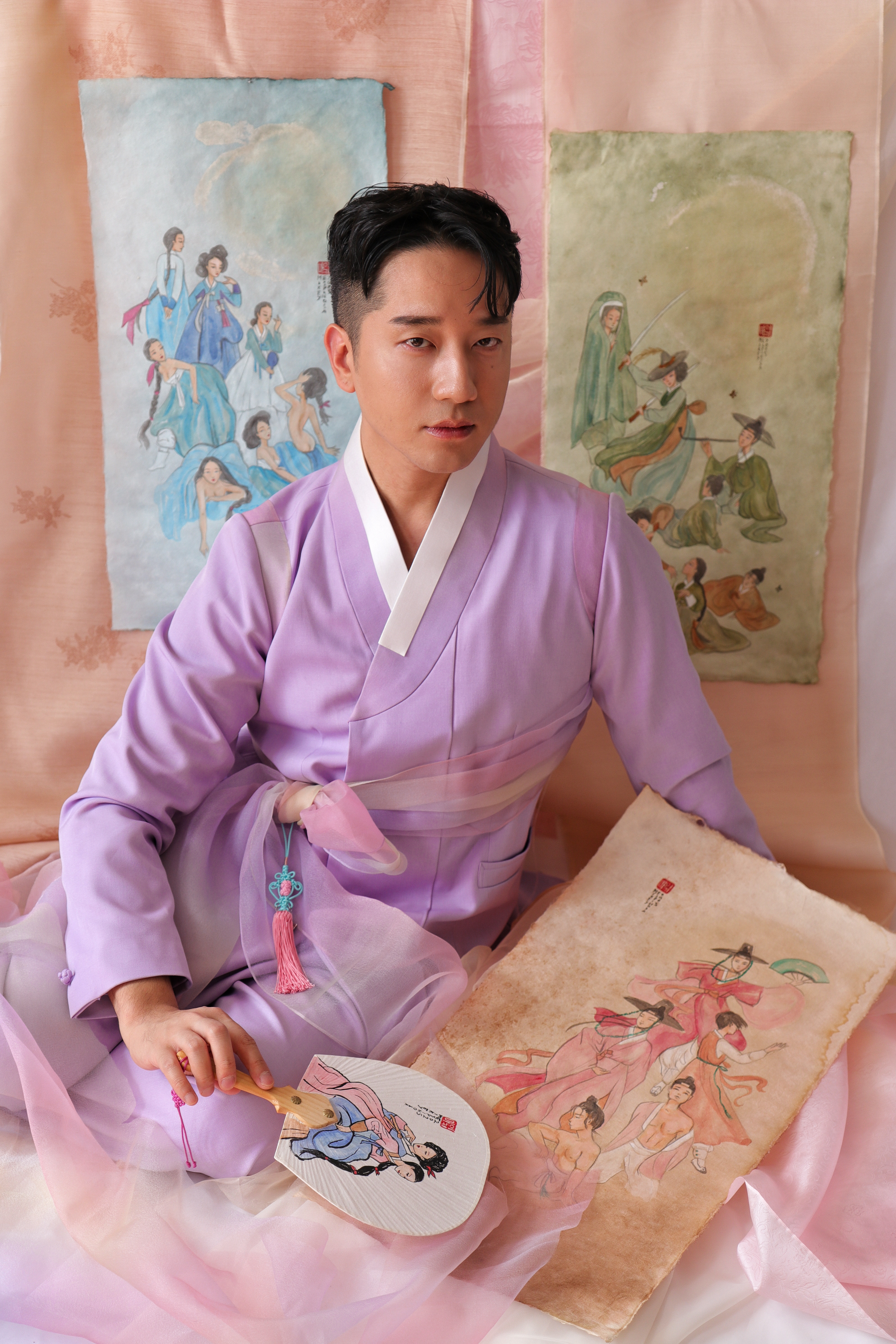
Could you introduce yourself and share how your artistic journey began?
Hello, my name is Mikey Espinosa, and cheesy as it may sound I’ve been drawing for as long as I can remember. I started with flags because I was mesmerised by their colours, and eventually moved on to drawing people. My early influences came from video games and comic books, and later, in secondary school, my fine art teachers introduced me to artists like Alphonse Mucha and Gustav Klimt. Their work inspired me to pursue a foundation course in womenswear at the London College of Fashion. Along the way, I discovered my passion for storytelling and went on to self publish three fairy tale books. I’ve always been fascinated by Korean culture, and as I shared more of my experiences online, a few posts went viral. That unexpectedly pulled me into the world of content creation, particularly around Korean businesses. Naturally, my artwork became increasingly shaped by Korean culture, and I also developed a deep love for hanbok. This appreciation for hanbok eventually connected me with the wider hanbok community a group of people whose creativity and passion continue to inspire me every day.
What first inspired your connection with Korean culture, and how has it shaped your artistic identity?
Growing up in East London, there wasn’t much Asian representation. I remember clinging to any glimpse I could find, Lucy Liu, Mutya Buena, and even characters like Disney’s Mulan. When YouTube emerged during my teens, it opened the door to the world of K-pop, and seeing people who looked like me creating and performing drew me toward Korean culture. Back then, Asian identities were often treated as a monolith, so as a Filipino kid, simply seeing another Asian face felt significant. That longing for representation, combined with my naturally visual way of experiencing the world, meant I gravitated toward “Asian looking” art and crafts. That desire of wanting to see those things, influenced the artist I eventually became.
How did your artistic style evolve after moving to or engaging deeply with Korea?
I actually began blending Korea into my art during a period of creative writing block. I couldn’t produce any stories, so to keep my creative energy alive, I turned to painting. I started with landscapes, ironically one of my weakest areas and quickly realised that European scenery, while classic and respected, felt repetitive and uninspiring to me. So I shifted my focus to Korea, a place I had visited several times. Once I started, I couldn’t stop. I painted landscape after landscape, and through that process I developed a deep appreciation for how rapidly Seoul has grown. Because of its quick development, the city’s architecture is incredibly diverse from traditional hanoks sitting beside ageing buildings from the ’60s and ’70s, which in turn stand in the shadow of sleek skyscrapers, all framed by a dramatic mountainous backdrop. Capturing that contrast and that beauty became something I genuinely loved and valued.
What elements of Korean tradition or philosophy influence your work the most?
Knowing Korea’s history and the attempts at cultural erasure during the Japanese colonial era I’ve come to deeply admire the resilience of the Korean people. Their determination to resist oppression, reclaim their identity, and rebuild what was nearly taken from them is extraordinary. That passion and drive inspire me profoundly, especially now that I understand the cultural stories I depict in my art carry a legacy of strength and survival.
How do you balance your own cultural background with Korean cultural themes in your art?
I balance my own cultural background with Korean themes by recognising the emotional and historical parallels between the Philippines and Korea. Although our cultures are distinct, both countries experienced colonisation, trauma, and cultural suppression especially during the Second World War. As a Filipino, I resonate strongly with the Korean concept of han, that deep, collective feeling of sorrow, resilience, and unresolved longing. It’s something I’ve always felt within myself, so expressing it through Korean cultural themes feels natural rather than foreign. At the same time, I make sure my Filipino identity remains present in my work. My exploration of hanbok led me to discover traditional Filipino textiles, which I now incorporate to create a fusion of Filipino and Korean clothing. That blending not only allows me to honour both cultures, but it has also pushed me to learn more about my own heritage. In that way, my art becomes a meeting point: Korea gives me a language to express emotions I deeply understand, while the Philippines keeps me grounded in who I am. Together, they create a balance that feels authentic to my identity.
What role does storytelling—especially Korean narratives—play in your creative process?
Storytelling especially Korean narratives plays a grounding role in my creative process. Many of my pieces are inspired by my personal experiences in Korea, and those moments become the starting point for the stories I tell through art. While I’m not yet ready to explore deeper, collective Korean narratives, I approach them with a lot of respect and a desire to eventually share them truthfully. Right now, storytelling helps me translate what I’m learning in real time about Korean culture into creative work that can introduce others to the experiences I’ve had.
How do you feel Korea’s contemporary art scene compares with the art scene in the U.K.?
The UK art scene for me feels well established because we have so many art museums, galleries and there’s just been a long tradition with art. In Korea the art scene feels very new and because of this it is moving very quickly with a lot of experimentation going on. They also often include historical context within the work but that’s just judging from the art I have seen.
In your view, why do global audiences connect so strongly with Korean cultural aesthetics today?
What originally drew me to Korea was K-pop and the desire for representation. Because Korean media has taken certain Western influences and reinterpreted them through its own cultural lens, there was a sense of familiarity for me growing up in the West , suddenly I could see aspects of myself reflected in it. I think this blend of Western influence with Korean creativity is part of why so many people are drawn to Korean culture today; it feels both new and recognizable. At the same time, Korea weaves elements of its heritage into its contemporary media, which creates a gateway for people to become curious about its deeper cultural aesthetics.
What message about Korea do you hope people take away when they view your work?
I know when people think of Korea they think K-dramas such as Squid game, films like Parasite and K-pop music. I hope that people would embrace and appreciate more of Korea’s cultural heritage such as Hanbok.
What inspired you to create an exhibition centered on hanbok?
Spending so much time in Korea especially within the Hanbok community has naturally become a major source of inspiration for my artwork. There were countless moments I wanted to express, whether through a fashion show, paintings, or simply trying to recreate the warmth and love I felt from the community. My goal has been not only to capture that connection but also to help others understand what makes Hanbok such a uniquely Korean cultural expression.
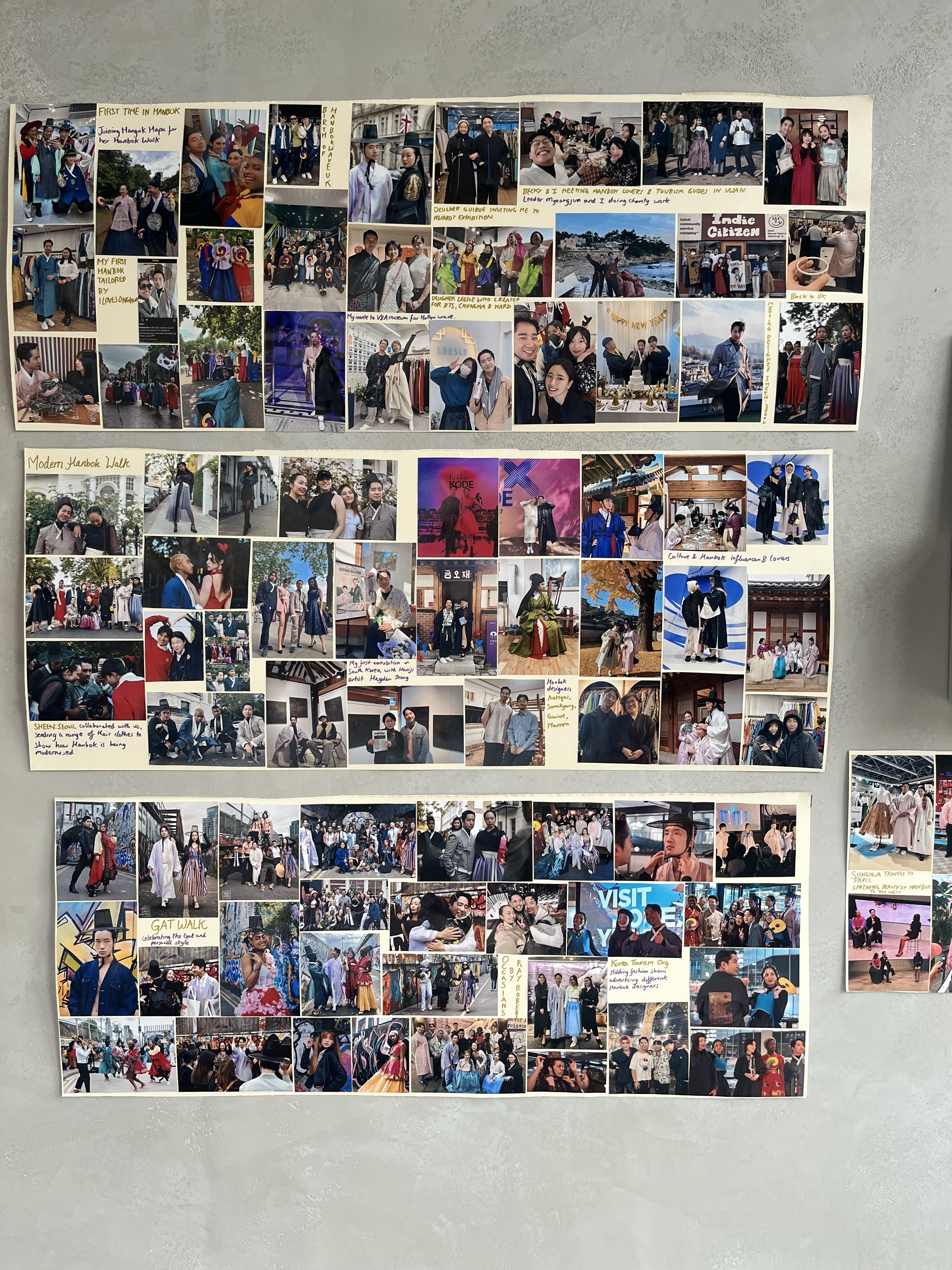
When preparing for this exhibition, what aspects of hanbok did you feel were most important to highlight?
I wanted to highlight the community I felt and the parts of hanbok that Koreas traditional clothing, uniquely Korean.
What was the most challenging part of translating a historical Korean garment into contemporary art?
The most challenging part of translating a historical Korean garment into contemporary art has been ensuring that I approach it with the respect it deserves. Hanbok has a long, intricate history, and understanding each element, its structure, symbolism, and cultural context requires careful learning. Because Korean isn’t my first language, even researching specific garment terms or pronunciations can be tricky, and I’m always aware of the responsibility to represent everything accurately. But this challenge has pushed me to keep studying, asking questions, and improving so that my work can honor the tradition rather than simplify it.
How have visitors in London responded to seeing hanbok presented through art?
Londoners have always loved Hanbok when it’s presented to them, though at first, if it’s a passing compliment they always tend to get the country it’s from wrong! But that’s also a big motivator for me, to help teach people about the differences. During my exhibition there was definitely a lot of interest towards Hanbok too and wanting to own it.
Do you think exhibitions like this can change global perceptions of Korean tradition?
Most definitely, because it helps showcase the culture and expand the knowledge, maybe people would find something fascinating and end up in a rabbit hole wanting to learn more, just as I have.
Which artwork from this exhibition is personally most meaningful to you, and why?
One of the works I’m most connected to is my painting of I♡Songhwa’s designer, Haejin Jeong. She created my first tailored durumagi, and I was incredibly grateful for the care she put into it. Until then, Korea had always felt like a place I visited as a tourist, not as someone who truly belonged. But when she told me that I could call her Noona if I ever needed anything, that moment shifted everything. It was then that Korea began to feel like a second home, she had also taken interest in my desire to make Hanbok using Filipino materials so she really helped a dream come to reality. The painting reflects not only that personal connection, but also the beauty of Hanbok and the innovative spirit of the designers who keep the tradition alive.
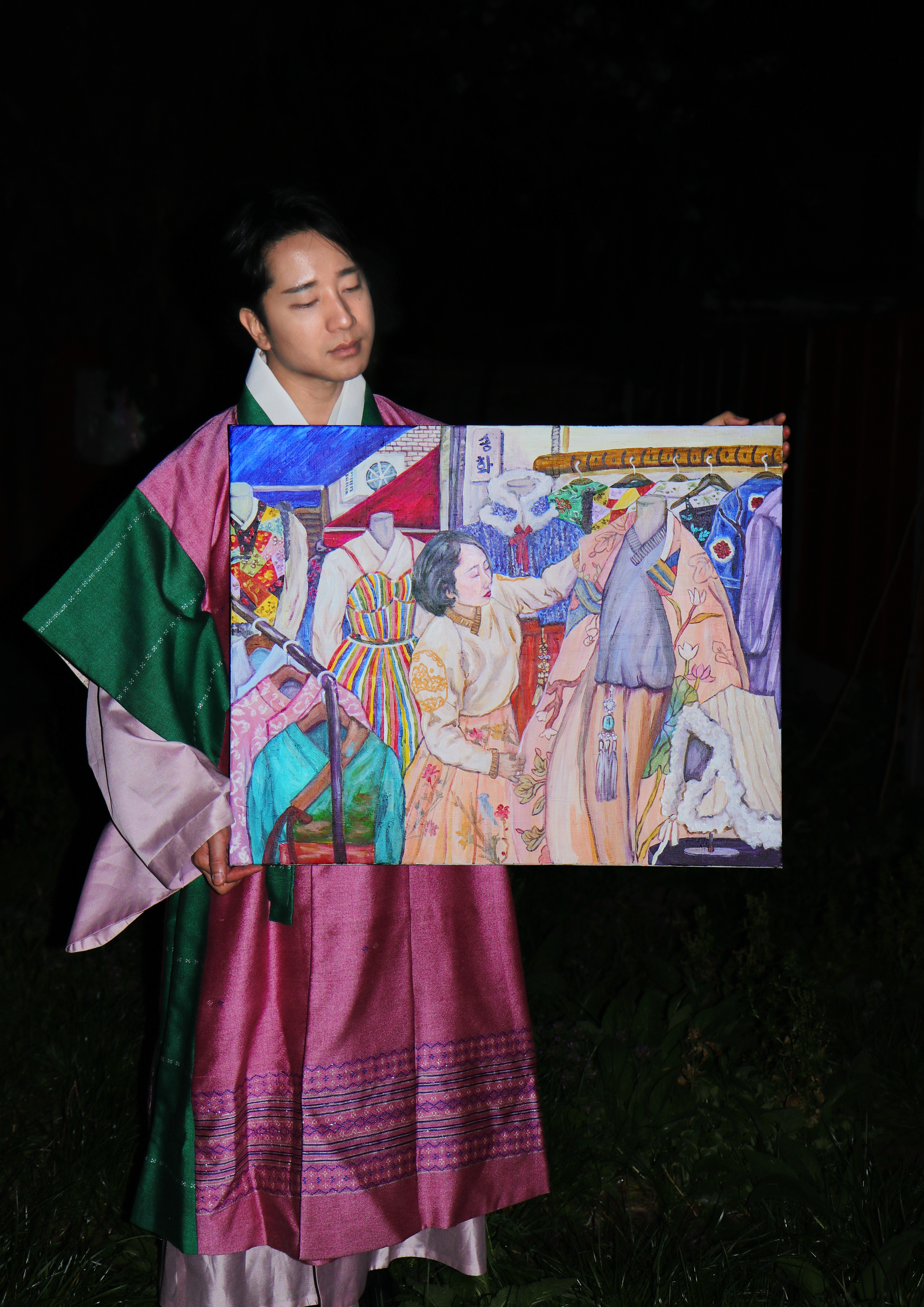
What do you hope international audiences understand about hanbok beyond its visual beauty?
That Hanbok has it’s own unique identity and that I know there is a conversation with cultural appropriation but that with cultural appreciation and respect, Hanbok can be enjoyed by everyone as that is something the designers themselves want to see with Hanbok.
How do you define the role of an artist when representing another culture?
To approach it with respect and understanding , to take time to learn so that what I am portraying is truth and honours the culture that it comes from. Hanbok is not just something that is beautiful and appealing, it is the Korean peoples culture and tradition with a deep history. My role as an artist is to build a bridge of meaningful and strong relations that allows people to be more informed and respectful.
What new themes or Korean traditions would you like to explore in future projects?
As an artist and learning about hanbok and looking back at old recordings of people through paintings, I’ve shown great interest in Minhwa which is an old style of Korean art and actually I’m going to Korea end of 2025 to learn the basics of Minhwa and hopefully continue that to see how it may eventually inform or change my own current style of art.
How do you see Korean traditional clothing evolving in global fashion and art?
There are already so many talented Hanbok designers modernising the traditional clothing while keeping Hanboks DNA so I believe that more people will find it accessible.
Alongside the exhibition, Mikey has launched KOLTURA, an online store offering modern Hanbok pieces from multiple designers. Currently in its soft-opening stage, KOLTURA aims to make Hanbok more accessible to audiences in the UK and promote cultural appreciation through fashion. As the platform grows, visitors can look forward to fashion shows, collaborative projects through Hanbokwave UK, and future exhibitions — not only from Mikey but also from others who share a passion for Hanbok. This initiative reflects Mikey’s ongoing dedication to celebrating Korean heritage and encouraging a wider audience to experience and enjoy the beauty of traditional Korean clothing.
How about this article?
- Like1
- Support0
- Amazing0
- Sad0
- Curious0
- Insightful0