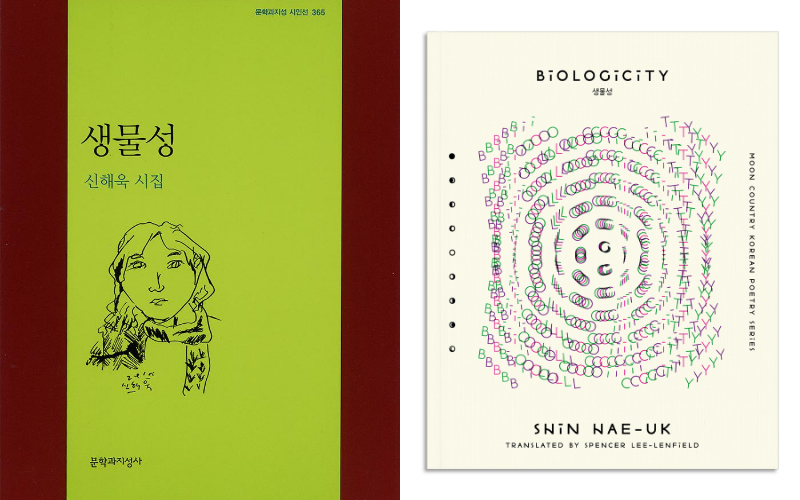
Two Korean poetry collections stood out in 2025 when they were shortlisted for the 2025 Lucien Stryk Asian Translation Prize, one of the most respected international awards dedicated to Asian literary translation. ‘’Biologicity’’ by Shin Hae-uk, translated by Spencer Lee-Lenfield, and ‘’Just Like’’ by Lee Sumyeong, translated by Colin Leemarshall. The shortlist was announced on Sept 11, 2025, drawing attention to the growing global presence of contemporary Korean poetry and the translators who bring it into English. The year’s competition reached its conclusion on Nov 6, 2025, when ‘’Just Like’’ was named the winner of the 2025 Lucien Stryk Prize at the American Literary Translators Association’s annual awards ceremony.
‘’Biologicity’’ explores shifting identities and blurred boundaries, letting voices move between people, objects, and memories. ‘’Just Like’’ takes a more abstract path, using fragmented language and dreamlike images to challenge how meaning is made.
Spencer Lee-Lenfield is an assistant professor of Comparative Literature at Harvard, where he focuses on teaching translation studies: research on translations, the practice of translation, and the history of how people have talked and thought about it. He’s working on a first book right now about the past century of translation among Korean-language writers and Korean émigré/e writers working in English, in both directions. Spencer was adopted from Korea as a very small child, and learned Korean as an adult, which helps him appreciate the language as something deeply precious, and won at hard cost, toward which he hopes he has a very humble relationship.
Spencer Lee-Lenfield is a celebrated journalist, scholar, and translator. His achievements include winning the 2023 William J. Foltz Journalism Award, publishing in leading academic journals, translating contemporary Korean poetry; ‘’Biologicity,’’ and joining Harvard’s Department of Comparative Literature faculty in 2025.
Below are excerpts from an email interview with him from Oct 21 to Nov 30 about Shin Hae-uk’s "Biologicity.’’
1. How did you encounter Shin Hae-uk’s "Biologicity," and what made you want to translate it?
I first read ‘’Biologicity’’ in Korean in the summer of 2021. I was trying to explore contemporary Korean poetry more, and I visited the wonderful bookstore Wit & Cynical, whose owner, the poet Yoo Heekyung, recommended the collection. He knew I was interested in collaborating with a poet on an English translation, and offered to introduce me to Shin Hae-uk.
2. What do you find most rewarding about translation?
I’ve always been interested in translation, even since I was about thirteen, maybe earlier. Translating words makes them come to life more deeply. The process of explaining or representing words in a different language somehow reveals more than you see on either side of the exchange alone; there’s the creative and interpretive pressure of rearticulation, which reveals rather than loses meaning, I think.
3. What was your favorite poem or line to translate from "Biologicity," and why?
‘’ Biologicity’’ charmed me because every line, every word, headed in a surprising new direction, but always with a surprising simplicity of style. I also admired Shin’s precision with sound so much, especially in her poem “Ears,” which made me want to translate the collection. I wrote several different drafts to try to represent the nuances of that tight three-line poem in English. It was the first poem I showed Shin my drafts of when we first met, and I’m grateful she let me translate the collection after that. I think we share a belief in the primacy of sound to poetry, which helps drive us from a similar impulse.
4. What does your translation process look like?
I normally begin a translation by writing marginal notes or ideas for phrases in the margins of a paper copy of the book. Then I start trying to turn them into a fuller draft, usually over one or two attempts. I go over the poems with the poet, if the poet reads in English (as Shin does). Then I usually ask many friends to read the draft, with varying kinds of perspectives on the language. Some might have Korean as their first language and then learned English; others might have English first, then know varying degrees of Korean; others might be bilingual and biliterate. Some might not know Korean at all, but know English poetry well. Each of these kinds of readers brings a different perspective, and can help save me from different kinds of mistakes
5. Did you imagine that your translation of "Biologicity" might be recognized by the Lucien Stryk Prize this year?
I’m very grateful that the Lucien Stryk Prize shortlisted me this year, and to the jurors for writing such incredibly kind notes about the book. The Stryk Prize helps draw attention to a genre of publishing that the vast majority of readers in the US barely see, and every bit of awareness and every additional reader helps.
6. The prize shows how translators connect different languages and cultures. What kind of connection do you hope "Biologicity" builds?
I hope that ‘’Biologicity’’ reveals a side of Korean poetry that readers in English may not have seen before: philosophical, cool, at times really funny. I think Shin’s Korean readers admire her partly for her ability to make them imagine differently, to always defy their expectations, and to expand the capabilities of Korean as a language. I hope that in its way, these translations challenge English to expand and grow in dialogue with Korean, too.
7. What are you working on next?
I’m currently working on Shin’s most recent book, ‘’Natural History from the Edge of the Natural’’ (2024), as well as a new approach to translating sijo and a draft translation from ‘’Hanmun’’ of a late-eighteenth-century diarist named Yu Manju. I’m really interested in classical Korean literature in addition to modern works, and I hope that I can help increase the range and visibility of Korean literature’s deep history.
The translation of ‘’Biologicity’’ in English allows readers everywhere to experience the beauty of Korean poetry.
How about this article?
- Like1
- Support0
- Amazing0
- Sad0
- Curious0
- Insightful0