Alessio Mariani, (Murubutu) professor of philosophy and history at the Liceo ‘Matilde di Canossa’ in Reggio Emilia, Italy and one of the leading exponents of Italian LetteratuRap, participated in the 25th Week of the Italian Language in the World in Korea. Murubutu in LetteratuRap Talk was a programme of events took place from 28 to 30 October 2025 in various locations between Busan and Seoul, in collaboration with the Italian Embassy in Korea, the Italian Cultural Institute in Seoul (IICSeoul), the University of Foreign Studies (BUFS), the Swiss Embassy in Korea and Hankuk University of Foreign Studies (HUFS).
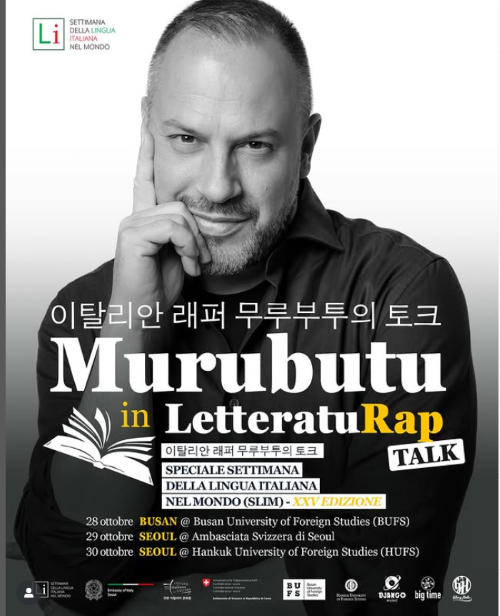
During these lecture-talks, Murubutu offered a reflection on Italian music, literature and language through a particular musical genre: rap. His literary background, musical career and teaching experience are a perfect mix for addressing the relationship between music and the Italian language. In fact, song lyrics must not only describe a situation capable of arousing emotions, but above all they must be able to tell a story. To achieve this, it is necessary to study, observe and understand the heritage of our language, including through new forms of expression such as rap, used in this case as an educational tool.
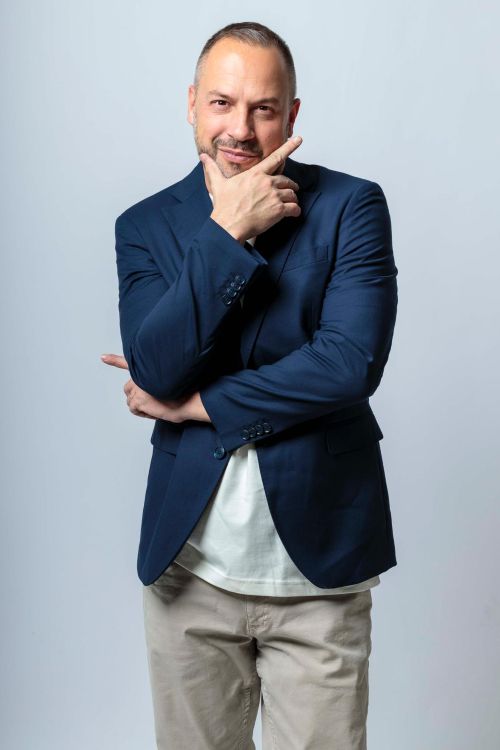
Throughout his career, Murubutu has released eight albums, including Infernvm, produced together with rapper Claver Gold and dedicated to the first of the three canticles of the Divine Comedy. His musical production connects music with poetry and classical and contemporary fiction, without forget the central role of experimentation.
Personally, I believe it is important to find new ways to communicate literature to young people, and music is one of the best tools for attracting their interest. The use of music for educational purposes not only allows young people to approach literature, but also allows foreigners to learn about Italian cultural heritage through a universal language. I interviewed Murubutu, whom I thank for his availability, and I hope that his literature will also win over Korean and international audiences and readers.
HR: Could you kindly introduce yourself and tell us about your musical training?
Hello. I'm a teacher of philosophy and history at the “Matilde di Canossa” high school in Reggio Emilia in Italy, as well as a rapper and songwriter. When I was young I studied clarinet at the conservatory, then during my adolescence I was struck by hip-hop culture. I’ve always been fascinated by the fact that it was a street culture, vital, direct, and that rap was the musical expression of a movement offering a strong possibility for identification.
HR: Could you explain the origin of your art name?
Murubutu comes from Marabutto, a word used in Sub-Saharan Africa to refer to a shamanic figure capable of healing both physical and social ailments. A name that evokes the therapeutic and healing power that words can have.
HR: You were recently invited to Korea. Can you tell us about that experience?
I was invited by the Italian Cultural Institute to the Italian Studies departments of Seoul and Busan. I thank Dr. Erika Sfascia and Prof. Campitelli for this wonderful experience. I had the opportunity to give three lectures at the Italian Studies departments in Seoul, Busan, and at the Swiss Embassy. I met Korean students studying Italian and evaluated their musical productions in the language. It was a highly educational opportunity on a professional level and deeply meaningful on a human one.
HR: Were you familiar with Korean culture? How were you received? Was there anything that particularly impressed you?
I had a superficial knowledge that came mostly from auteur cinema, particularly the works of Bong Joon-ho. I was impressed by the blend of progress and tradition that emerges in the cities I visited. It was very interesting to perceive the Buddhist influence on the interpretation of existence that emerges in ethics. I appreciated the importance given to education.
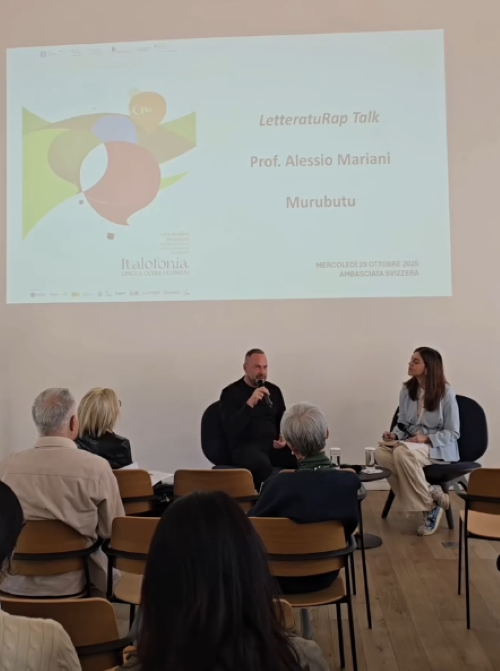
HR: During the 'Letteraturap' series of meetings held in Korea during 25th Week of the Italian Language in the World, what did you think of the audience? Did they understand your message?
I was pleased to find an audience interested in interpreting my words, despite the fact that my writing requires an effort of imagination, not just a linguistic one. I noticed the great dedication shown by students learning Italian in capturing the shifts in meaning and the nuances that emerge in poetic composition.
HR: Do you know Korean music? If so, what do you think of it?
I didn’t know Korean music well, except for some mainstream K-pop artists. It was interesting to discover Korean rap artists such as Nafla, Khundi Panda, and Paloalto.
HR: Korean music has some genres that combine social issues, music and theatricality, such as Pansori. Are you familiar with this Korean musical genre?
I learned about it for the first time during my stay in Seoul. It is a genre of great anthropological interest that could become a resource for me and an excellent opportunity for tribute through musical sampling aimed at producing beats for my tracks.
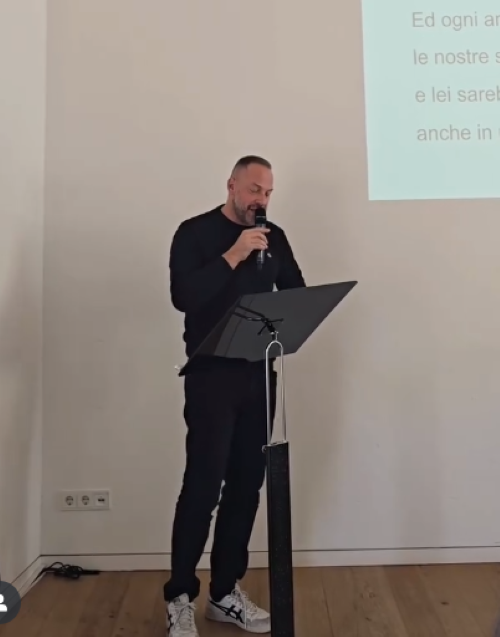
HR: You have published illustrated books based on the lyrics of your songs. How did you feel when you saw this project come true?
It is a remarkable satisfaction and a wonderful feeling to see the lyrics of one’s songs come to life through illustrations that fully convey the storyline and the emotions one wants to communicate.
HR: What are your future plans?
In early 2026 my booking agency, Django Music, has organized my first European tour, which will take me to Barcelona, London, Brussels, Berlin, and Dublin. This is not something to take for granted for an artist who sings exclusively in Italian. Then I will play new dates throughout Italy, and we are working on a new project with strong jazz influences.
How about this article?
- Like2
- Support0
- Amazing0
- Sad0
- Curious0
- Insightful0