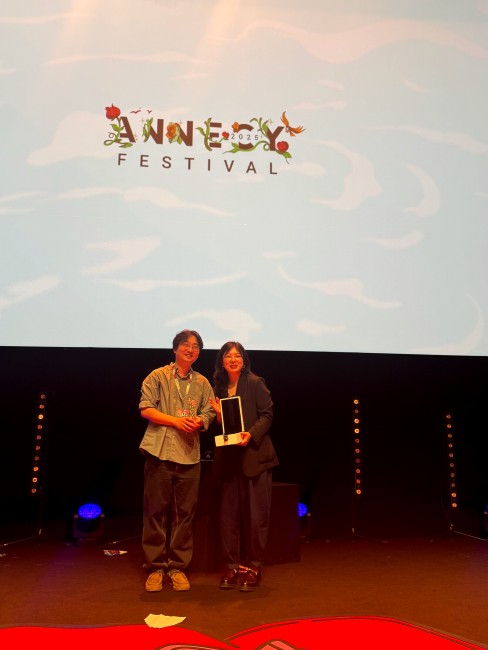
Director Kim Bo Sol's animated film 'The Square' (Gwangjang) won jury prize in contrechamp feature film competition at the prestigious 49th Annecy International Animation Film Festival in France. A graduate of Korean Academy of Film Arts, and this is the director's debut feature film. Director Kim's film The Square gained international recognition for it's unique genre and compelling storyline.
In May 2025, at the Far East Film Festival, in Italy, it was first premiered and chosen as the closing film. Furthermore, this film is selected to be featured at the 29th Bucheon International Fantastic Film Festival in July, at Korean Fantastic category. Hence, domestically it is going be screened for the first time in Korea .
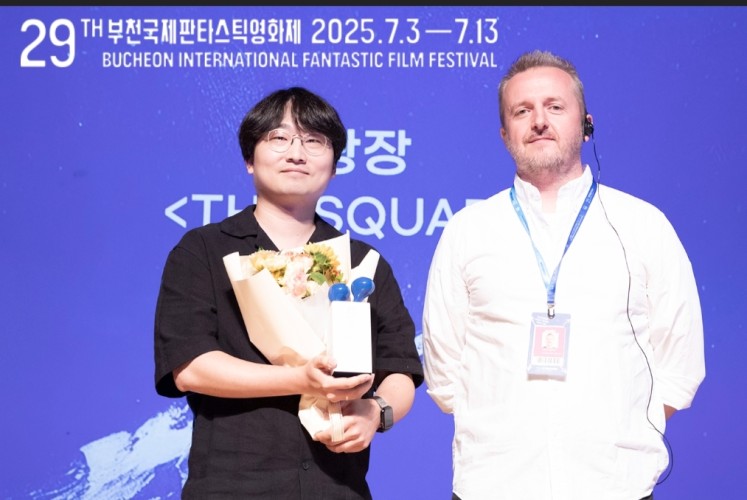
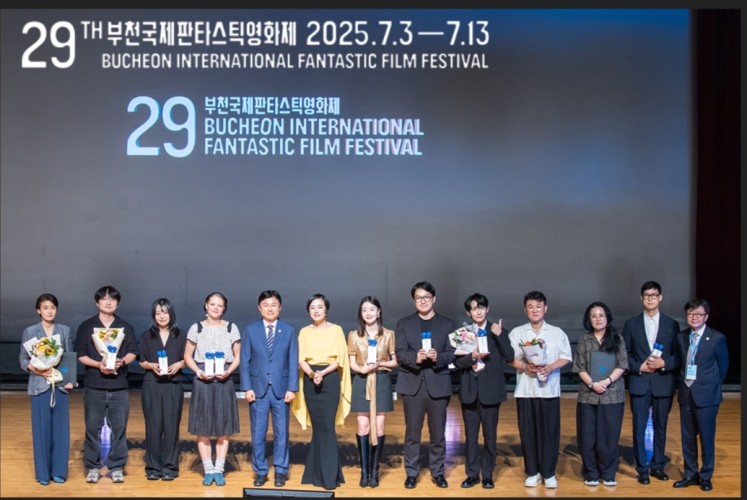
On 11 July it was announced by BIFAN that Director Kim Bo-Sol is recognized as the Best Fantastic Director in the Korean Fantastic feature film category for his film 'The Square’.
I learnt about "The Square" while searching films on the BIFAN website. After reading about this film, it seems interesting and I wanted to know more about his creative process. I was fortunate enough to interview Director Kim Bo Sol via email from 13 June to 20 June.
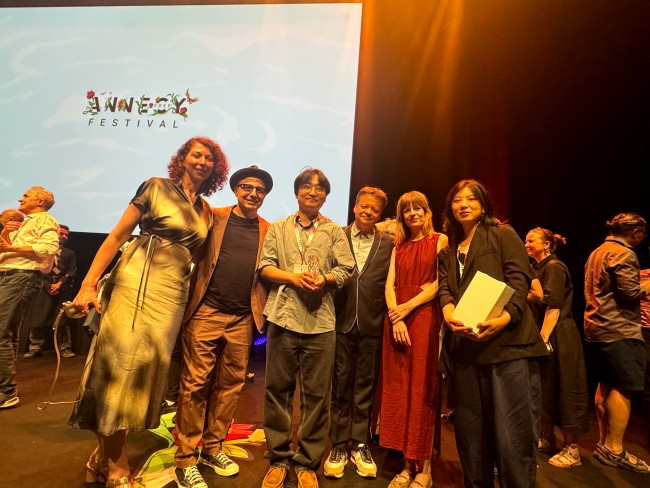
1. Please introduce yourself.
My name is Kim Bo-sol and I am a film director. I majored in film, but currently creating animations.
2. How did you get interested in animated filmmaking ?
The reason I started animation was when I was studying film, I wrote a scenario for my graduation project, but it was a story that was absolutely impossible to make into a movie. It was a story about a cat living 9 times and dying. I wanted to make it so badly, so I decided to make it into an animation, and that's how I ended up making my first 2D animation. After working at several places, I wanted to make my own movie, so I entered the Korean Academy of Film Arts. I like animation because it's a world where there are no limits to imagination.
3. What do you think is the most important thing about creating animation?
It's hard to say just one. I think there's nothing that's not important. Scenario, character design, storyboard, animating, staffing, background, lighting, filming, post-production, sound, music, etc., none of them are unimportant. I think the answer to this question depends on what kind of story the director is telling. Even within animation, there are several directions that are pursued. There are films that proceed mainly with abstract images, and films that are composed of narrative-centered films. I'm someone who focuses on genre films so if there's one thing that I pay special attention to, it's probably the scenario. Animation is also a film, right? The level of the work is determined by what kind of story it tells, so I think the scenario is the most important.
4. Can you tell us about your inspiration behind making "The Square".
There are very complex reasons. When I was in high school, a teacher told me stories about Korea's geographic characteristics during class. It was rarely heard in the Korean high school environment where students had to study only for college entrance exams. The teacher explained the relationship between Korea, Japan, China, and the United States in a very interesting way, and the story was based on a book. The teacher often said, we should read the book if we want to know more. Lee Young-hee, a respected journalist and intellectual during 1950s and 1960s, was the writer of the book.
I am not a generation that experienced that era directly, but I learned that it was a time when the fear of war dominated the world. After the Korean War ended in 1953, the Korean peninsula was divided into two parts, and tensions were high that war could break out again at any time. During this time, reporter Lee Young-hee was the one who suggested that we look at the conflict from a new perspective. Reporter Lee Young-hee in her article did a symbolic act that showed her perspective of looking at the relationship through dialogue and understanding rather than tension and conflict.
Thanks to this background, I was influenced by my high school teacher to read reporter Lee Young-hee’s books. The geographical location of Korea is interesting not only for me but also for most Korean men because we have to serve in the military.
In the meantime, in 2016, when I was studying film, I came across an article. It was an interview article conducted after a Swedish diplomat returned from working in Pyeongang, Democratic People's Republic of Korea after three years. When the reporter asked, “What was life like in Pyeongang?” the diplomat answered, “I was so lonely.” This phrase really piqued my curiosity. In addition, the diplomat said that he could not even share a drink with his colleagues due to the surveillance and control there. In the end, he said that the only way he could relieve his stress was to ‘ride a bike alone in a square where no one was present.’ Crucially, the powerful image of a ‘diplomat riding a bicycle alone in an empty square’ became a powerful trigger, intertwined with my interest that I had for a long time. So, I thought about making it as a short film.
5. What is the meaning of the title "The Square" ?
The image of "a Swedish diplomat riding a bicycle alone in an empty square" this scene was set in a space called 'square', and the novel 'Square' by Choi In-hoon, a Korean writer, also influenced me. The main character of the square in the novel, 'Lee Myung-jun' and the main character of my movie ' The Square', 'Lee Myung-jun', are the same. The 'secret room' mentioned in the novel is not a 'secret room', and the 'square' is not a 'square'. In the movie, the closed room is invaded by the superiors from time to time, and the square is empty.
The real protagonist of the movie is Lee Myung-jun, and I wanted to take off his curtain of anxiety. The moment Myung-jun feels lonely, he feels freedom for a very short time. And the background of that climax scene is also a ‘square.’ That’s why the title became ‘Square.’
6. What is the main theme of your film ?
The keyword of the movie was ‘loneliness’. If I describe this movie in one line, I would say ‘a thin leak in a thick concrete wall’. I never really thought about the theme of the movie. I did think about the goal that the movie should show. That was to make the main character, Myung-jun, feel ‘loneliness’. You might misunderstand. That’s because Myung-jun in the movie looks lonely throughout the running time. But he is not lonely. He is anxious. He is too anxious and tense to feel lonely. So my goal in the movie was to make Myung-jun feel ‘lonely’. Is the moment he feels ‘loneliness’ the moment he feels ‘freedom’? I thought that if ‘The Square’ showed that, it would be successful.
7. Are there any reasons behind choosing a foreigner as one of the main characters ?
The article that triggered this movie had a Swedish person in it. That was one reason, and Actually, after researching the facts, I found that there are embassies of Germany, Switzerland, and Sweden in Pyeongang, Democratic People's Republic of Korea. It was also a reason to thoroughly stick to the facts. In fact, the fact that his grandmother was a Korean is more important than the fact that he is Swedish. This movie ultimately has a layer underlying it to tell a story about Korea.
8.How do you ensure that these characters get emotionally and visually relatable with the audiences?
In order for the characters to emotionally and visually resonate with the audience, they have to be well-made. The storyboard affects this part greatly. I draw the storyboard myself, and I edit the images in my head while following them to create a video. And when a scene ends, if nothing is felt, I draw it again. When I work that way, the viewers seem to be a little more immersed in the story.
9. As Pyeongang is an unreachable place, can you guide us through your research process ?
The first was Googling, the most common thing and anyone can find information reported in the media. The second was Instagram. I was frustrated because of limited image research. However, now it allows many tourists from around the world to take close-up photos of actual roads and people in Pyeongang and share them, these images helped a lot. Research on images and videos were easy, but we were curious about, culture, clothing, and history, that was done through interviews. There are many defectors from Democratic People's Republic of Korea who came to Republic of Korea, and we asked them for interviews, and they helped us a lot when we were actually coordinating the scenario and language.
10. Can you introduce us with voice actors and staff members?
It wasn't easy to find voice actors. The voice had to match the image on the screen. Since pronunciation was important, we had to find actors who had a background in theater. I wanted to keep the historical accuracy as much as possible. I didn't want to exaggerate the dialects. So I thought about going to someone who actually lived in Pyongyang, but that was impossible. So I worked hard to find actors who fit the characters, and ended up casting Jeon Woon-jong for the character of Myung-jun, and Lee Ga-young for the character of Bok-ju. Thanks to the actor Jeon Woon-jong we met other actors. Director Oh Yu-jin and cinematographer Lee Do-hyun are my close friends who gave me honest advices and worked hard to make this film.
11. What was the most challenging and rewarding moments creating The Square?
I was most nervous about recruiting music director Yongjin Jeong. Around 2015, I first met the music director at a creative workshop. I attended the workshop as a junior creator and listened to the pitches of many creators, but music director Yongjin Jeong felt different. I remember that music director Yongjin Jeong talked about his thoughts on making music and how he had come to this point. At the workshop, he gave us a sheet of paper with phrases from books that he could use while working. I had such fond memories of that time that I thought, ‘If I become a film director later, I want to work with him.’ I kept the paper that he gave me. Even before the script for ‘Gwangjang’ came out, I asked the PD to hire music director Jeong Yong-jin, but, I got the answer, ‘I don’t work with students…’, then PD asked me to meet the director once and decide. I briefly mentioned our past relationship and asked him to participate in the film. After listening to my story, the director decided to work with me, and I felt a great sense of accomplishment the first day I received the music for ‘Gwangjang’. I framed the A4 paper that I had received 10 years ago from the music director and gave it to him as a gift on the day of the final mixing.
12. How do you feel about the recognition of “The Square” internationally and domestically ?
I am happy. I actually expected the overseas response because of the curiosity about Pyeongang, Democratic People's Republic of Korea. The genre of the film helped it with universal recognition. In Korea, it will be first screened at the Bucheon International Fantastic Film Festival. Since Bucheon Film Festival screens so many films with strong genre characteristics, I actually did not have high expectations. I was surprised after getting the selection message from the distributor. I was so grateful that they chose a film that no domestic film festival would show.
The Official Trailer of 'The Square’ ( Video Credit : Bucheon International Fantastic Film Festival)
13. What was the most challenging scene to animate in The Square?
There are many scenes of riding a bicycle, and drawing them was the most difficult. In particular, there is a long take at the beginning of the movie where Isaac rides a bicycle alone in the square.
14. Are there any future projects that you are currently working on?
Yes, It's about three sisters fighting ghosts in the middle of Gwanghwamun.
15. What do you think about the future of animation in Korea?
While traveling to overseas film festivals, I received many questions about the Korean animation industry. At the time, I answered positively, but I don’t really know. Since I have been working on a small scale, I don’t know the infrastructure, the production capabilities and skills of the industry. I know that they receive a lot of work from the US and Japan, but I think the most important thing is how much thinking power they have. If originality comes from Korea and there are more competent directors, I think the Korean animation industry will naturally grow.
16. What advices do you want to give to the future animation directors ?
I'm not very good at it either, so please give me some advice. If you want to become an animation director, I think you should first make animations. Make them, enter them in film festivals, and watch a lot of other works. For now, I think it would be good to start like that. And I think it would be helpful to introduce the method I trained myself. First, I tried to watch a lot of good movies and I compare the level of those good movies with the works I made. Second, I give beyond my limits. I want to give up, quit, compromise. It’s painful and agonizing, but I think creation starts from there.
17. Please share a message to our readers.
I think there are probably a lot of people among readers who are not related to animation industry. However, I hope you can enjoy the story of someone who is in a different field than you. Summer is coming soon. I hope it won't be too hot and you will have a nice summer. Thank you.
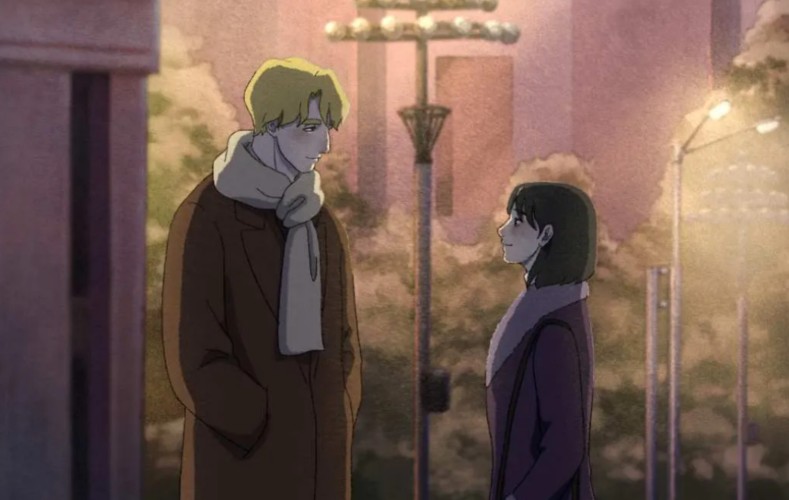
In the above interview, Director Kim Bo Sol, shared his journey of making "The Square". From a student of film study to becoming a director of animated films, what made this change. Director Kim talked about his inspiration behind making 'The Square'' and shared his creative process. This film discusses the story of a Swedish diplomat in Pyeongang who feel in love with a traffic officer, but it is more than a typical love story, as it in the film it shows an inaccessible place for most of the us. Director Kim Bo Sol's tirelessly research and dedication made "The Square" a successful film.
The interview was conducted before Kim Bo Sol's win at BIFAN.
How about this article?
- Like5
- Support2
- Amazing0
- Sad0
- Curious0
- Insightful0