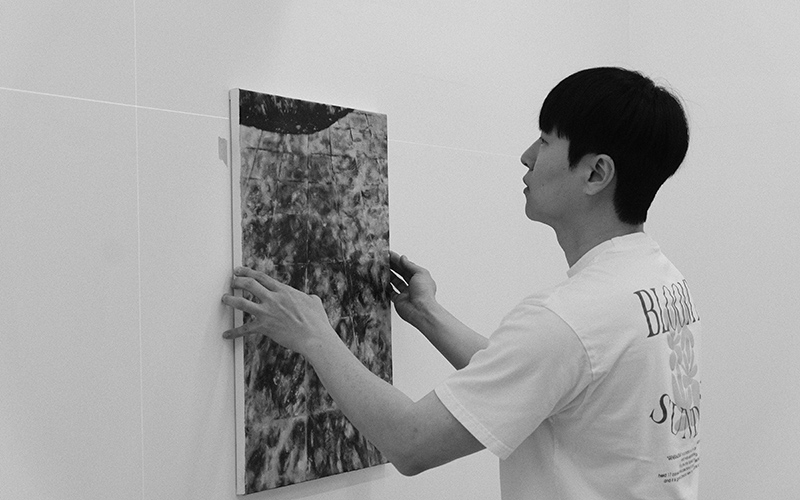
There is a certain depth hidden even in the most ordinary moments of daily life — in the effort of a plant to grow, in the stance of an object, or in the stroke of a brush. Artist Kim Dae You captures these quiet vibrations beneath the surface and brings them to life through his paintings. In his world, a work is considered “complete” not merely when it is visually balanced, but when it begins to speak through intuition.
Describing himself simply as “a person who paints,” Kim’s practice spans from figurative to abstract, weaving together diverse techniques depending on the subject and the mood. Beyond the canvas, he establishes subtle dialogues with nature and everyday objects, inviting viewers into a shared space of reflection. Sometimes, his work appears unexpectedly in a popular Korean drama; other times, it waits quietly in the stillness of a gallery.
In this interview, we explore his relationship with art, the rhythms of his daily life, his intuitive sense of completion, and his philosophical reflections on the concept of “possession.” Kim Dae You’s world offers a gentle invitation to those who dare to pause and breathe in a fast-paced age.

- Who is Kim Dae You? Could you briefly introduce yourself to us?
I'm Kim Dae-yu, a painter. I usually deal with everyday scenes and draw them using various techniques depending on the object or situation. I usually work with oil on canvas, and sometimes I also draw and sculpt.
- If you had to describe your art in just three words, what would they be?
Surface, uncertainty, mediation.
- Can you describe an ordinary day in your life as an artist?
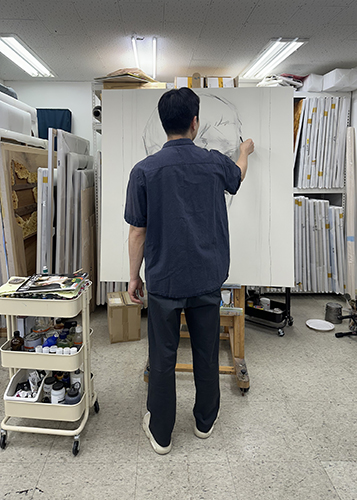
I usually have a light meal and exercise when I wake up in the morning. And then I head to my studio. After a cup of tea or warm water, I start drawing. I usually work until around 10 p.m. and go home. I tend to bring a lot of my favorite things to my studio and enjoy them. I have several plants, including insectivorous plants, Nepenthes, so I tend to manage them and look into beautiful collections like pottery, tea utensils, vases, and lacquer.
- How and when do you know a piece is finished?
I think the most important part of my painting is deciding when the work is completed and the moment it stops. I make decisions based on intuition rather than following the logical structure of capturing and drawing a scene or object. This is because I also understand the reason as I draw it. So, usually when the reason for starting painting is revealed on the screen, it's over. However, it has to be balanced formatively as well. When the two are completed together, you decide that the painting is over. This work sometimes flows surprisingly smoothly, and sometimes it takes a lot of struggle.
- How does it feel to be an artist working in Korea?
Korea is rapidly increasing its interest in culture and art. About 15 years ago, there were very few people who went to art galleries daily, and art in other fields did not receive much attention except for popular music, movies, and dramas. Now, I feel that the atmosphere has changed a lot. It is amazing to hear my friends abroad say that their interest in Korea has increased even in foreign countries. However, I think the art trade market, such as collection and sales, is just beginning. Therefore, I don't think it is easy in many ways to make a living through art activities in Korea.
- How does South Korea’s rapidly changing cultural landscape influence your art?
Changing quickly also means a good environment to accept new things. So it's good for various experiences based on new information. On the other hand, being too fast also puts pressure and pressure on you. Everyone has their own speed. But in an environment like Korea, I feel like I'm constantly lagging behind. I feel a lot of pressure to always run with a fast beat. I think I can work for a long time by controlling myself so as not to fall into that kind of mood.
- What is the strongest feeling or message you hope to convey through your art?
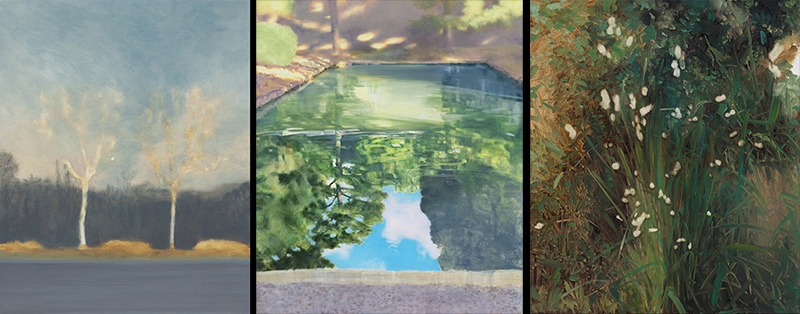
In previous works of landscape, rather than specifying a specific message, I wanted the audience to find out what they felt in the painting. I get a lot of inspiration from nature, but I don't think there's a specific message in nature itself. It's just there. It's up to people to find meaning there. I hope my painting works that way.
- Is there an artist, book, music, or film that inspires you?
Many artists make me love painting more. From Velázquez and Manet to Lucian Freud, Richter, and Alex Katz, I tend to see many artists ranging from classical to modern. I still enjoy trying and experimenting with this and that, rather than organizing myself.
- We know that your artwork has appeared in some popular Korean dramas. How did you become involved in those projects, and what was the experience like for you?
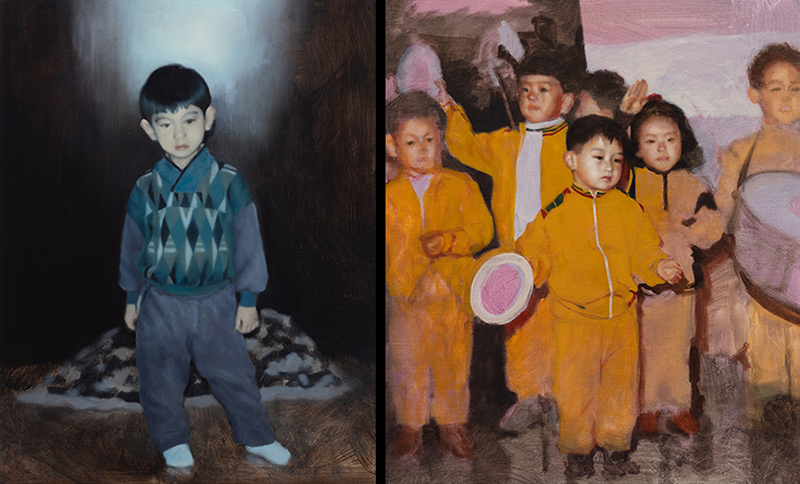
It's my first time working on tvN's drama "Little Women." The art team was looking for an artist and got a recommendation from an acquaintance of mine. After that, they contacted me after seeing the figure painting I posted on my Instagram feed. In fact, I rarely drew characters after graduation, but the painting I drew recently was a little dark, so I think they judged that it went well with the atmosphere they wanted in the play. I thought it was really interesting when those conditions fit well. Thankfully, the art team of "Little Women" participated in the work of "When Life Gives You A Tangerine", and they asked again.
Usually, writers work on an individual basis, so I think there are more cases where they think about the direction of their work alone and create it.
The experience of participating as part of a big project and playing a particular role was interesting and enjoyable. Also, it's a big difference to receive feedback in the middle of work. Sometimes it's frustrating when I think about it alone. Should I go like this? Would it be better to go like that? In that sense, it is easier to work if there is a relatively clear goal.
In addition, it is difficult for many people to see even if they work and exhibit, but I also feel that there is a great strength in that area, because many people see works through the mass media.
- What has been the most memorable comment or piece of criticism you’ve received?
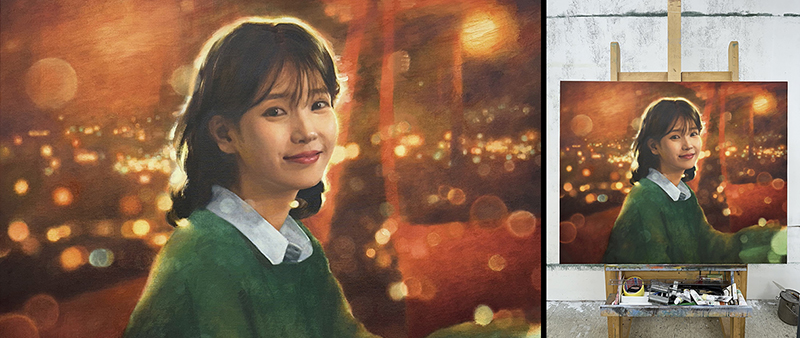
Recently, I posted a portrait of IU in the drama <When Life Gives You A Tangerine> on Instagram.
Someone said in the comments, "No, this Art-piece was drawn by Choong-seop!" I thought that the character in the play loved it, and it was the most memorable words because I laughed at the way he denied reality.
- What projects or goals are you planning for the near future? Could you share what excites you artistically these days?
I've been thinking about 'having' lately. While drawing landscapes for a while, I drew them based on specific emotions or feelings. In the end, I thought that maybe that too was a way to come up with a way to possess something intangible that I couldn't have. I like collecting small things. Then, I suddenly thought, what does it mean to own something? Can I say that I own something just because I bought it and have it? Can I say that I own something like buying clothes for a character in a game, which is not a real thing? Are memories completely mine? And so on. I feel like I'm in the process of moving on to new work. I hope you'll show a lot of interest in my new paintings.
I would like to thank him again for agreeing to interview me. I hope you enjoyed reading it.
Thank You
How about this article?
- Like2
- Support0
- Amazing7
- Sad0
- Curious0
- Insightful0