Many kings have ruled in an organized political way, but the list of truly best ones is comparatively short. Such kind of lists include Monarchs like Sejong. King Sejong the Great who was born on May 7, 1397, became the fourth king of Korea during the Joseon Dynasty (sometimes called the Yi dynasty). King Sejong was regarded to be the wisest and greatest King universally. The reason behind this is very clear “King Sejong The Great” created many things and the most prominent one is Hangeul originally Hunmin jeong'eum (훈민정음) i.e Korean Alphabets. King Sejong was personally involved in the creation of Hangeul. Hangeul is an entirely distinctive system of writing that Koreans consider to be the very soul of their cultural treasures.
Who was King Sejong the Great?
King Sejong the Great “세종대왕”, born by the original name Yi To, was the fourth monarch of the Joseon Dynasty, ruling Korea from 1418 to 1450. He is remembered as one of the greatest kings in Korean history, largely due to his numerous cultural contributions, the most significant of which is the creation of Hangeul, the Korean alphabet.
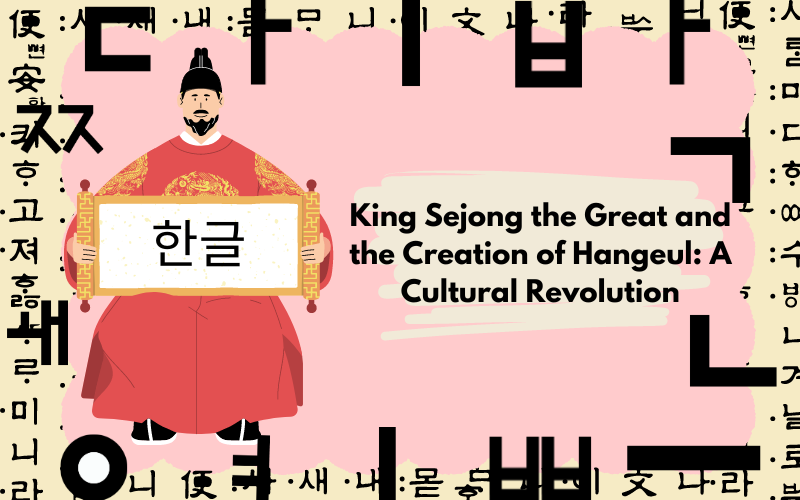
King Sejong's picture represents his involvement in the creation of hangeul, [ Picture credit: made by Sumaiya Chauhan on Canva].
What did King Sejong create?
Sejong’s most profound contribution was the invention of Hangeul, originally named Hunmin Jeongum ‘훈민정음’, meaning “The Correct Sounds for the Instruction of the People.” Hangeul provided the Korean people with their writing system, replacing the previously used Chinese characters. It was designed to be simple and accessible, enabling even the common people to read and write. This innovation revolutionized literacy in Korea. Hangul Alphabet consists of 24 letters which were originally 28 letters, now there are 14 consonants ㄱ ㄴ ㄷ ㄹ ㅁ ㅂ ㅅ ㅇ ㅈ ㅊ ㅋ ㅌ ㅍ ㅎ and 10 vowels ㅏ ㅑ ㅓ ㅕ ㅗ ㅛ ㅜ ㅠ ㅡ ㅣ.

9th October is celebrated as Hangeul Day or Hangeulnal, [ Picture credit: made by Sumaiya Chauhan on Canva].
When was Hangeul created?
King Sejong the Great first announced the idea of Hangeul in 1443, and it was officially completed and introduced to the public in 1446. Since Korea’s independence, 9th October has been celebrated as Hangeull Day or Hangeulnal. Despite initial resistance from scholars and officials who preferred Chinese characters due to their political relations and thought that it would be hugely disrespectful towards the Chinese Empire. King Sejong believed that they needed Hangeul so that Koreans could have their own language that would be able to capture the unique meaning of the Korean language. Hangeul eventually became the dominant script, shaping how Koreans communicate.
Where was Hangeul developed?
The development of Hangeul took place in the Joseon Dynasty of Korea, with much of the intellectual work conducted in the Jiphyeonjeon Hall, a royal academic institute established by King Sejong. This institution was home to scholars who worked closely with the king on various cultural and scientific advancements.
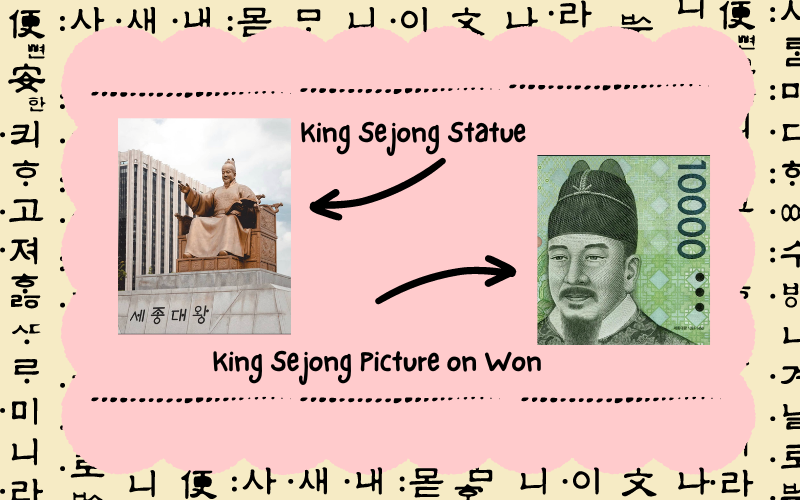
King Sejong's popularity can be seen through his photos on won, academies and statues, [ Picture credit: made by Sumaiya Chauhan on Canva].
Why did King Sejong create Hangeul?
King Sejong was dedicated towards a desire to improve the lives of his people. At the time, only the educated elite could read and write using the complex Chinese script, leaving the majority of the population illiterate. King Sejong saw this as a significant barrier to communication and societal progress. His goal was to create a script that was easy to learn so that even the common people could express their thoughts and feelings in writing.
How was Hangeul designed?
Hangeul’s design is both scientific and intuitive. Each consonant was based on the shape of the mouth and tongue when producing the sound, while the vowels were formed using simple lines and circles. The system was structured to make learning straightforward, reflecting Sejong’s deep understanding of linguistics and his vision for an egalitarian society where literacy was accessible to all.
King Sejong was awarded the title of “King Sejong The Great”, his period was even regarded as “the Golden Age of Korean history”, full of intellectual thoughts and cultural accomplishments. Hangeul is a lasting testament to King Sejong’s legacy. It is more than just an alphabet, it represents the king’s dedication to his people and his belief in the power of education and communication. Today, Hangeul is a proud symbol of Korean identity and culture, a reflection of the wisdom and vision of King Sejong the Great.
How about this article?
- Like6
- Support0
- Amazing1
- Sad1
- Curious0
- Insightful0