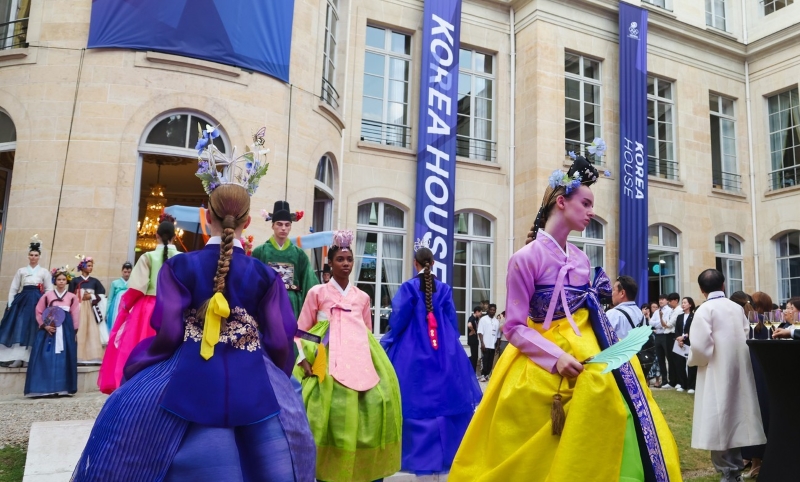
On Aug 1, during the 2024 Olympics, the Ministry of Culture, Sports and Tourism, along with the Korea Craft & Design Foundation, organized a Hanbok (Korean traditional attire) fashion show at the Korea House, located at Maison de la Chimie in Paris, to celebrate and showcase Hanbok to the world.
Seven esteemed Korean Hanbok designers participated, including Kim Young-jin from Tchai Kim, Kim In-ja from Dangchomoon, Kim Ji-won from Wondress, Kim Hye-soon of Kim Hyesoon Hanbok, Song Hyemi from Seodamhwa, Yoo Hyun-hwa of Yuh Hyunhwa Hanbok, and Lee Hye-soon from Damyeon.
I had the opportunity to interview two Hanbok brands that participated in the Hanbok fashion show at the Korea House during the 2024 Olympics in Paris.
Tchai Kim is a ready-to-wear brand based on the free-spirited and nomadic sensibilities of Namsadang, one of Korea's traditional performing arts, which was founded in 2012 by Kim Young-jin. The brand primarily uses pure and natural materials such as linen, cotton, and silk to provide comfort, while mixing traditional and modern fabrics to enhance the garments with delicate details.
Tchai Kim's clothing breaks away from the limitations of traditional Hanbok design, offering more original pieces that seamlessly blend with contemporary fashion. Rooted in traditional Hanbok, designer Kim Young-jin creates clothing that captures Korean lines and sentiments while being both global and modern. Signature items from Tchai Kim include the cheollik dress, Yeonan Kim-style jeogori, jeoksam jeogori, baenaet jeogori, sapok pants, dapho, and baeja. These garments reinterpret traditional designs with added functionality, showcasing the splendor and practicality that rival Western clothing.
Kim Youngjin is also recognized for designing Hanboks for the K-drama “Mr. Sunshine” (2018), the film “Love, Lies” (2016), and the play “Hamlet" (2016), as well as for the Hanboks featured in the Visit Korean Heritage campaign promo video, which was displayed at New York’s Times Square billboard in 2021.
The Tchai Kim brand has been featured in several Hanbok exhibitions and fashion shows, including “Hallyu! The Korean Wave” at the V&A Museum in London from 2022 to 2023, and “Kfashion82” at Paris Fashion Week in 2023.
Below are excerpts from an email interview with Kim Young-jin on Aug 13-20.
1. Could you share your journey as a Hanbok designer?
I have always loved theater, particularly traditional Korean performing arts. My passion for our cultural heritage was so strong that I even studied Korean traditional music. As a result, I naturally developed a deep affection and interest in Hanbok. Additionally, when I was young, my sister took Korean dance as a hobby, and the Hanbok I saw at that time left a lasting impression on me.
Initially, pursuing a career in theater proved to be economically unstable, so I started working in the fashion industry for a more stable livelihood. Although, I didn’t have a special background in fashion, my dedication allowed me to gradually gain recognition and build experience. After working in the luxury fashion industry for about ten years, I faced health issues and felt a sense of burnout. What started as a pursuit of mental and physical well-being turned into a more serious engagement with Hanbok when I was fortunate to be accepted as a student by Park Sun-young, a Seoul Intangible Cultural Heritage master. This allowed me to delve deeply into creating hanbok.
2. Where do you draw inspiration for your Hanbok designs?
Continuing traditions is crucial. Since understanding comes from seeing, it is important to study traditional attire extensively. For example, studying garments from museum collections can be very informative. However, inspiration also comes from beyond historical clothing; films, theater, dance, and even everyday life as seen on platforms like Netflix. I first select materials based on the design I envision, and then I refine the details to bring the design to life.
3. Hanbok design features a variety of colors, styles, and materials. Which design elements do you focus on the most? Do you prefer experimenting with different styles, or do you follow a particular design approach?
I consider the temperature of colors to be the most important, but I also believe that good clothing starts with quality materials. From the perspective of a brand manager rather than just a designer, I sometimes grapple with using only the best materials. However, knowing that the hanbok I create could be remembered as "just another garment" motivates me to choose the best materials from the start; those that are comfortable and don’t strain the body. This commitment to using high-quality materials, coupled with my unwavering dedication, has allowed me to consistently produce excellent Hanbok. I believe this sincerity has resonated with those who wear Tchai Kim’s Hanbok, contributing to the brand's popularity.
I view designers as akin to chefs. One of the essential virtues of a chef is having a keen eye for ingredients. Similarly, I believe the most important quality for a designer is the ability to understand and evaluate materials. It’s crucial to constantly consider how to use a material, what its characteristics are, and how to maximize beauty and functionality through it.
4. What motivated you to take part in this event?
We aimed to showcase both the present and traditional aspects of Hanbok alongside other talented Hanbok designers through the Hanbok Promotion Center.
5. What was your main inspiration behind the Hanbok designs you showcased at the Korea House during the Paris 2024 Olympics?
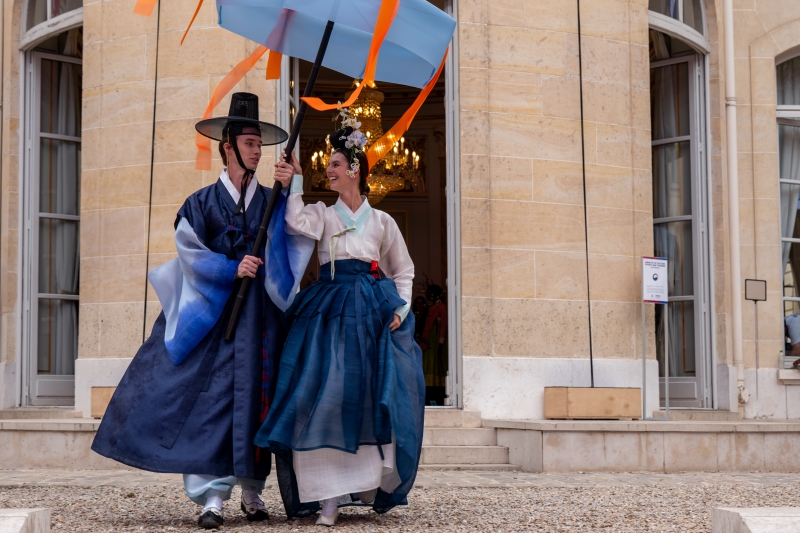
The designs were inspired by the theme of "A Summer Outing of a Young Girl." I imagined a girl who participated in the 1900 Paris Exposition returning to visit the Korea House at the 2024 Paris Olympics. The outfits were designed to wish for and celebrate the victory of the Korean Olympic team.
6. Which types of Hanbok did you use for the event? Did you focus on royal, court, or other specific styles and why?
Given that the event was held in the heat of summer, we chose to use lightweight materials. We incorporated skirts made of hemp and ramie as underlayers and focused on dyed skirts and ramie jeogori to create a harmonious look. The designs featured playful elements, such as ribbon skirts and jeogori made from summer silk, to match the lively theme.
7. How do you want the public and international fans to view Tchai Kim’s Hanbok?
Tchai Kim is a fashion Hanbok brand that offers both ready-to-wear garments for everyday convenience and custom Hanbok designs tailored to individual preferences and settings. We hope that people will enjoy wearing Hanbok with Tchai Kim's unique colors and characteristics, choosing pieces that fit their own tastes and situations.
8. How do you preserve traditional elements in your Hanbok designs while also introducing new Hanbok styles?
The most important aspect of my Hanbok creation is adding my own innovation on top of tradition. For instance, the development of the women’s cheollik dress, which was traditionally a men’s garment, exemplifies this approach. While my personal touch is crucial when conceptualizing a new Hanbok, a deep exploration of tradition is always the starting point. I continuously study and research traditional Hanbok to variate them in my own way.
During the Joseon Dynasty, which was a male-centric society, Hanbok development was naturally centered around men’s garments. I realized that it would be beneficial to adapt the aesthetically and functionally excellent Joseon-era men’s cheollik to contemporary times, adding my unique touch to create genderless or women’s Hanbok. This led to the creation of Tchai Kim’s cheollik dress. Alongside this, I have also been developing designs such as the Yeonan Kim-style jeogori, 16th-century jang jeogori, danryeong, jiknyeong, and akju-eum.
9. Are there any upcoming collections or future plans?
We are currently developing Hanbok that are easy to wear while traveling, inspired by Tchai Kim's spirit of wanderlust and the freedom of Namsadang. The collection will use materials that are less prone to wrinkling, allowing the garments to be taken out of a travel bag and worn immediately when needed. Additionally, we plan to utilize the advantages of flat pattern cutting to create garments made from a single fabric that can be worn in multiple ways, expressed through Tchai Kim’s unique design language.
How about this article?
- Like3
- Support2
- Amazing0
- Sad0
- Curious0
- Insightful0