Greek HR and author attends the first online Seoul International Writers’ Festival (SIWF)
2024-08-06"We are a narrative species." - Hwang Sok-yong
Summer may still be underway, but for Korean literature aficionados, autumn peeks promisingly on the horizon—with the colours of the 13th Seoul International Writers' Festival! SIWF (서울국제작가축제) is an annual cultural event, which has been taking place since 2006 and which enables the literary exchange between Korea and other countries of the world. The organisation behind SIWF is the Literature Translation Institute (LTI), both of which lie under the auspices of the Ministry of Culture, Sports and Tourism of Korea.
As the upcoming SIWF of September 2024 will take place in Seoul, it is obviously difficult for many overseas authors and literature lovers to attend it in person. As an HR from Greece since 2020, this had me reminiscing about how 2020 was also the year that I was able to experience this rich festival—because for the first time, due to the ongoing COVID-19 pandemic, the incredible 9th SIWF didn't take place in person but online! Although initially this may seem like a pity (the international writers participating back then didn't have the chance for live one-on-one discussions), the fact that that year's SIWF happened online broadened its audience, expanding it towards all corners of the world. I experienced the rich conversations and poetic atmosphere of the 9th SIWF while wearing my writer's hat, too, and even if it was through my computer screen, it was an unforgettable experience that I vividly remember to this day.
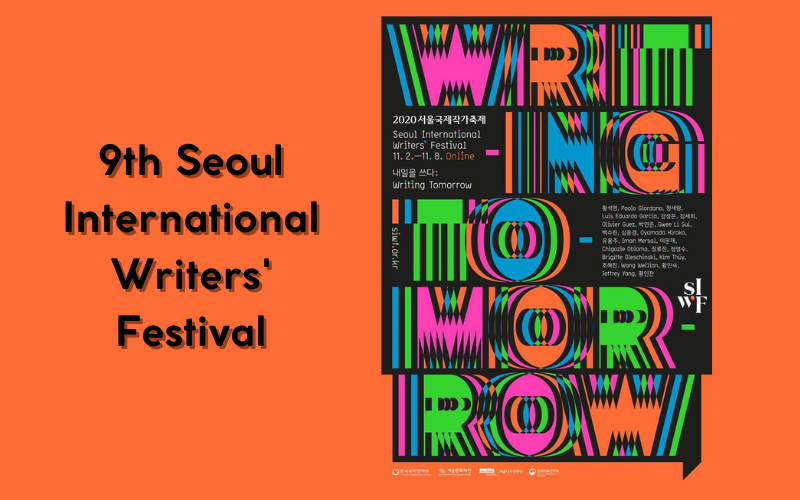
Preceded by pre-event reading sessions, which the participating writers themselves performed, the discourses spanned from the 2nd to the 8th of November 2020. That year's SIWF was the 9th since the festival was first established, and its theme was ‘Writing Tomorrow’. Following the Opening Keynote Speech day, the program consisted of two sessions per day, all of which started with each creator reading an excerpt from their work. The brilliant discussions ensuing among the invited writers covered a wide variety of subjects extending beyond the writing craft, such as gender equality and the harsh reality of minorities, while they were also masterfully linked with the global pandemic and its impact. The sessions that followed only broadened and enhanced this promising premise.
— 2nd of November, Opening Keynote Speech - "Writing Tomorrow" (내일을 쓰다)
The digital opening of the 9th SIWF featured greetings from Kim Sa-in (Literature Translation Institute of Korea), Kim Jong-whee (Seoul Foundation for Arts and Culture) and Choi Kyung-ran (Seoul Design Foundation), who set the tone not only for this introductory session but also for the themes of the entire SIWF. The importance of solidarity and how we should actively incorporate it in our lives was pointed out, as well as the role of the writers and their literary concepts of the world to come. The Opening Keynote Speech was delivered by Korean author Hwang Sok-yong ('Princess Bari', 'The Old Garden'). Quoting from the poem 'Night Spent Counting Stars' by national poet Yun Dong-ju, the renowned and acclaimed author stressed how much poetry helped him cope with the difficult times we all faced due to the pandemic.
"The COVID-19 pandemic looks like a question, asking us whether the civilisation we have achieved and the daily lives we lead have been right." - Hwang Sok-yong
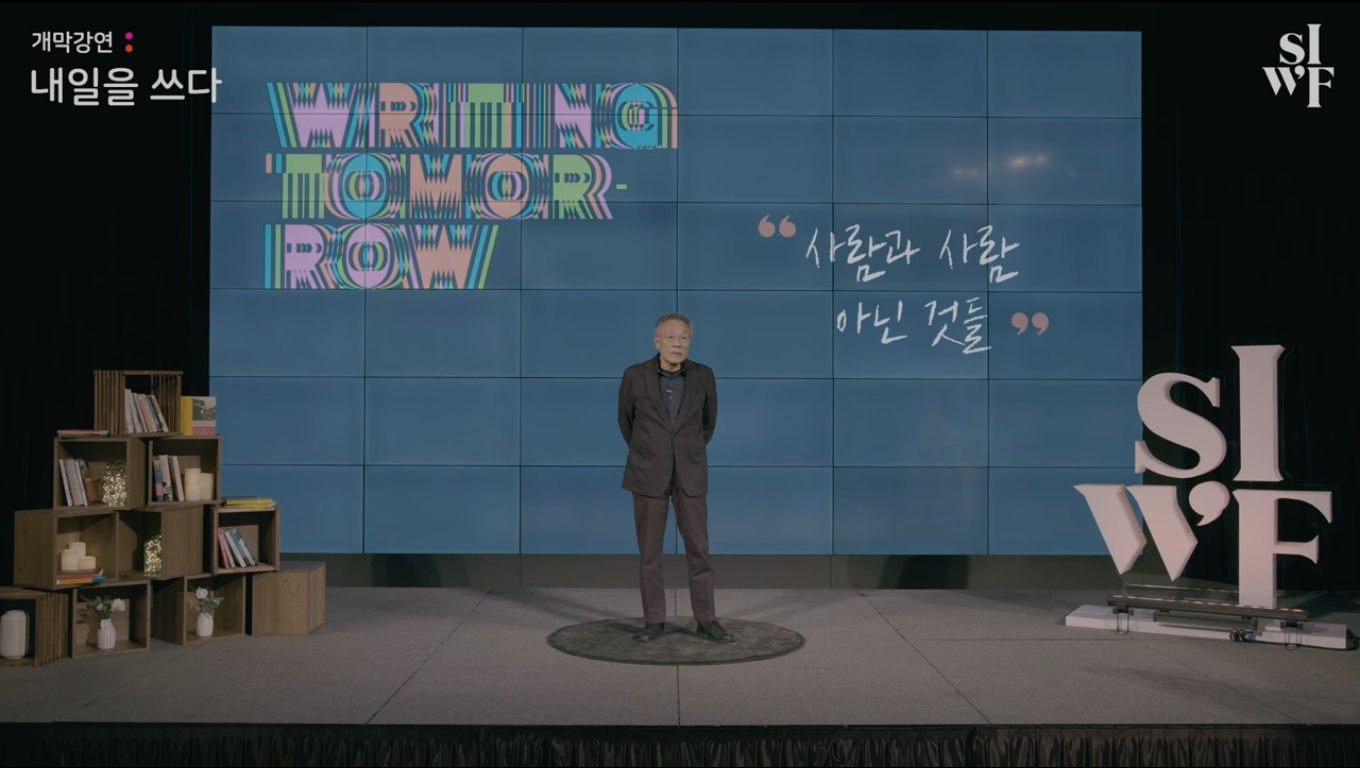
Moving on to elaborate on the effects of the COVID-19 pandemic, author Hwang described it as a terrible occurrence and as something that marked the beginning of a new era. Our world revolves around numbers and measuring things, but the pandemic proved how this model of life simply doesn't work. The writer that he is, Hwang beautifully built a comparison of how we are given the chance to move from the "summery 20th century" (symbolised by 'The Old Garden' in his novel of the same name) to the "autumnal 21st century", where we are to keep only the finest parts of the harvest. According to him, the balance that must be struck lies between what we conceive as individual freedom, desires and potential greed and what constitutes the common good and the solidarity engulfing it.
"True universality means respecting each other's different identities." - Hwang Sok-yong
For author Hwang, the ever-neuralgic, present and global subject of migration poses issues of identity and universality. On the other hand, we just have to look at phenomena like Hallyu, an undeniable, grand example of embracing something different from our own culture. The writer masterfully cited another comparison around the Korean mythology of 'dokkaebi'—inanimate things, too, play a vital role in our lives. That is why we must treat them with respect; we are more than aware of how undeniable climate change is, along with the immediate need for our planet's protection.
“In the eyes of the Earth, we are coronavirus.” - Hwang Sok-yong
Regarding Korea's reflexes on tackling the pandemic, author Hwang praised the country's resilience and strong community spirit, which saved the day. He identified the very same resilience in literature, too. For example, binge-watching may have undoubtedly skyrocketed during the pandemic, but the publishing industry also noticed an upward trend. Reading is a unique chance to self-reflect, claimed author Hwang. And people read a lot during the COVID-19 lockdowns, which multiplied our solitary hours despite technology uniting us. Everything connects us and, as author Hwang quoted again from a famous Korean proverb, "illness helps you grow". Everything is a matter of perspective and where we focus on, which is why, at the end of the pandemic, a sense of improved self might await us.
— 3rd of November, sessions "You Must Crawl Forward" (낮은 포복으로 전진하라) and "Adventures Surrounding 'Me'" ('나’를 둘러싼 모험)
The afternoon session titled "You Must Crawl Forward" featured writers Kang Sung-eun ('Scheherazade') and Sou Linne Baik ('Brown Sugar Candy') from Korea, as well as Kim Thúy ('Ru') from Canada. Elaborating on the history of women and its depiction, their discussion revolved mainly around female autobiographies. Sou Linne Baik stressed the importance of not labelling a literary work carrying the voice of a female character or written by a female writer as a separate genre because this may lead to it being treated as such—perhaps, that is, as a trend that may not last throughout time. On the same note, the writer also pointed out how female writers of today spread their wings across a wide variety of genres. Sharing her story across multiple professions, including being a lawyer before becoming a writer, Kim Thúy acknowledged how each of her professions has taught her and contributed to her literary career. She also shared her experience on the challenge of being a writer fluent in three languages and the effects of that on her work. The discussion ended with the conclusion that the key to transforming our present and forming a better future, literary-wise, too, is to tackle and eradicate inequalities.
The next session titled "Adventures Surrounding 'Me'" featured writers Cho Hae-jin ('The Joys of Promenaders') from Korea and Chigozie Obioma ('An Orchestra of Minorities') from Nigeria.
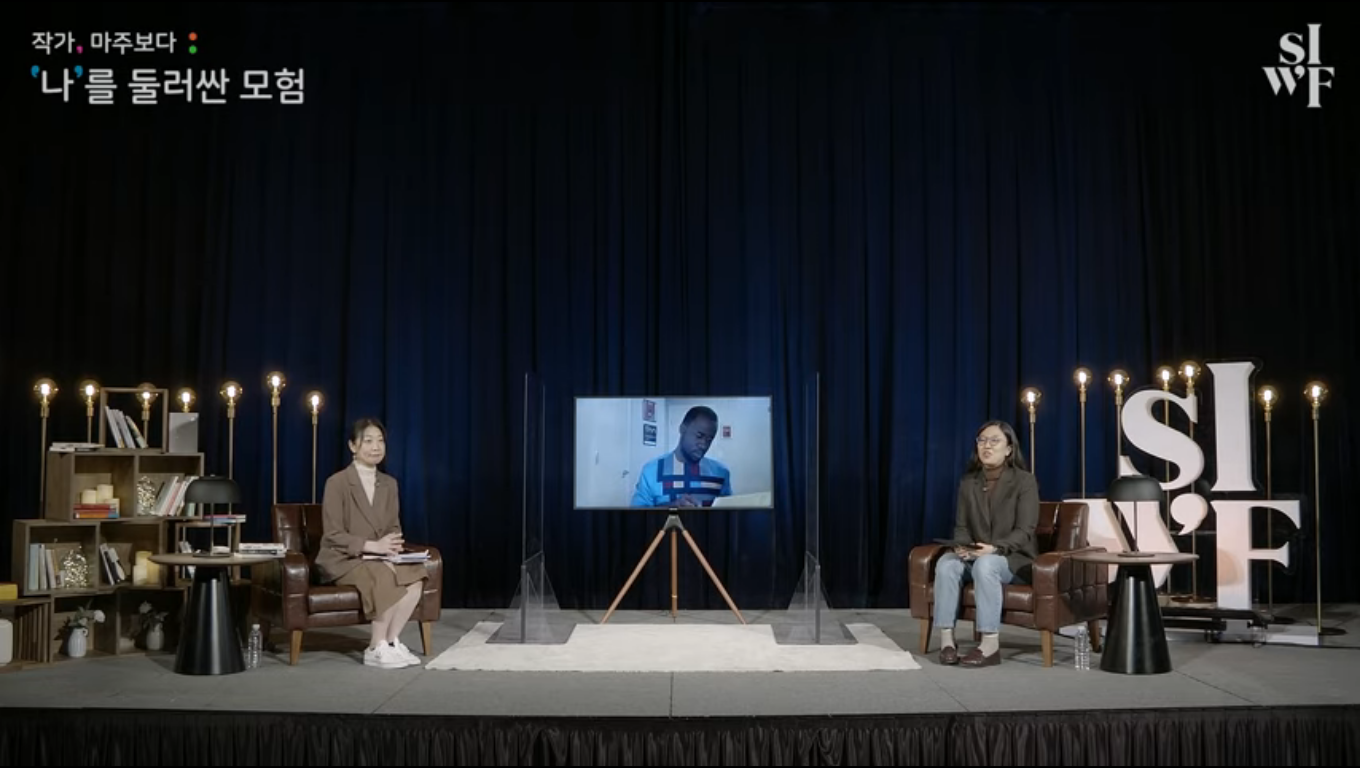
"Individuals come before the world, and the world cannot suppress our imagination." - Cho Hae-jin
Discussing minorities as a literary subject, both writers admitted drawing inspiration from their personal stories. As far as solidarity within the circles of minorities is concerned, writer Cho claimed that this is what makes us feel alive and helps actualise our purpose as humans. As for her heroes, they belong to different kinds of minority groups (e.g. in terms of financial means, etc.), yet they all search for happiness. For her, the role of history in moulding our lives is undeniable. However, each of us is and remains unique. On the other hand, writer Obioma, who has been inspired in his work by Nigeria's Ingbo cosmology, emphasised that we remain a part of the world and its history. According to him, minorities are created at any given time and for whatever reason; even when we feel we don't belong, we're instantly a minority. Regarding their first steps as writers in their countries of origin, Obioma admitted that curiosity about people's lives propelled him to start and keep writing. For Cho, writing is an outlet for the mind's troubles, and she finds her way by sailing across each of her characters' psyches. As for the pandemic, writer Obioma claimed that against the hardships related to it, we should all appreciate everything we have. He stated that repeating patterns in our daily lives, within and outside of us, leads us to grasp the meaning of existence.
"Essentially, I write novels because I often regard myself as a minority." - Cho Hae-jin
— 4th of November, sessions "Writing in Social Isolation" (고립된 세계, 고독한 글쓰기) and "Where Literature Stands" (문학이 선 자리)
The session "Writing in Social Isolation" featured poets Hwang In-suk ('Sadness Wakes Me') and Hwang In-chan ('Washing a Myna') from Korea, as well as Jeffrey Yang ('The Grass') from China-US. Noting how the pandemic reforms a writer's everyday life and routine, poet In-chan also stressed how important it is for literature to incorporate the queer perspective in it. Yang elaborated in turn on how language lies at the centre of all art forms, while for Hwang In-suk, poetry is an outlet for the turmoil within her inner world and her bearer towards bliss. She also admitted that growing up, she saw her work shifting more and more, from focusing on her emotional state to other people and what is happening in their lives.
"Creative activities heal us." - Hwang In-suk
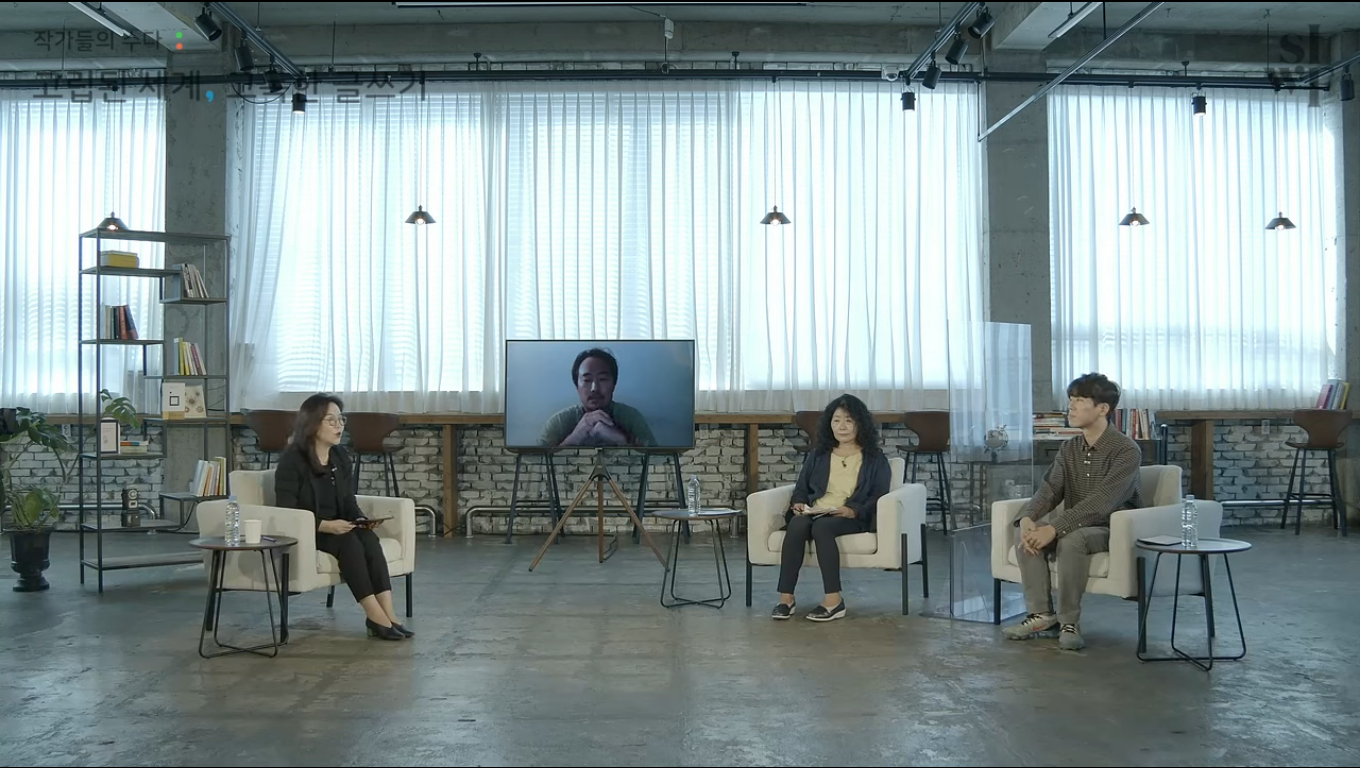
The "Where Literature Stands" session found novelist Olivier Guez ('The Disappearance of Joseph Mengele') from France and poet Yu Yong-joo ('Red and Green Nail') from Korea conversing on how having different day jobs affects their writing. Yu, a labourer before becoming a poet, mentioned being inspired as a teenager by Yoon Dong-ju's poem 'Foreword' and how his journal was the pivotal source of his inspiration. Guez analysed how, for him, writing sessions are something that doesn't happen to him daily but only when there is inspiration. Moreover, as a journalist, he expressed his gratitude for the variety this job has brought him, such as experiencing new places, meeting new people, and so on.
"Art unites us" - Olivier Guez
— 5th of November, sessions "Writer · Media · Room" (작가 · 미디어 · 방) and "Exposed to Danger" (위험 앞에 노출된)
The "Writer · Media · Room" session featured writers Gwee Li Sui ('The Hermit') from Singapore and Jung Young-su ('Tomorrow's Lovers') from Korea.
For Sui, a multi-talented poet, critic and graphic artist whose works appear on many digital platforms and social media, each medium works best with a different art form. While he is working on literary pieces he aims to publish, he uses Instagram as an outlet for his poems ('Insta-poetry'), aiming thus also to uplift, encourage and engage with his fan base. Defending the new era's wide variety of digital media, which writers now have at their disposal, Sui stressed how they open new horizons and help us reach out to new audiences beyond those of our own countries. A writer should always be mindful, of course, of their work not becoming too dependent on their readers and their wants. According to Sui, self-published writers play an essential role too, many of whom have very original things to say and offer. And thanks to the new digital era, they finally have access to a wide variety of platforms to make their works known.
Jung, a fiction writer and literary editor, elaborated on how imagination can only lead a writer halfway, as far as literary fiction is concerned. From then onwards, experience has to take over and provide its raw material for inspiration. On the positive side of being an editor, he pointed out how structured and multifaceted the world of editing is. Aspects of it also help him grow as a fiction writer by allowing him to experiment with different writing styles. Talking about his digital literary magazine Munhakdongue, Jung stressed the need for new literary platforms; writers need outlets to showcase their works and receive steady payment in exchange.
Poets Iman Mersal ('The Clot') from Egypt and Park Yeon-joon ('Venus Pudica') from Korea took the floor for the "Exposed to Danger" session. During their discussion around poetry, Mersal drew on her own experiences and her country's history to support the idea that writing is a kind of resistance. Park led with a beautiful point of view, as well: sometimes poetry is the only suitable means through which something can be expressed, and the quality of a poem is (oddly) measured by its ability to 'wound' the reader—"a worthy wound”, as the poet herself said.
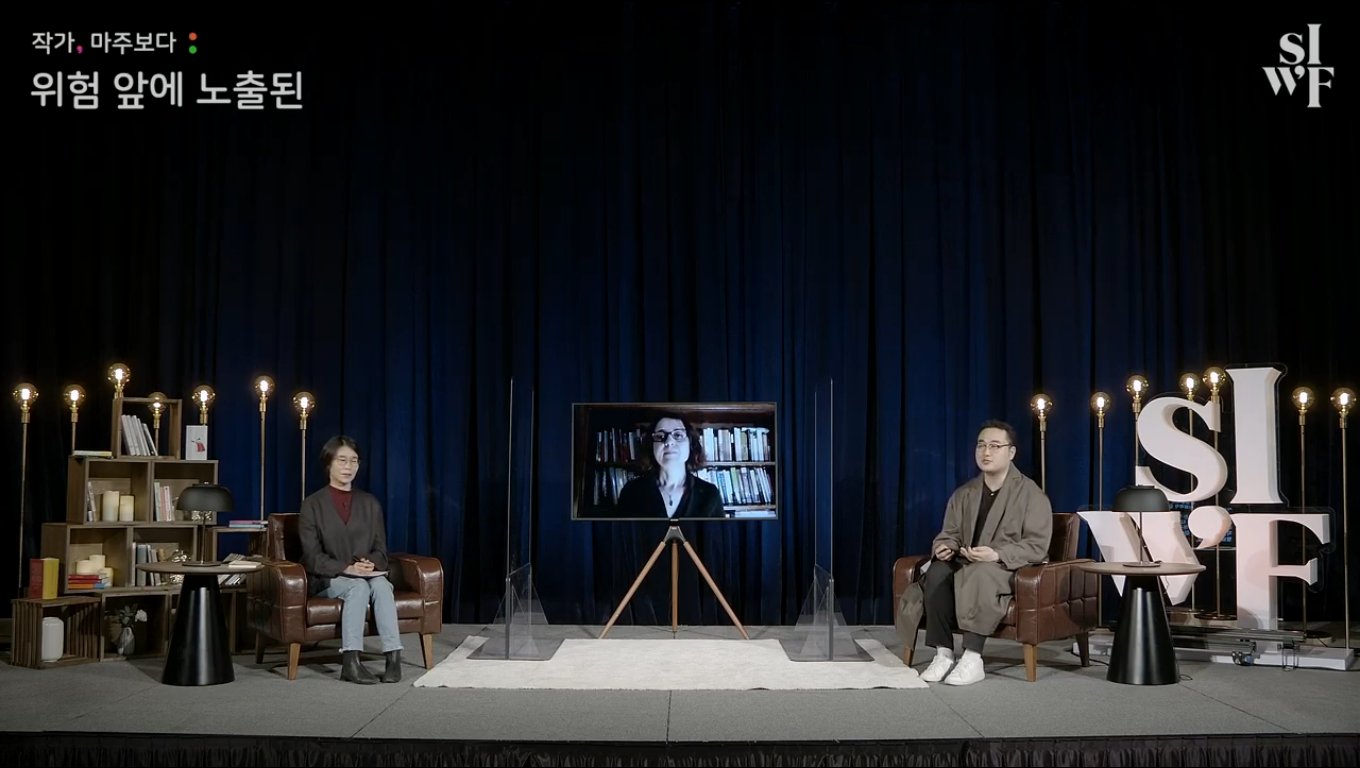
Elaborating on the Confucian and patriarchal system, according to which she and, even more so, her family generation before her grew up, Park explains how, in her very own words, "society forced femininity" on her. Contrary to men, women have always been subject to a whole lot more evaluations and an absurd amount of boxes to be ticked, while also burdened with the responsibility for the feelings of others. For Park, all this may lead women to not love themselves or take a lot of time to learn to do so. Poet Park also quoted Virginia Woolf's 'Killing the Angel in the House' and stressed the importance of allowing artists, especially women artists, the freedom to express themselves. This is the only way to truly move towards gender equality.
— 6th of November, sessions "In the World of Tomorrow" (내일의 세계에서는) and "Growing Suspicions" (생각할수록 수상한)
"In the World of Tomorrow" session writers Sim Yun-kyung ('Seol') from Korea and Luis Eduardo García ('Latest Trends') from Mexico discussed the role of literature in a social context, specifically in terms of the younger generations and their future. Their conversation also focused on how people nowadays, and on a global scale, no longer read literature. During the next session, Japanese writer Oyamada Hiroko ('The Factory') recounted her different job experiences before becoming a writer—having worked as an administrative assistant at a factory led her to see firsthand how negatively our current socioeconomic system impacts our lives. Korean author Jang Ryu-jin ('The Joys and Sorrows of Work'), as she too has worked at an office, talked about the challenges of freelance writing in contrast to the stability office environments provide.
— 7th of November, sessions "Despite Loneliness and Sorrow" (외로워도 슬퍼도) and "Garden of Tomorrow's Language" (내일의 언어 정원)
During the first session, we met Wang Weilian ('The Sound of Salt Forming') from China and Kim Se-hee ('Practicing Emotions') from Korea. Both writers, born in the 80s, analysed social isolation, what literature means to our lives today, and their generation's take on the matter. Weilian mentioned how lonely his generation back home is since it was after the 80s that the one-child rule started applying in Chinese households. As for fiction writing, he described it as a means of self-education, a way for us to be led to the bare truth that lies untapped within us.
"My generation has been forced to wear clothes that don’t fit.” - Kim Se-hee
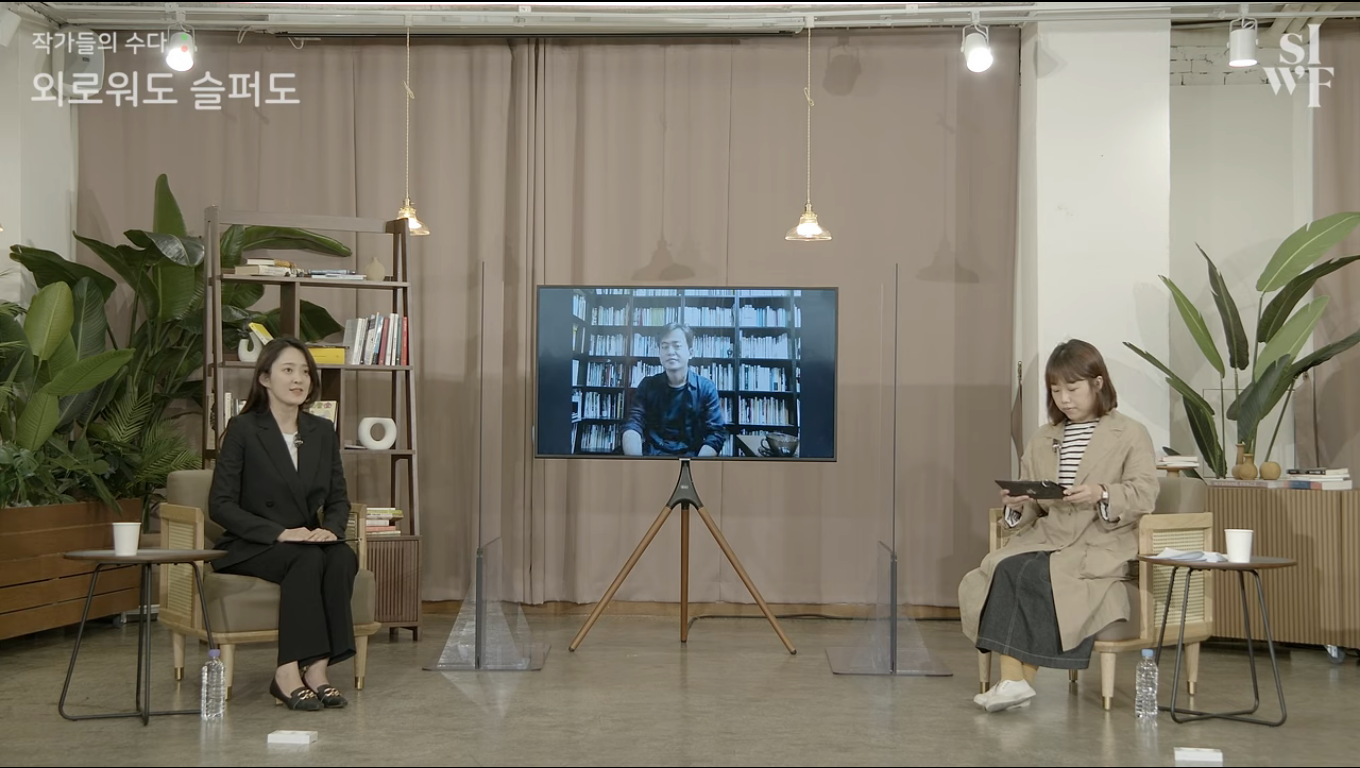
Poignantly agreeing, writer Kim claimed that today's generations have all kinds of sources of entertainment at their disposal. She, however, both as a reader and as a writer, opts for literature, because it is the only means that has the power to be a true mirror of every aspect of our lives.
Welcoming poets Brigitte Oleschinski ('Mental Heat Control') from Germany and Lee Moon-jae ('The Joke') from Korea, the second session of the day revolved around how the lightning-fast rhythms and style of everyday life leave the authentic, creative parts of ourselves stunted and depleted.
— 8th of November, Closing Keynote Speech - "In Our Devastated World" (망가진 세계에서, 우리는)
The closing discussion featured writers Chung Se-rang ('You Can Have My Voice') from Korea and Paolo Giordano ('How Contagion Works') from Italy. As the 2020 SIWF concluded, Chung echoed author Hwang Sok-yong's point of view during the opening keynote speech: the cause of the COVID-19 pandemic is our unacceptable conduct towards our planet, and we have the undeniable climate change to prove it. Our species has become highly selfish, and literature can solve our disorientation by awakening our solidarity and sense of community. Giordano concluded that the lockdown in his homeland had negatively affected his reading and writing habits by adding that "each behaviour of us isn't only about us anymore."
"The essence of love is in its ability to spread." - Chung Se-rang
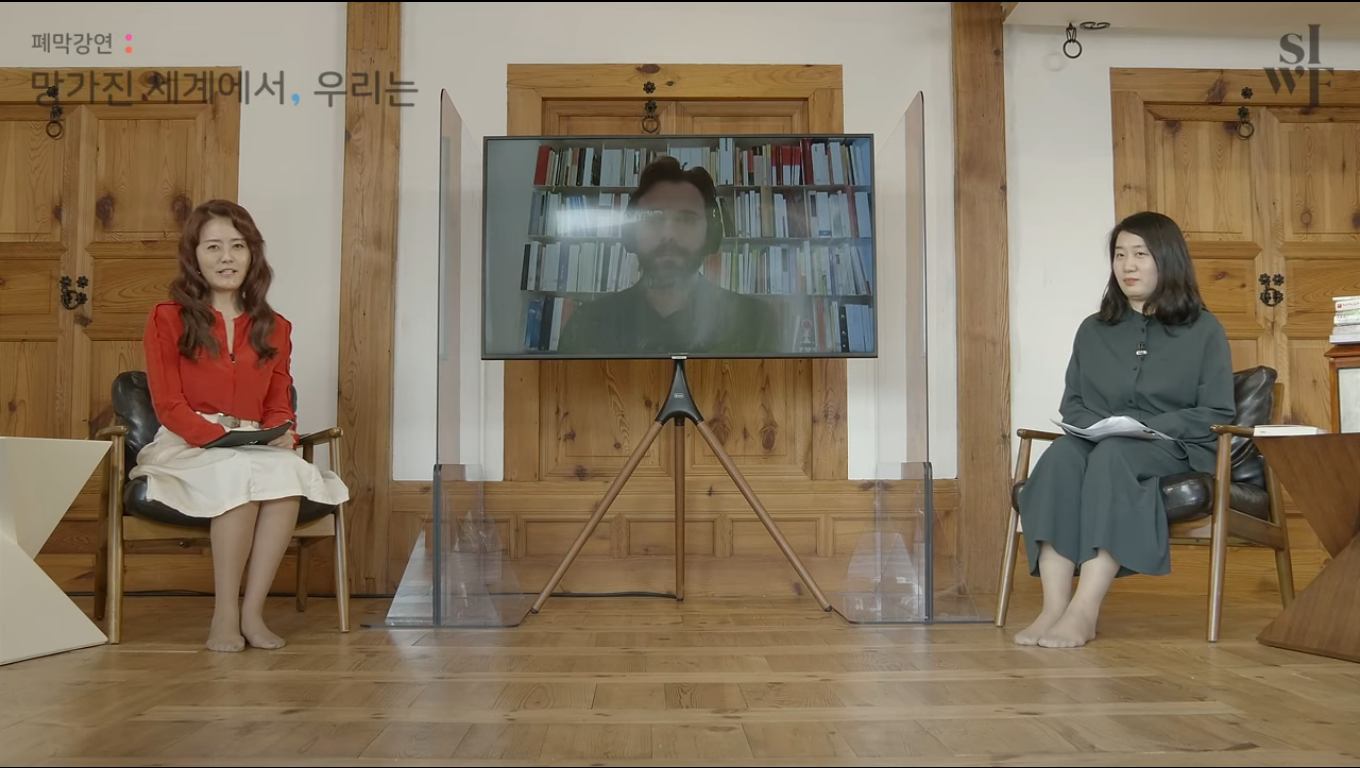
Having watched the entire festival and clicked the exit button on my browser after the last speech wrapped up, I felt that the 9th SIWF was the most wholesome and thought-provoking writers' festival I have ever attended. It indisputably stands as a model for other international writers' festivals in all aspects—high artistic quality, variety of unique and inspiring topics, diversity and pluralism, and promotion of equality and human values, to name a few. Moreover, the fact that that year, the festival was also accessible to a broader audience by being available online gave a further dimension to the importance of literature writing and reading for our future as humanity.
Being a writer is a thing of unique beauty. Although it can plunge us into the depths of despair whenever we are tormented by a comma that won't heed us, it can also make us soar into the skies, tagging along with our untamable imagination. Furthermore, it provides innumerable opportunities to grow and discover new things and horizons. That is why, on a more personal note, the 9th SIWF allowed me to find out about authors from all over the world whom I might otherwise not know. Attending those online, fruitful discussions was a most creative experience for me as a writer, reader, and global citizen.
Here's to hoping this review of the COVID-19-era SIWF whets everyone's appetite for this year's festival, themed 'Particles & Waves'. Even if it takes place in person in Korea, SIWF will always remind us that no matter how far away we might be from each other, we are closer than we think—through reading good books and writing stories worth telling.
Till the 13th SIWF—and beyond–read on!
More information on SIWF, including literary material, past sessions, featured writers' bios, and more, can be found on its official website and the LTI YT channel.
*I'd like to extend my warmest thanks to SIWF and LTI Korea for their excellent and prompt cooperation regarding the photo material of this article.
How about this article?
- Like2
- Support1
- Amazing1
- Sad0
- Curious0
- Insightful2