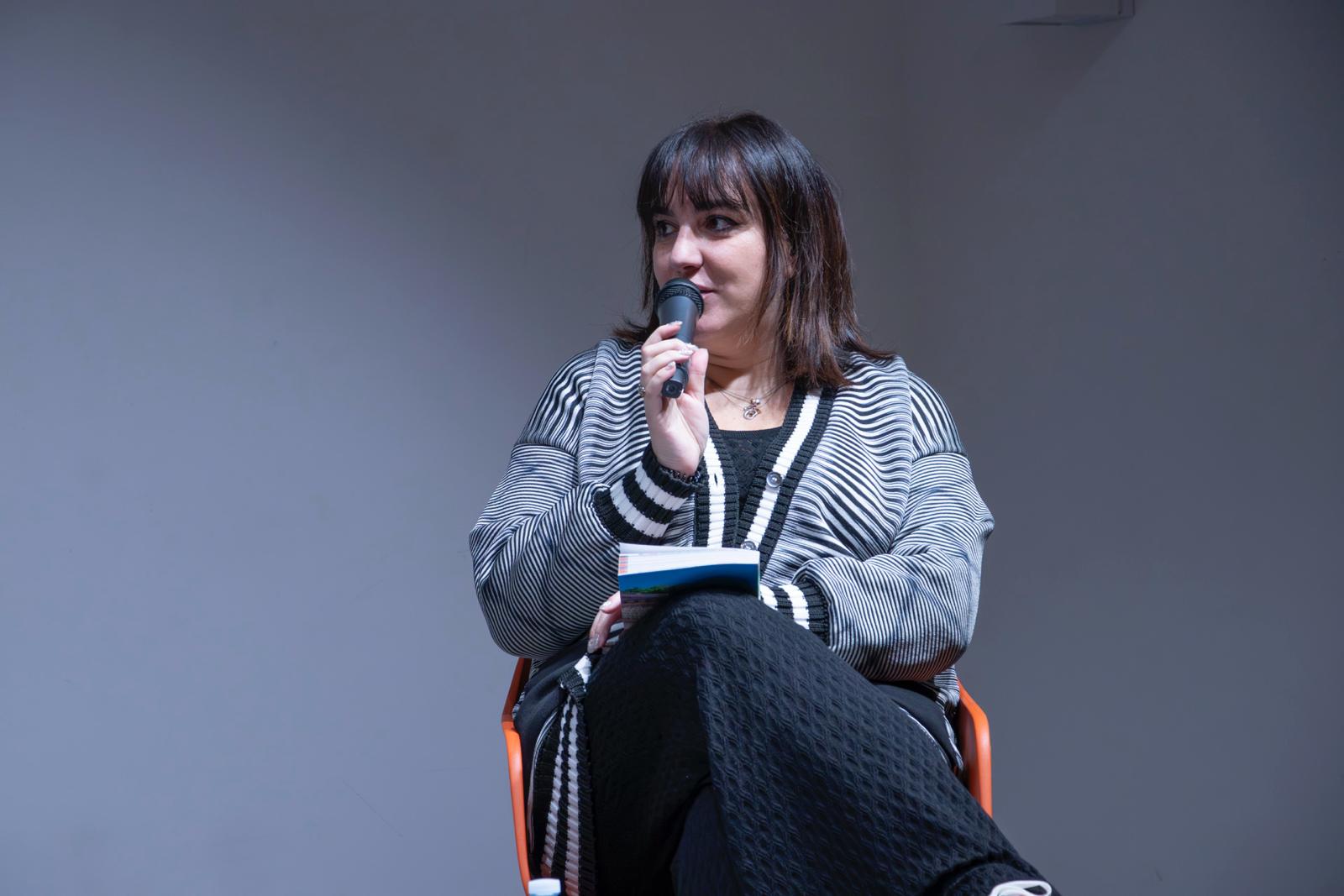
Marianna Baroli is an italian journalist and probably one of the major voice of Hallyu (Korean wave) in Italy. She works for 'Panorama' and 'La Verità' magazines, reporting investigations and politics and a few year ago she combined her passion for Korea with work, becoming the first and only to interview Korean Idols and celebrities for the italian public.
Few months ago she cooperated with Korean cultural institute in Rome and she wrote “La Corea dalla A alla Z” (Korea from A to Z), a book in dictionary format where Marianna, through the explanation of iconic korean words in alphabetic order, she manages to tell Korean culture.
Knowing her in person I became curious and asked her to tell me how she experiences her work and how she came to create this book.
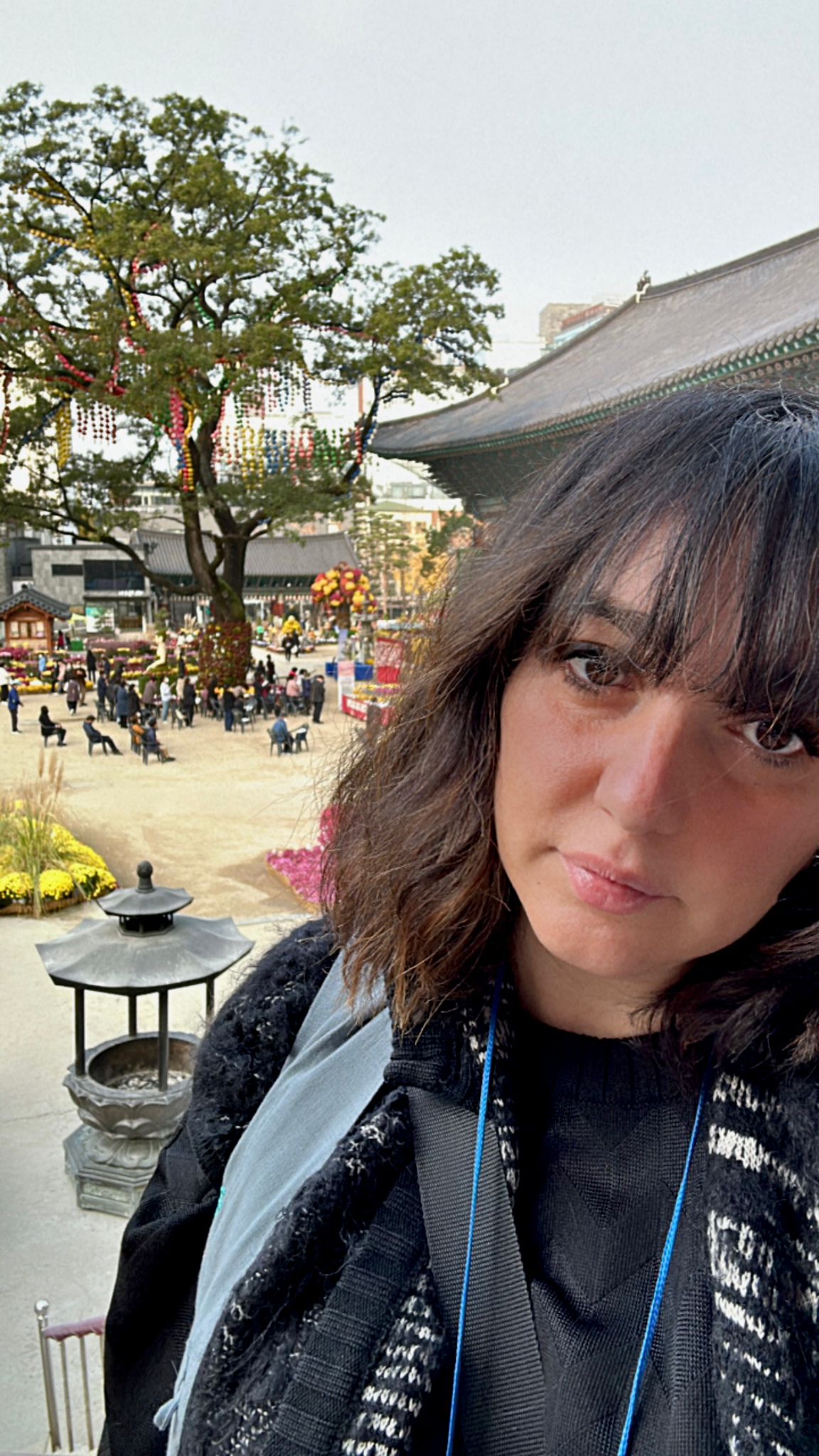
Classic question: how and when did you approach Korea?
I approached Korea completely unconsciously around 2010 thanks to the K-drama "Boys Over Flowers". I was looking for the transposition of Hana Yori Dango but I had no idea it was a Korean product because I watched it through a forum of Japan enthusiasts. Let's say that the Korean influence has always been there, if I look at old playlists I have some Kpop songs on the list... but the real passion was reawakened when I found "Mic Drop" by BTS.
What is your work and how were you able to connect it to Korea?
I am exclusively a journalist. And I'm not saying this to be snobbish, but because I worked hard to get this title. I am an editor, so I take care of both the relationships with collaborators and colleagues (meetings, assignment of articles, correction, publication) and the
writing my own pieces. I managed to enter the Korean sphere just before Covid when I realized that, after many years of work, I needed to lighten up the topics I was dealing with (politics and investigations). I asked and found a lot of openness from my director. I was lucky, but I struggled a lot with colleagues who still don't understand "why Korea".
What are the pros and cons of this job and what is your 'typical day'?
The pros are definitely lucky enough to do what I love, which is writing and having access and being able to see a different side of things. The latter is also a con because very often seen from the outside it can seem like favoritism when in reality for me it is work. Another con is that often, if I'm working, even if I'm at one of the most beautiful and fun events in the world I can't fully enjoy it freely because I have to remain professional and 100% focused.
My typical day is very strange. Until before Covid I had a very regular rhythm: breakfast, meetings, lunch break, meetings, dinner - almost always out or with friends - and we started again.
Now the borders are no longer there. I have fixed meetings at set times, I work from 9 to indefinite hours in the evening. I have dinner around 8.30pm, sometimes I take a little break, but then I start working again "with Korea" around midnight and sometimes I continue until dawn. It's something I can afford to do only because smartworking has changed our editorial routine.
Being not only a professional, but also part of the fandom, did you happen to participate in events or interviews with someone you particularly liked? And is there anyone you would like to interview but haven't had the chance yet?
Absolutely yes, I'll name a few: Sung Hoon (who was my very first interview), 2PM, Lee Minho, JayB from GOT7 and recently Seventeen.
I would like to interviw BTS without a doubt. Jackson Wang. Lisa from Blackpink. I have an endless list. One of my biggest dreams remains the Bang PD and JYP combo.
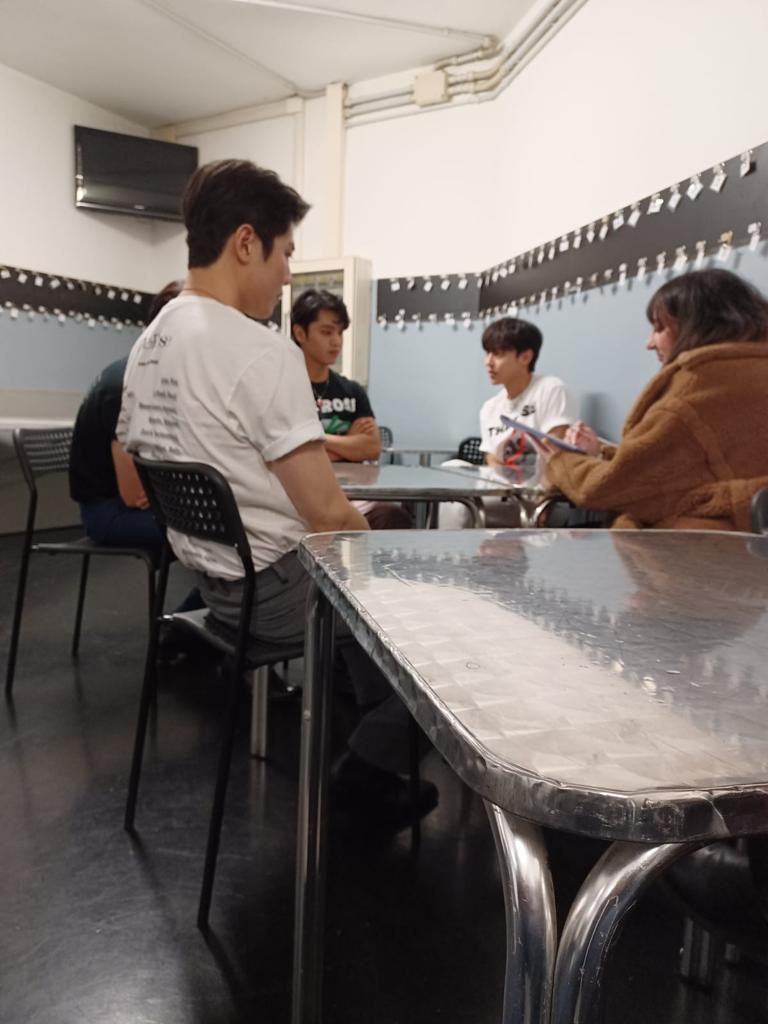
How is the internal Marianna compared to the external one in that moment?
I think she's a Marianna who turns off the switch as a kpop fan and kdrama eater and goes into work mode. The only real hesitation I had was with Lee Minho, during the interview I went into blackout for a few seconds for technical reasons with the Zoom call and I had to eat a candy because I felt faint. The very first interview, the one with Sung Hoon, I admit I screamed at the end because it didn't seem real to me.
Once the interview is over, the first person I write to is my sister. Then my friends, especially Cristina who is a crazy supporter in moments of collapse, and also my mother who is totally external to the world of Korea and therefore she is always fascinated by what she sees and I tell her.
Among fans of the genre you are "the most envied in Italy", what is the approach that people have towards you and has there been an occasion in which this was judgemental?
It's something I haven't learned to handle yet. I consider myself a very simple person, but I know that at first glance I often come across as cold, snobbish and unfriendly. Someone who boasts, in short. In reality I am the exact opposite. I'm just very private, but I'm also reserved in my relationships.
I'm happy to be greeted and I'm the first to reciprocate, but I'm always embarrassed for fear of making mistakes or appearing "too much".
And yes, very often I have felt and feel judged, I know I am, and I also know that there is a lot of gratuitous malice surrounding me. I think I'm the only one who interviews idols... yet almost no one never takes the matter back. For goodness sake, freedom of thought and action always. But I find it a bit peculiar. With social media, no one is spared and I often receive messages or digs or questions asked in an attempt to bring out something bad or negative about me and what I do.
It's something that initially hurt me a little, also because as I was telling you, I don't like to expose myself too much and put my face on it. I prefer to write and continue on my path. I'm learning slowly, I think, to be more open with people. And to select better: I trusted and considered people as friends who were instead at my side only with malice and the desire to exploit my role. Or that I found people who used my name to open doors in Korea and then badmouthed them to friends and colleagues. This disappointed me a lot, I don't like those who use other people's effort for gain. But you get over everything, right?
I am aware that as a fan I am in a privileged position, and I try to keep the details of my work to myself. Not out of selfishness, but out of professionalism and respect for the artist and the fandom. And because if one day I had to stop I would remain a fan who had a parenthesis lucky in the past. I also believe I am a very generous person, if I can help or share experiences I never hold back. But I often know that my no's are viewed with malice. I am sorry? A bit'. But I am sure that I am not wrong and always act in a crystal clear manner.
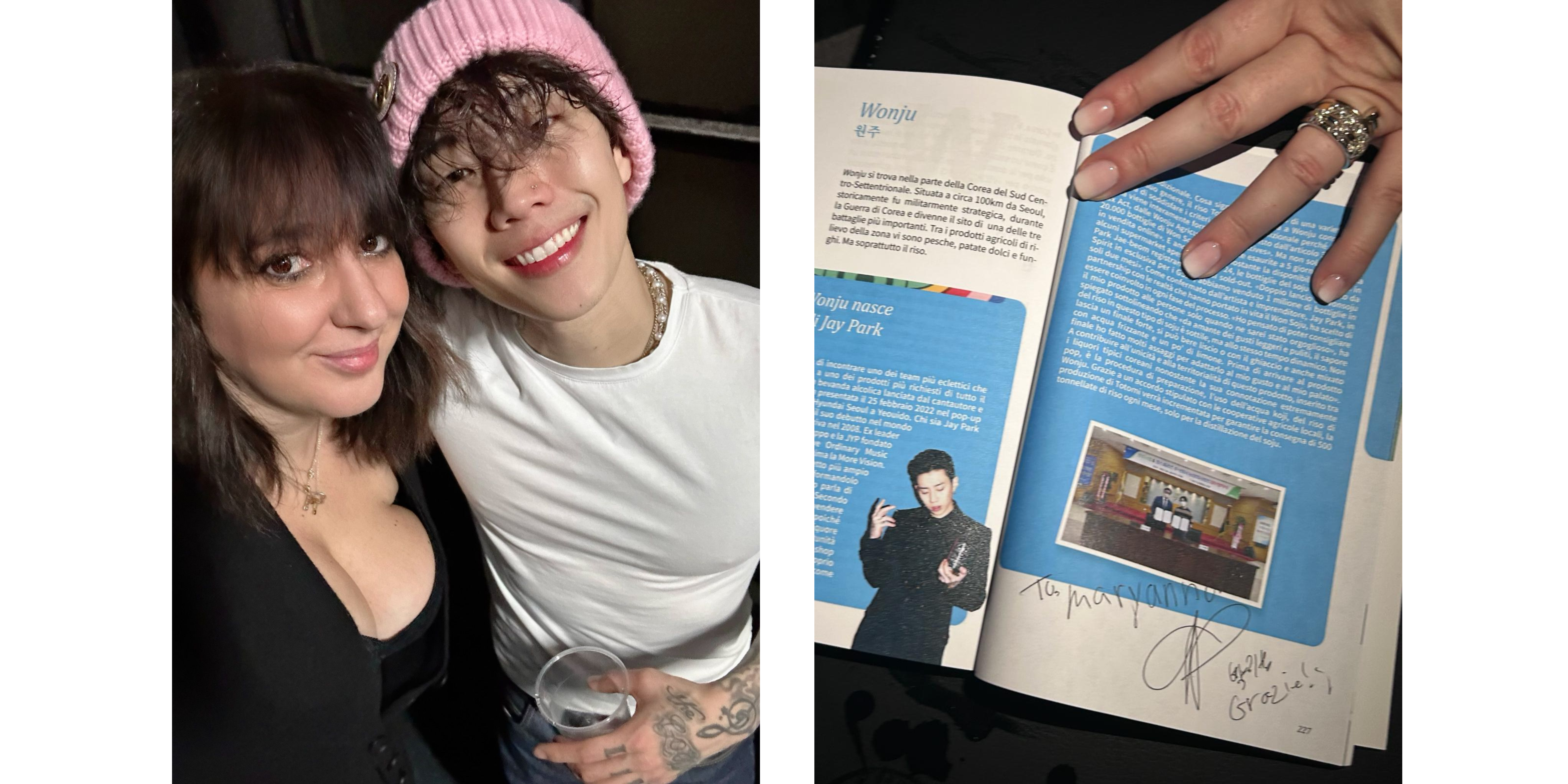
“Korea from A to Z”: after and behind everything you do, a book was also published, like and with who came up the idea?
It was born by chance. My parents, my sister and my friends always told me “you should write a book". But I always thought it wasn't the right time. One day, during an exchange of messages on kakaotalk, the head of the Korean cultural institute asked me: but what if I had to write a book about what would you do?
I rattled off two ideas... including "Korea from A to Z". I didn't know he was proposing the project in an internal competition at KOCIS... and we won. After a few months contacted me again saying “they liked the idea. Let's make a book about it”.
And there the right moment created itself. Without pressure or demands. I'm very attached to this project and grateful to all parties involved.
What's in the book and why in dictionary format?
There is an attempt to make something simple that is not everyday life for everyone.
I thinking “how do I make it light, not boring, that doesn't bind you to the fact of having to read it from page 1 to page 250 without skipping anything because otherwise you won't understand anything?” I knew I didn't want guidance. And I even thought about putting it in the hands of my mother and tell her: here, this is a taste of Korea and that strange language you hear me speak sometimes.
I didn't bother much with the dictionary, I confess. Once I've decided on the content, I have immediately thought of the dictionary as a format. Maybe it's a war flashback of the years passed through Greek and Latin dictionaries ahah
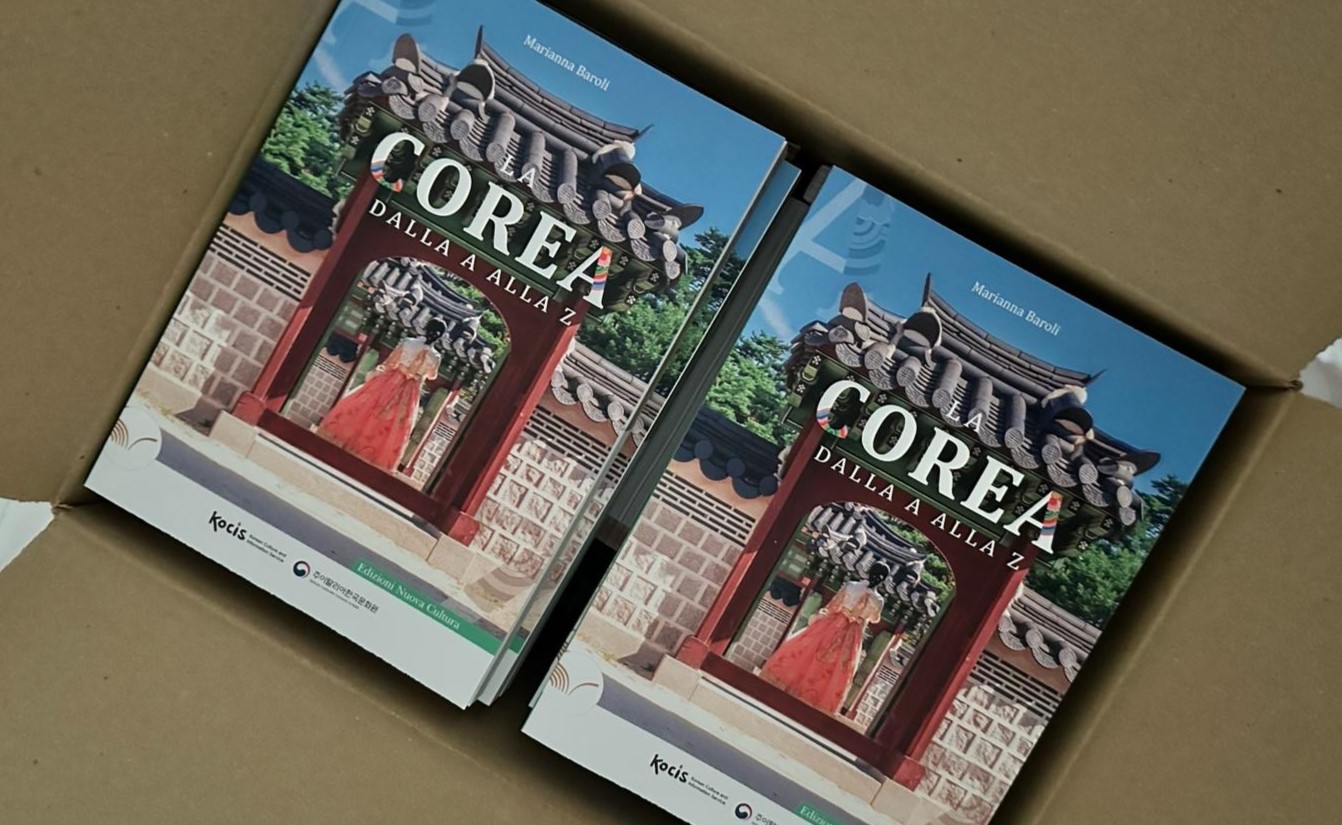
You decided to publish it and spread it for free, my reflection: I think this detail says a lot about your personality, as much as it is said, with the hard work you do, the final goal (besides the work) is to share. I see your interviews as a gift and also the book gives the same idea, also because among all these words there are your personal advice and experiences gained in the field, like "the important thing is that whoever wants it can have it", like you see her? Why did you decide to do it this way?
You fully grasped the meaning. I do my job, I love doing it and I get paid for it. I love Korea, I visit it at my own expense and I am happy to share the same passion with those who love it. But I'm nobody, and starting from this assumption I didn't feel like asking for money for this job. After all, I don't teach anything new, I don't live in Korea, I'm not "the grand master of South Korea". So I felt obliged to leave it free and make it available to the curious, critics, enthusiasts, and even to those who perhaps stumble upon it by chance and decide to download it just for the sake of it. I know that some have read this decision backwards, as a way to sanctify myself, but this is not the case. I simply don't feel like I'm teaching anything, I just had the privilege of being chosen by KOCIS to put down on paper the concepts and experiences that I and thousands of other people have experienced in South Korea.
How much time and effort does it take for a project like this?
In this project I used my heart a lot. I only thought about what I love about this passion and how to make the best of it. I have a flaw - which is also an advantage - I write very quickly.
Especially at night. Bear in mind that after having had the green light on the words to insert... in two months (July and August) I wrote everything.
“넌 나의 기억을 추억으로 바꿀 사람 사람을 사랑으로 만들 사람”“You are the person who will turn my memories into memories, a person who can make people fall in love.” it's the phrase of Trivia: Love by BTS' RM and found at the beginning of the book, what meaning does it have for you and why did you decide to put this as the very first thing?
I wanted to play on the concept of Saram-Sarang without mentioning it. And I wanted something in Korean. And that brought me back to my first real goal: being invited to a BTS conference.
To be corny, it's a beautiful declaration of love ahah
Which of these is your favorite word in Korean?
Palli palli 빨리 빨리 (expression that means "get a move on, quickly"), Like my life.
If you want me sappy, it's 'Seoul', because of how it is pronounced and because I feel that my soul is truly stuck on those uphill roads.
Your happy place in Korea or what you would like to visit
I'm planning a trip that includes Jeju, driving alone with my sister. I want to smell the sea air and the tangerines and see the blue of the water and the sky clashing with the green and color of the island's flowers.
But my happy place is Seoul. Everywhere, every corner, I have so many memories in the city and they are all part of a puzzle that has made me grow a lot as a person and a woman in these three years.
The book is available for free: https://www.nuovacultura.it/prodotto/corea-dalla-a-alla-z/
How about this article?
- Like8
- Support4
- Amazing0
- Sad0
- Curious0
- Insightful0